A store camera is unusually good at remembering what happened and remarkably bad at answering a manager’s question. It records the customer who wandered from shoes to accessories. It cannot, on its own, say whether that route is common, whether the display did its job, or whether the assistant who could help is stranded at the wrong end of the floor. StrataVision’s business begins in that gap between seeing and knowing.
In one minute
- The product: computer vision software that analyzes existing camera feeds on site and turns movement and incidents into dashboards and alerts.
- The buyers: retailers, property operators, event teams and security staff with questions about traffic, space, service and safety.
- The useful test: can a measured pattern lead to a changed layout, staffing plan or response?
Founded in 2016 by Rohan Sanil and Jinjun Wang, the business first made its name as Deep North. In July 2024, after a new leadership team arrived, it became StrataVision. Chief executive Bjoern Petersen called the new name a sign of the company’s commitment to insights that help clients make decisions. The design agency behind the change said the old name and visuals did not clearly express the company’s strengths. The broadening is visible in its catalog: Consumer IQ for journeys and conversion, Guardian IQ for security incidents, property and event analytics, and now fitting-room planning. One camera system can be asked several kinds of questions.
A second stop is a small event with a large price tag
The most revealing example comes from a commercial property study StrataVision published in 2025. For three months, it analyzed shopper paths at a large retail site. More than 22% of shoppers visited one store and left. Some tenants accounted for more than a quarter of first stops; others were destinations later in the trip. That distinction matters to a landlord deciding which tenants belong near one another, and to a marketer wondering whether a promotion should attract new visitors or send existing ones across the hall.
Of one-stop visits converted into a second store visit: the change StrataVision modeled as roughly $1.5 million in additional annual tenant sales at the studied property.
Company model, not reported salesThat $1.5 million figure is a model, not a cash-register result. It is also a useful way to think. Instead of asking a mall to somehow “increase engagement,” ask which first-stop shoppers might plausibly visit a second tenant, and which adjacency, sign or offer deserves a test. The arithmetic gives a manager a specific bet. Reality must still settle it.
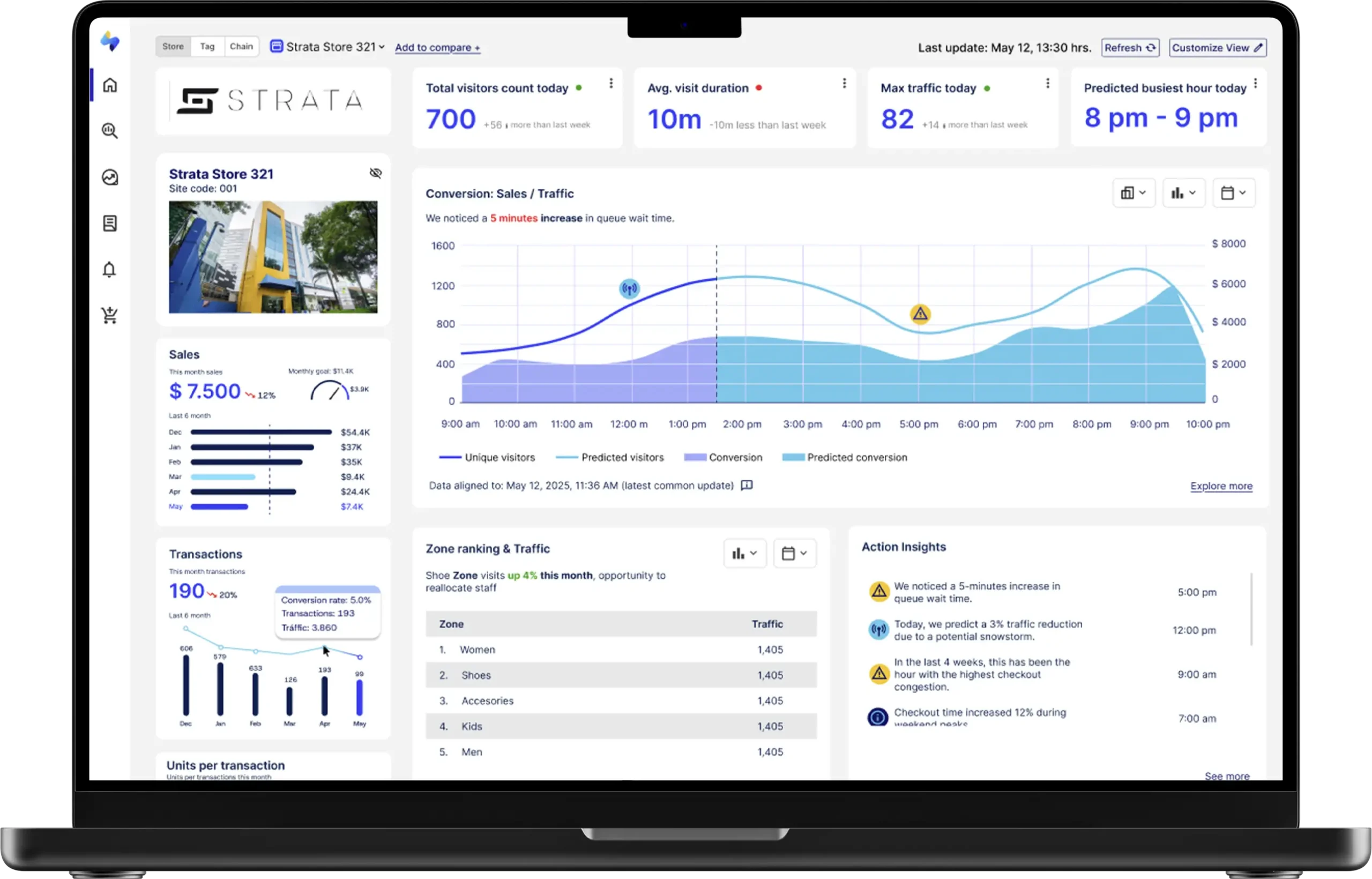
The camera becomes the first line of a question
StrataVision says its platform can use existing video infrastructure and analyze footage on premises. Its retail tools track traffic, dwell time, paths, busy zones and product engagement. Consumer IQ can combine those observations with point-of-sale and labor data. That combination is the important move: a camera can register a visit to the shoe aisle; the transaction system can show whether visits turned into purchases. Neither explains the entire story alone.
This makes StrataVision different from a door counter and from a camera wall watched only when something goes wrong. A counter measures arrivals. A conventional security feed preserves evidence. StrataVision’s claim is that the same space can be read continuously for operations and safety, with local processing keeping the analysis near the site. The competition is partly other video analytics vendors, but it is also the old routine of walking the floor, asking staff, and guessing from yesterday’s receipts.
The name changed; the invoice question did not
For a buyer, the appeal of reusing cameras is clear: there may be less new hardware to install. It does not make deployment effortless. Coverage has to match the question; a blind corner cannot yield a shopper path. Video has to be processed locally, metrics matched to store zones, and the results connected to the people who schedule staff or change a floor plan. StrataVision’s event product makes the exception explicit. Strata Events+ can include camera and hardware kits selected for a booth’s design and key performance indicators.
Its business is enterprise software and solution sales, with demos and consultations leading the buying process. The customer’s cost has two parts to evaluate: a negotiated software and solution contract, and the work of turning a measurement into an operating habit. The second is visible every time a dashboard goes unread.

Security, fitting rooms, and the rest of the floor
Guardian IQ takes the same video premise into incident response: real-time alerts, location-based camera access, playback and clips for investigation. It is pitched to security teams that cannot stare at every feed at once. That is a more immediate job than rearranging a store. If an alert arrives early enough and points staff to the right zone, its value is measured in response time, not in a prettier report.
At the other end of the drama scale is the fitting room. In January 2026, StrataVision announced Fitting Room Intelligence for comparing utilization across stores and formats. The software can flag peaks and service pressure, while historical views tell planners whether a store has too many rooms, too few, or about the right number. Scott Endres, its vice president of product management, put it neatly:
“At a time when every square foot matters, fitting rooms can no longer be planned by intuition alone.”Scott Endres / VP of Product Management
A fitting room is a good symbol for the company’s ambition. It is mundane, expensive and easy to misread. An empty room at noon might be wasted space; an empty room at noon on a quiet weekday might be entirely sensible. The value comes from comparison across time, stores and actual demand. Even the cleverest model needs enough camera coverage, a reliable baseline and someone authorized to change the plan.
Between physical security infrastructure and business intelligence: the cameras supply observations, while software turns them into decisions for operators.
Start with one decision. Pick a queue, a second-store visit or a high-risk zone. Define the action first, then measure whether the footage can support it.
There is a reason Deep North raised a $25.7 million Series A in 2020, another $16.7 million Series A-1 in 2021, and joined Dell Technologies in a 2022 partnership to bring video analytics to global customers. Turning streams of footage into timely, credible metrics is an infrastructure problem as much as a clever-algorithm problem. It also has a human ending. A manager must trust a count, a guard must trust an alert, and a property owner must believe a journey map strongly enough to change a lease conversation.
A September 2026 product post carried the same method into manufacturing, warehouses and logistics. Precision IQ describes camera-based tracking of manual work, bottlenecks and hazards. The setting has changed from a fitting room to a plant floor, but the test is familiar: does an observation arrive in time for someone to act?
StrataVision’s most interesting claim is modest once stripped of the AI gloss: physical spaces should be allowed to answer questions about themselves. The camera was already watching. The harder work is deciding what to ask, what an answer would cost, and who will do something when it arrives.