The first useful fact about Laura Marx is not that she markets cybersecurity. It is that she once taught tennis. A tennis instructor cannot hide inside a slogan. The ball either clears the net or it does not; the student either understands the correction or returns to the same elegant mistake. Watch, translate, adjust, repeat. Long before Marx was explaining identity systems to global buyers, she was learning the practical difference between saying something and getting through.
That distinction has followed her into a career spent around complicated products and crowded relationships. At Monster, she worked on the international expansion of media alliances. At Polycom and then Poly, she moved through alliance and partner marketing into global product leadership. In 2022, she joined RSA as chief marketing officer. Three years later, the title acquired another noun: growth.
Job titles tend to make careers look tidier than they felt while being lived. Marx's path is less a ladder than a succession of translation problems. A partner needs to understand a product. A sales team needs a reason to lead with it. A customer needs to recognize a problem before caring about the solution. A storied security company needs to explain how a name associated with authentication fits a world where identity has become the front door, the key ring and, occasionally, the person wearing the locksmith's uniform.
The office was never the point
Marx worked remotely for more than a decade before a video window became standard office furniture. In a 2023 conversation about her route to the C-suite, she recalled being told that working from home meant she would never become a vice president. Then leadership changed. Executives were no longer all sitting together, the old assumption met reality, and she was promoted.
There is a compact organizational lesson here. Companies often promote the customs they can see and call the result culture. Marx's experience forced a different question: what if performance traveled perfectly well, while recognition was the thing stuck in the building?
She did not romanticize distance. Her point was that connection has to be built deliberately. When colleagues do not share a hallway, managers cannot leave belonging to the coffee machine. They must create a rhythm, make space for conversation and notice the people who are easiest to overlook. Remote work, in that sense, is less a location policy than a test of managerial attention.
The subject was personal as well as professional. Marx has written about the relief of communications tools that made her life more balanced and productive. She is a mother of three. In one candid post, she described spending a Saturday moving among basketball, tennis and art instead of composing a ceremonial message for International Women's Day. The message arrived later, carrying a list of women who advised her, leaders who trusted her with harder jobs, colleagues who became friends, and family who kept the machinery moving.
“Being an executive mom is a team sport,” she wrote. The phrase has the virtue of refusing two fashionable myths at once: that senior work is a solo triumph, and that balance is achieved by one person's immaculate calendar. Marx names the support system. Gratitude, in her telling, is operational.
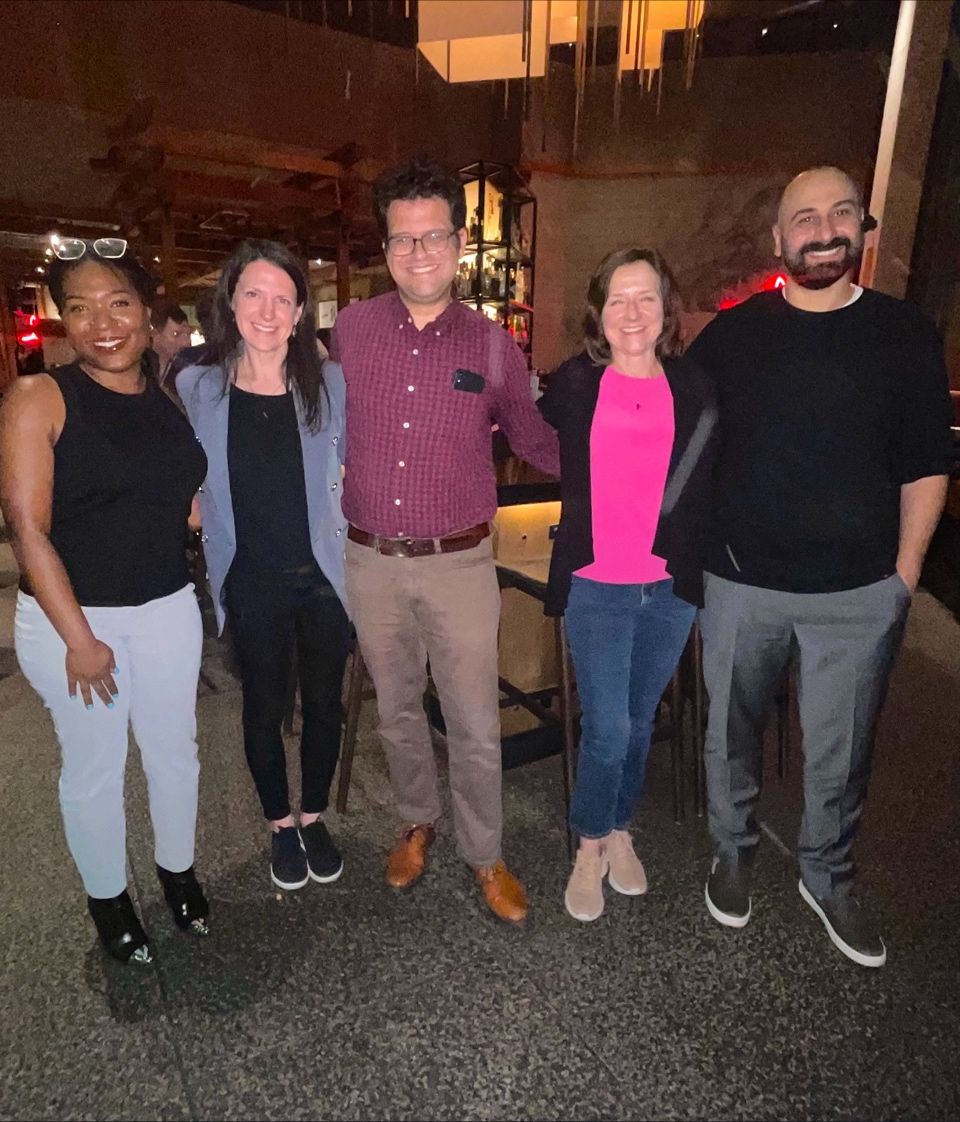
The product marketer in the middle
Marx studied psychology and Spanish at Washington University in St. Louis, then earned an MBA in entrepreneurship from Boston University. That combination feels almost too apt: human behavior, another language, and the mechanics of a business. Her MBA years also produced a concrete early win. She and a teammate won Boston University's 2005 business-plan competition and a challenge round at Rice University's competition.
Still, she does not present credentials as a substitute for operating experience. Her sharper claim is about the discipline itself: “Product marketing is really the center of the business.” It sits between product, sales, customers and partners, translating without becoming merely decorative. The work demands enough technical fluency to resist nonsense and enough empathy to recognize when accuracy has become unintelligible.
At Poly, Marx led global launches across products, software and services. The setting was useful preparation for RSA. Both communications equipment and identity infrastructure recede when they work. Nobody begins a good meeting by praising the camera. Nobody celebrates a routine sign-in. Success often looks like the absence of an interruption.
Marketing an invisible success is hard enough. Marketing security adds a temptation: frighten everyone until they listen. Marx's own writing takes a more domestic route. She begins with ordering dinner, streaming a show, talking to teachers, and the dozen small logins through which a digital self passes each day. Then she opens the machinery beneath them.
Identity and access management asks three plain questions: Who are you? What may you enter? How long may you remain? In a large organization, the answers travel across cloud services, old systems, employees, contractors, customers and machines. The complexity is forbidding. The consequence is intimate. Someone gets in, someone stays out, and the business continues.
A famous name learns a larger vocabulary
Marx arrived at RSA during a corporate transition. The SecurID business was becoming an independent software company after RSA's separation from Dell Technologies. Her brief was to elevate the brand, define marketing strategy, drive growth and explain its value. The assignment joined legacy and reinvention: preserve trust earned in authentication while making a broader case for identity governance, lifecycle management, risk-based access and passwordless security.
Her stated reason for joining was the tension at the center of the product. Digital systems should let people work from anywhere, find opportunity and move quickly. The same openness enlarges the territory an attacker can exploit. Security that blocks the business has failed one test; convenience that admits the wrong person has failed the other. The interesting work lives between.
By 2025, RSA had widened her remit to Chief Marketing & Growth Officer. The change made explicit what the earlier job already implied: brand, demand, partners and customer growth are not neighboring plots. They share irrigation. Marx said she wanted to scale innovation, advance passwordless identity security, strengthen partnerships and build an ecosystem around customers' resilience.
The partnership language is characteristic. Her career has been unusually rich in alliances, from Monster's media relationships to Poly's technology ecosystem and RSA's work with Microsoft. Alliance marketing teaches a bracing fact about corporate life: your beautiful plan must survive contact with somebody else's beautiful plan. Influence matters more than ownership. Shared value must be specific enough to withstand two sets of priorities.
Room for the useful mistake
In the same interview where Marx discussed remote leadership, she described high performance without polishing away its cost. Leaders make difficult decisions. They will not always be liked. Teams need standards, but “mistakes have to be part of the ecosystem.” The word ecosystem is doing serious work. A mistake is not an exception smuggled past the culture; it is expected evidence that people are attempting something whose answer was not known in advance.
Her favorite books include The Art of Possibility, whose title could double as an answer to the executive who once treated remote work as a ceiling. Possibility is not cheerfulness. It is the habit of inspecting the frame around a decision and asking who put it there.
Marx's public account of her own career makes that inspection unusually social. She credits her mother with introducing her early to senior women who offered counsel at consequential moments. She credits women who gave her larger roles, names a former chief executive whose boldness still informs her, and remembers colleagues through the laughter as readily as the strategy. The list is not ornamental gratitude tacked onto a résumé. It is a map of how professional confidence is assembled: one introduction, one stretch assignment, one honest conversation at a time.
There is a quiet connection between that map and alliance marketing. Neither works through command alone. Both depend on discovering what another person values, earning permission to proceed and keeping the relationship alive after the launch. A career can be full of impressive nouns - vice president, global, chief, growth - while the verbs remain listen, connect, explain and decide. Marx's story is most convincing in the verbs.
That habit now meets a market with no shortage of frames: zero trust, passwordless access, artificial intelligence, identity governance. The vocabulary multiplies faster than most buyers' patience. In 2026, Marx used RSA's identity research to argue that leaders should assess their capabilities and prioritize action as identity-related breaches and help-desk social engineering rose among surveyed organizations. The marketer's task was not to make an alarming statistic louder. It was to make the next move clearer.
The tennis instructor remains visible in the executive. Observe what is happening. Name the correction in language the other person can use. Leave room for the next attempt. And remember that the score, however individual it appears on the board, was made by a team.