Before Brian Gladstein sold cybersecurity, he built software. The distinction matters, though perhaps not in the way a résumé would suggest. His early technical work gave him fluency in systems, but the more consequential habit was social: he kept tagging along when a product marketer visited customers. While the commercial web was still young, Gladstein wanted to hear how people used the thing he had helped make. He was the engineer asking what happened after the code left the building.
That question pulled him toward business school, product management and, by 2004, security work at RSA. Product marketing offered a useful border crossing. He could stay near the machinery while talking with salespeople and customers about decisions that affected the business. He had found a profession for someone who liked both the mechanism and the conversation around it.
The path also left two pieces of evidence that do not usually appear in a marketer's portfolio: patents. Gladstein is named on software inventions involving a speech-recognition grammar interface and shared application access. Long before brand positioning became his full-time concern, he was thinking about interfaces, access and what a user needs to see. A patent is no guarantee of good prose, of course. It does make it harder to bluff him with a diagram.
Customer advocacy before it acquired a wardrobe
In 2010, Gladstein started Explorics, a consultancy devoted to customer intelligence, customer marketing and advocacy. The phrase “customer advocacy” now arrives at conferences wearing a lanyard. At the time, Gladstein was turning a recurring observation into a business: satisfied customers could do more than approve a reference call. Their experiences could sharpen products, give sales teams credible stories and reveal why a market moved.
Four years later, GYK Antler acquired Explorics. Gladstein stayed, his team stayed, and he became executive vice president of technology marketing. His announcement focused less on an exit than on what the combined operation could offer clients. That detail fits the broader pattern. The customer was not a decorative quote parked at the bottom of a case study. The customer was part of the operating system.
“I always think of team building as a puzzle.”Brian Gladstein on assembling a marketing organization
After GYK Antler came Carbon Black, where Gladstein worked in product and strategic marketing around cloud-delivered endpoint security. Then came Cmd Security, focused on Linux environments, and A-LIGN, where compliance sat directly in the path of revenue. A prospect might like a product and still refuse to buy until the supplier could prove it was secure. In that setting, compliance stopped looking like paperwork and started looking like a commercial conversation about trust.
The job pitch with the warning label
Gladstein is more revealing when discussing mistakes than triumphs. He has said he made bad hires by choosing people who appeared capable and happened to be available. During one interview, flustered by the performance of recruiting, he abandoned the polished pitch. The role would be difficult, he told the candidate. The team might not succeed. But if the candidate wanted to try, Gladstein would work to make that person successful. He later described the hire as one of his best.
The moment changed his recruiting idea. He began looking for people drawn to consequential difficulty, people who wanted responsibility and growth. In exchange, he treated their future résumé as part of his job. The premise is bracingly adult: talented people may eventually leave, so a manager should make their time count rather than pretending the relationship has no horizon.
At A-LIGN, that philosophy encountered the ordinary fog of promotion. Team members did not know what moving up required. Gladstein admitted he did not know either. The response was a job-leveling matrix that made expectations visible across mastery, accountability, autonomy, influence, leadership and learning. Quarterly objectives gave the structure something measurable to hold. The matrix did not promise that careers would become tidy. It did give people a map.
Accountability, in Gladstein's telling, is not the art of picking a target certain to turn green. It means choosing an ambitious goal, communicating it and discussing the result without hiding the failures. He gives reports room to reach their own conclusions and supports the decision when the reasoning is sound. When he does not understand an area, he says so and finds people who do. The confidence comes from process, not omniscience.
“No, wait, this is just normal, this is what growth feels like.”Gladstein on meeting unfamiliar work without retreating
He learned that lesson repeatedly. Feeling overmatched, he would break the imposing problem into smaller ones, isolate the stubborn part and begin there. His participation in Pavilion's CMO school came from the same posture. He expected to learn in some sessions and perhaps teach in others. Then a budgeting class landed in the exact week his CFO requested a plan, and the templates went straight into the work. Professional development rarely gets a neater punch line.
At Tufin, a broader frame for security
Gladstein joined Tufin in late 2022 and was announced as chief marketing officer in January 2023. The remit covers demand generation, product marketing, communications and brand development. The company was two decades into network-security policy management, with deep recognition among practitioners and the accumulated complexity that comes with serving hybrid, multi-vendor environments.
The marketing task was not simply to make the logo brighter. Gladstein described bringing customer advisory boards, shared funnel data and analyst conversations into the same transformation. Tufin's story widened from firewall management toward network security posture management: visibility into exposure, controlled policy changes and continuous governance across on-premises networks, cloud, SASE and microsegmentation.
In January 2025, Tufin launched a refreshed brand after what Gladstein described as two years of growth, profitability, stronger customer connection and product work. The sequence is instructive. The visual identity followed operational change. Brand, in this account, was the expression of a company that had already moved, not a curtain hung in front of an unchanged room.
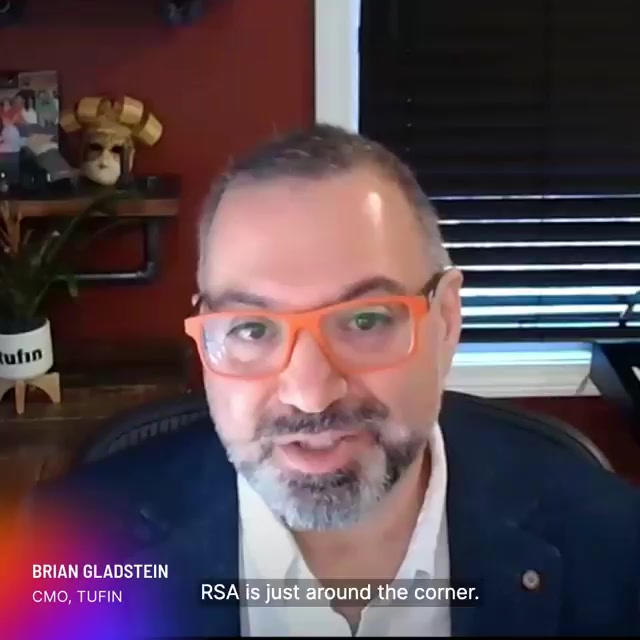
By RSAC 2026, Gladstein was talking about a faster problem. Software agents were beginning to make changes inside enterprise networks at a pace that periodic audits could not match. His pitch for Tufin's own agents included compliance assessment, prioritizing vulnerabilities through connectivity context and checking application deployment against policy from the start. The vocabulary had changed since his RSA days. The translator's job had not.
He was still explaining a technical system by starting with the user's predicament: your environment is changing faster than your old process can observe it. At Tufinnovate 2026, the same thread connected agentic AI, exposure, hybrid visibility and governed action. Gladstein's contribution sits where it has for years, between what engineers can build and what customers need to trust.
The director did not disappear
There is a less corporate way to understand Gladstein's career. In high school, he wanted to direct movies. His favorite film remains a toss-up between the original Ghostbusters and Back to the Future, a pairing that suggests affection for unruly systems, practical problem-solvers and machines with inconvenient consequences. He jokes that directing people and telling stories survived in his current work.
The analogy only goes so far, which is probably why it works. A marketer cannot call for another take after the customer has left. The product must perform outside the frame. The people delivering it have careers of their own. The audience is free to distrust the premise. Good direction here depends on evidence, listening and the humility to revise the script.
There is another continuity hiding in plain sight. Gladstein's early patent work concerned how people navigate a technical system. Explorics asked how companies could organize and use the voices of their customers. His hiring matrix made an opaque institution easier for employees to navigate. Tufin's current language is about seeing paths through sprawling networks and governing the changes made along them. These are different domains, and it would be silly to pretend they are one grand design. Still, each rewards the same reflex: reveal the structure, reduce needless ambiguity and let the person on the other side make a better decision. Marketing, at its most useful, is interface design conducted with sentences, conversations and proof.
Gladstein has said that, after executive life, he would like to teach a college course. An older personal note mentions wanting to return to the piano. Both ambitions make sense for someone whose career has been an exercise in arrangement: technical detail and customer language, ambition and accountability, expert voices and a coherent line. The work is not to make complexity vanish. It is to give complexity a form that people can follow.
Career dates and roles reflect public company biographies, published interviews, patents, posts and event records available through September 2026.