The great industrial machine has many natural enemies: friction, dust, impatience, and the tiny replacement part nobody can identify. Kristina “Kris” Harrington met the last of these enemies while working around mining equipment. A shovel could be magnificent, expensive, and productive, yet its working life still depended on somebody finding the correct component in a paper universe. One machine might travel with three thick manuals. The factory would keep changing the design. The books, serenely unaware, began aging the moment they left.
Harrington noticed the absurdity because she had lived close to it. Her career began in the machinery business, not in a software incubator. At Bucyrus International she worked in new-equipment and aftermarket sales. Caterpillar later put her in a regional role covering northern Latin America, Mexico, and the Caribbean. Other assignments carried her through Canada, Brazil, and Peru. Her last Caterpillar remit stretched across 18 countries and 16 dealers, which is one way to learn that a “simple order” is often neither.
The recurring problem was information. Equipment owners needed parts; manufacturers possessed the engineering knowledge; dealers understood customers; technicians knew the machine in front of them. Yet the useful facts could be stranded in bills of materials, drawings, enterprise systems, binders, or the memory of the person who had handled the account since fax machines seemed modern.
“We believed there was an easier way.”Kris Harrington on GenAlpha's beginning
01 / The useful annoyanceA manual should not become an heirloom
In 2011, Harrington and fellow heavy-equipment veterans co-founded GenAlpha Technologies. She joined full time in 2013. Their premise was admirably specific: reuse the technical material manufacturers already have, including 2D and 3D engineering data and bills of materials, and turn it into an interactive way to identify and buy parts. The company eventually gathered those capabilities into Equip360, a platform spanning digital catalogs, eCommerce, product configuration, returns, warranty, and equipment support.
This sounds tidier than the problem actually is. A sweater buyer chooses a color and size. An industrial buyer may need to know the exact machine, serial number, assembly, revision, customer account, dealer relationship, price, authority to purchase, and urgency of a repair. The wrong sweater is an errand. The wrong component can leave valuable equipment motionless while a second order makes its way across a continent.
Harrington's insight was not to pretend that complexity had vanished. It was to arrange the complexity so a person could act. In one example she gives, a technical-service worker stands beside a machine with a tablet. That worker may not have purchasing authority, but can identify the parts, add them under the customer's account, and create a quote. A maintenance engineer receives it. Procurement logs in under the same account and converts it to an order. The system follows the work rather than demanding that the work flatter the system.
How the paper chase becomes a working trail
There is a modest radicalism in that sequence. B2B software is often sold from the perspective of the organization buying it. Harrington talks from the perspective of the people passing a job from one set of hands to another. Customer service, technical service, dealers, maintenance, and procurement all benefit, even when only one of them presses the final button.
02 / Field notesThe map became the management education
Harrington studied at Marquette University from 1999 to 2003, then spent the next decade learning the equipment trade through roles whose geography mattered. The work joined a Wisconsin home base to customers and dealers across the Americas. International sales can make abstractions uncomfortable. “Channel strategy” becomes a real dealer with a real territory. “Localization” becomes a customer who needs the correct information now. “Aftermarket” becomes the years, sometimes decades, after the celebratory machinery sale.
Those tensions appeared clearly when manufacturers began selling online. Direct commerce could look threatening to dealers, the very partners who had built customer relationships. Harrington's answer has been to make data visibility and participation part of the design. An online system can route transactions, share knowledge, reveal demand, and give a dealer better tools. The useful question is not “dealer or digital?” It is how the network can serve the owner without turning every new capability into a family argument.
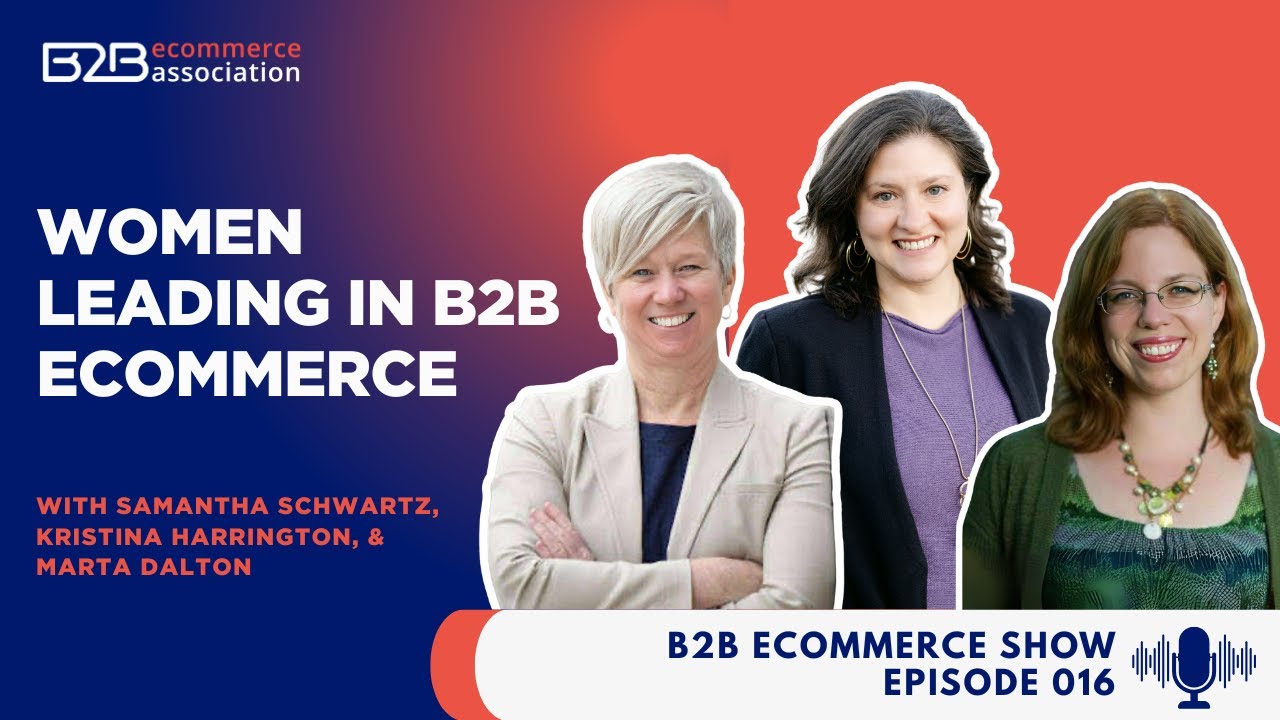
Her public work has returned to this theme for years. Harrington has explained product search, configuration, channel conflict, customer adoption, generational knowledge transfer, and the hard truth of selling complex parts online. She has appeared on manufacturing and commerce podcasts, written industry columns, and co-hosted A BROADcast for Manufacturers. The format changes. The subject remains the practical dignity of letting people complete a job.
Colleagues describe a leader who cares about employees, products, and client outcomes, while setting high expectations. That combination is worth noting because industrial transformation is rarely rescued by a launch party. The software can work correctly and still fail to become habit. Adoption needs dedicated people before, during, and after a change. Harrington has increasingly written about that unphotogenic labor: defining ownership, preparing data, training customers, and staying with the system after the ceremonial ribbon has been cut.
03 / The long lifeMachines outlast trends
In January 2023, Harrington moved from President and Chief Operating Officer to CEO. Her stated ambition was to build on GenAlpha's first 11 years, keep its technical standards, and broaden its contribution to manufacturing. The promotion put a co-founder at the center of the next chapter, but it did not require a new philosophy. Her argument had always concerned the life of the equipment, not merely the moment of sale.
That long view has sharpened as artificial intelligence enters every corporate agenda. Harrington's recent writing insists on foundations: organized product information, clear architectural boundaries, usable workflows, and people assigned to the transformation. AI can make retrieval and decision support better. It cannot confer order on a company that has declined to decide who owns the data. A chatbot perched atop a junk drawer remains a cheerful guide to a junk drawer.
The richer software opportunities often hide inside processes that insiders have stopped questioning.The builder's lesson in Harrington's career
The aftermarket also becomes more important when new-equipment spending slows. Parts and service revenue can steady a manufacturer, but only if customers can find the business when need arrives. Harrington's 2026 columns range from warranty management and customer adoption to online visibility and aftermarket revenue during uncertainty. Together they make a plain case: digital commerce is not a decorative storefront. It is an operating capability that connects old machines, current data, and future customer relationships.
The generational question matters here, too. Experienced workers are leaving manufacturing with hard-won knowledge. New employees expect information to be accessible. Harrington has discussed digital tools as a bridge between them. A searchable technical catalog cannot replace judgment, but it can keep routine knowledge from evaporating with a retirement lunch. A useful interface lets a novice ask a better question and an expert spend time on the exceptional case.
04 / Beyond the officeThe hobby farm is not a metaphor, though it behaves like one
Harrington owns a hobby farm in Wisconsin. She has spoken about the lessons of farming alongside her manufacturing career, and GenAlpha has connected that personal thread to a community program supporting Milwaukee's Hunger Task Force Farm. During the growing season, that farm produces fresh fruit and vegetables for people who rely on food banks. GenAlpha linked software demonstrations with donations to the effort.
It is difficult to imagine a cleaner counterweight to the airy language of transformation. A farm is schedules, weather, equipment, repair, and repetition. The harvest receives the photograph; maintenance gets the Tuesday. Industrial software lives by much the same unfairness. The successful order is visible. The cleaned product data, mapped permissions, revised diagram, and patient training that made it possible mostly are not.
This may be why Harrington's story feels pleasantly resistant to founder mythology. The company did not begin with a desire to “disrupt” a category. It began with people who knew exactly how annoying the category could be. They had stood inside the workflow. They had watched a manual become obsolete in transit. They understood that a dealer relationship is not a line in a slide deck and that an equipment owner values certainty more than digital theater.
A dozen years into her full-time GenAlpha work, Harrington is still writing about basic questions: Why are sales being lost? Can warranty claims be simpler? What makes customers adopt a tool? How should manufacturers prepare their information for AI? The questions sound ordinary because the work is ordinary. Their consequences are not. Somewhere, a technician is standing beside a machine, trying to turn an exploded drawing and a serial number into motion.
The old answer was a three-volume manual and several phone calls. Harrington's answer is a connected trail from technical truth to commercial action. The machine still needs maintenance. The business still needs relationships. People still need judgment. But the paper labyrinth has lost some of its authority, and the right part has a better chance of arriving before everyone learns its number by heart.