A marketing dashboard can be a very agreeable colleague. It arrives on time, wears tidy colors and generally tells the room that progress has occurred. Kristina Canada has built a career around asking the impolite follow-up: did any of it change the business? At Net Conversion, the Orlando marketing and analytics agency where she is chief marketing officer, attractive media metrics are evidence, not a verdict. Reach, clicks and conversions may each contribute a sentence. The client’s total business gets the final paragraph.
This distinction sounds modest until one considers how much advertising machinery is designed to blur it. Platforms sell their own scoreboards. Channels celebrate the outcomes they can see. Automation makes the numbers arrive faster. Canada’s answer is neither nostalgia nor a bonfire of dashboards. It is a demand for better accounting: understand the role each channel plays, connect investment to a business result and keep enough human judgment in the system to notice when a lovely chart is answering the wrong question.
A career spent following the traveler
Before the agency dashboards, there were destinations. Canada’s career moved through One&Only Resorts, Atlantis Bahamas, Universal Studios Hollywood and sbe Lifestyle Hospitality. The progression gave her an unusually vivid laboratory for modern marketing. A resort stay is not a tube of toothpaste. A family may dream, search, compare, postpone, ask a friend, watch a video, return to search and finally book. The purchase has a long prehistory, much of it invisible to whichever advertisement happens to receive the credit.
Travel also refuses the convenience of a single emotional register. It sells anticipation and logistics at once: the fantasy of escape beside the stubborn facts of dates, rooms and price. Universal Studios Hollywood adds another layer. The product is physical, theatrical and time-bound, while the courtship plays out through screens. Canada learned digital marketing in places where a customer’s path could meander for weeks and where the final click was often the least interesting part of the story.
Illustrative scale of cited touchpoints, not a like-for-like average. Net Conversion's tourism presentation also cited research showing travelers viewed an average 141 pages and spent 303 minutes with travel content before booking.
That background explains why her definition of performance is broader than direct response. Performance-first, in Canada’s telling, does not mean living forever at the bottom of the funnel, waiting to harvest demand someone else created. It means choosing the right measure for the actual job. Connected television can create demand and capture it, but those are different assignments. Forcing both to report to the same immediate-response metric is less rigorous than it looks. It is the analytical equivalent of judging a concierge by the number of room keys cut.
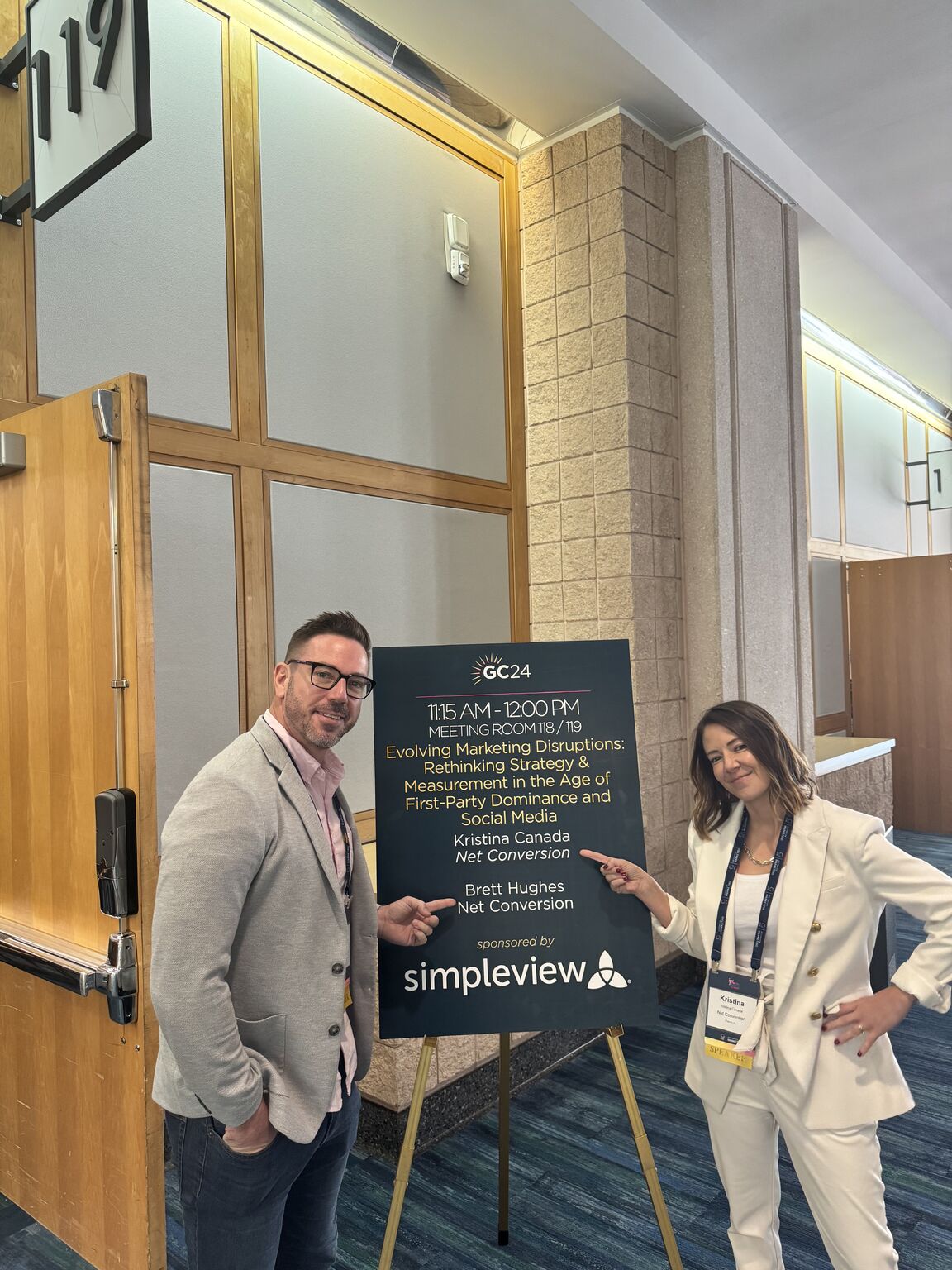
The first female executive joins an independent shop
Canada joined Net Conversion in 2018 as vice president of marketing and as the company’s first female executive. The agency had been founded in Orlando by leaders from travel and hospitality who believed their outside agencies could not adequately show what media did for the larger business. It was a congenial problem for Canada: the same knot she had been pulling at from the brand side, now moved to the center of an agency.
Her remit did not stay confined to promotion. Net Conversion credits her with helping more than double its size and reshaping its strategy, culture and brand identity. She launched internal training initiatives and became known for showing up personally for new hires. In 2020, while businesses were improvising ways to retain and train people through the pandemic, the Orlando Business Journal selected her for its 40 Under 40 class. She became chief marketing officer in 2023.
Growth stories can become bloodless rather quickly, full of head count and geography. Canada’s has a counterweight. When Cynopsis honored her in its 2025 Top Women in Media program, she accepted on behalf of the people around her and “the belief that you can drive exceptional business results while creating a culture that values camaraderie and kindness.” It is a sentence with two scorecards. One belongs in the boardroom. The other is measured in whether anyone wants to enter it.
“You can drive exceptional business results while creating a culture that values camaraderie and kindness.”Kristina Canada, accepting her 2025 Top Women in Media honor
A colleague supplied a less ceremonial character reference. Asked which three coworkers she would bring to a deserted island, media manager Kelly O’Connor chose Canada because they laugh hard together and because Canada is a strategic thinker. It may be the perfect agency testimonial: useful in a crisis, pleasant after the meeting. Canada’s dog Pepper offered a further endorsement by strolling into frame during a 2026 podcast interview and receiving an immediate introduction. Pepper, the host decided, was going to be famous.
Everyone gets an intern
The podcast arrived at a timely fault line. Marketing platforms increasingly promise to choose audiences, bids, placements and creative combinations with minimal intervention. Net Conversion has used automation for years, and Canada is not pretending that a clever spreadsheet can out-process a machine. The agency’s internal phrase for AI is “everyone gets an intern.” The charm is in the hierarchy. An intern can accelerate useful work. An intern does not quietly become chief strategy officer because the settings menu was tedious.
Canada’s preferred image is a strategic wheel. Let AI optimize tactics, she says, while people keep their hands firmly on it. Human oversight carries the client’s context, challenges a platform’s incentives and protects proprietary data. It also preserves the right to argue. She has described spirited disagreements with Google representatives over highly automated campaign products. Skepticism, here, is a form of participation. She wants the processing power without renting out the decision.
Machines may compare, draft and optimize at scale. People remain responsible for the objective, the trade-offs, the data and the final call.
That position fits the agency’s case for independence. Large holding companies offer scale; Canada readily grants the point. An independent shop offers a different set of advantages: agility, transparency and fewer conflicting interests. If an analyst is not pushed toward a channel because the agency has a revenue commitment attached to it, the recommendation can remain closer to the client’s outcome. Independence is useful not as a personality trait but as an incentive structure.
Creative work gets its own accountability
Canada’s argument for measurement does not end with a smaller box for creativity. In a 2025 essay, she called wasted creative opportunity a larger risk than static media spend. The point was practical. Streaming alone asks an idea to work across platforms, content types and viewing devices. Data can identify where to focus, but brands need the creative capacity to make distinct work for those settings. One immaculate asset, repeated everywhere, may save production money while squandering the intelligence gathered about the audience.
Her proposed truce between creative and performance is exacting for both sides. Creative work must do more than look good; analytics must do more than restrict it. Performance data should reveal which human response matters, which context changes the meaning and where another version is worth making. Measurement becomes a creative brief with numbers in its pockets.
In 2026, Net Conversion’s consumer work widened that lens again. A survey of 900 American adults examined intentional spending, streaming habits and AI in the purchase journey. At the agency’s partner summit, Canada said participants were not gathering merely to learn what was changing. They were there to build the playbook for what came next. The phrase is typical of her public voice: change acknowledged, sleeves already rolled.
“Our partners aren't just here to learn what's changing. They're here to build the playbook for what comes next.”Kristina Canada, 2026 Net Conversion Partner Summit
The unfashionable question wins
Canada now occupies a useful contradiction. She markets a company built on analytics while warning against the seductions of automated certainty. She advocates performance while defending brand creation. She celebrates independence without pretending scale has no value. The connecting principle is accountability: choose the tool, metric or structure that serves the business, then remain alert to the moment when it begins serving itself.
She has suggested that YouTube and Reddit remain undervalued by performance-minded advertisers. The observation matters less as a hot tip than as evidence of method. Look past the inherited hierarchy. Decide what a channel is actually doing. Measure it for that job. In a trade fond of giving new names to old promises, Canada’s question is almost stubbornly plain: did the work move the whole business?
The dashboard may still glow. It should. Good instruments make complexity legible. But in Canada’s version of the room, the chart does not get to flatter its way out of cross-examination, and the algorithm does not chair the meeting. Somewhere nearby, a team is building the next test, a creative idea is acquiring sharper purpose, and Pepper may be making another cameo. The numbers have work to do. So do the humans.