Imagine two people outside a shop. One steps through the door. The other cuts across the car park on the way somewhere else. To a hurried advertising dashboard, they might look remarkably alike. To the shopkeeper, they are different species. GroundTruth’s business begins in the few metres between them.
The company sells advertisers a way to turn evidence of where people go into audiences, campaigns and reports about who subsequently shows up. Restaurants want diners. Dealers want people on the lot. Consumer-goods brands want shoppers near the shelf. The attraction is wonderfully mundane: a business with a front door would like its advertising to have some relationship with that door.
- The mechanism: mapped locations, behavioral audiences and ads delivered across several channels.
- The useful outcome: visits associated with ad exposure, with campaign tools to optimize toward them.
- The question to keep asking: how many visits would have happened anyway?
01 / The parking lot is a philosophical problem
A circle around a shop is easy to draw. It includes things the shop does not own: a road, a neighbor, perhaps the coffee shop that is doing rather better. GroundTruth’s proprietary Blueprints use polygons to describe three different spaces: the store’s interior, its lot and the surrounding retail block. The Blueprints product page reports more than 4.8 million mapped locations.
That distinction changes the question a marketer can ask. For a dealership, entering the lot may matter. For a retailer, the building boundary may be more useful. The technology supplies a spatial definition; the advertiser still has to choose a definition that makes commercial sense. Precision is most useful when you know what you mean.
Eligible location signals and identifiers allow GroundTruth to connect an ad exposure with a later presence inside the chosen boundary. Those visits can also help build audiences: previous customers, competitor visitors or people whose movements suggest a relevant interest. Instead of asking only what somebody browsed, an advertiser can ask where they have actually been.
02 / Seventeen people and a very specific bill
Consider Sharp Auto. In a case published in April 2024, Alpha Media worked with GroundTruth to reach prospective car buyers using dynamic mobile pre-roll video and geofencing tactics. The campaign ran for just over two months. GroundTruth reported 17 visits, a 1.28% click-through rate and an average effective cost per visit of $24.68.
Seventeen has a refreshing lack of grandeur. It invites arithmetic instead of applause. The reported unit cost gives the dealer a concrete efficiency measure to compare with the economics of getting a qualified shopper onto the lot. Whether that price makes sense depends on what those visits become: appointments, test drives, purchases. The sensible commercial question is the value of the visit.
The method is copyable without copying the number. Pick a destination. Choose an audience with a plausible reason to go there. Match the creative to what the business sells. Measure the physical response, then compare its cost with the value of the customer action you actually want. A dealer and a sandwich shop can use the same sequence and arrive at very different acceptable prices.
GroundTruth also has documented cost-per-visit buying arrangements, including campaigns for Coach and Toyota. But an effective cost-per-visit metric in a report is not automatically the campaign’s billing method. Buying impressions and dividing spend by visits produces a unit cost too. Knowing which arrangement you have is part of knowing what you bought.
03 / The first obstacle was the buying process
The machinery could be clever and the purchase still be awkward. GroundTruth’s March 2021 announcement of its Addy acquisition contains a useful admission: small-business customers wanted a simpler ad-buying process. Addy brought self-serve technology and a more approachable planning interface. The company responded to the complaint by buying the means to change the experience.
Today, Ads Manager brings objectives, location selection, audiences and reporting into a self-serve workflow. It advertises no minimum spend. Managed services offer another route for businesses that want GroundTruth’s team to execute and optimize campaigns; partnerships and programmatic integrations let others incorporate its audiences and intelligence into their own operations.
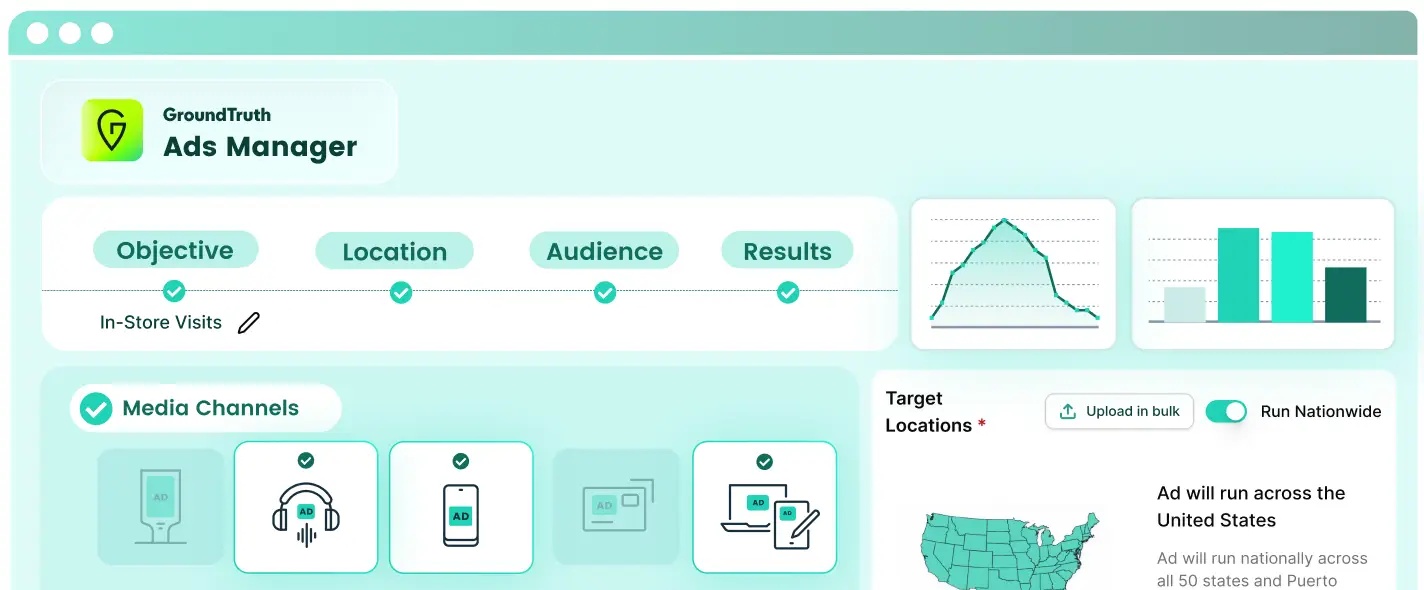
The users span agencies, national brands, resellers, small businesses and nonprofits. Public case studies include Ulta Beauty, Goodwill and PetSmart Charities. A visit can mean shopping, donating or arriving somewhere useful. GroundTruth’s place in the market is the combination of audience selection, media activation and physical-response measurement, offered through several ways of buying.
The people building the machinery have their own rituals. GroundTruth announced its fifth Ad Age Best Places to Work recognition in January 2026, and its careers page describes a remote-first environment. At a 2019 Women@GroundTruth event, guests discussed mentorship and career advancement, collected donations for homeless families and received Dammit! Dolls for the stressful holiday season. An unusually frank piece of corporate merchandise.

04 / The business that outgrew “ad”
GroundTruth began as xAd in 2009. Dipanshu Sharma and Sunil Kumar are among its co-founders. In 2016, xAd raised $42.5 million in Series E financing and acquired WeatherBug’s consumer properties. A weather app supplies a reason for people to keep checking their phones, plus context about conditions around them. For a location business, weather was a practical neighbor.
In June 2017, the company changed its name. “The name xAd was too limiting for our business,” Sharma said. Management wanted the identity to accommodate media and data applications beyond advertising. The change records a shift in ambition: the company believed knowing where people went could support more decisions than choosing an ad.
“The name xAd was too limiting for our business.”
Dipanshu Sharma / June 2017
Its current campaign channels include mobile, desktop, connected TV, audio, direct mail and digital out-of-home. The October 2025 Place Exchange integration added programmatic screen inventory and a way to connect eligible device exposure near screens with later store visits. A roadside display and a phone ad can now be parts of the same plan.
That territory has rivals. Foursquare offers omnichannel attribution and location-based advertising products; its measurement documentation describes a modeled control group and incremental lift. GroundTruth’s proposition is the convenience of its own mapping, buying and reporting workflow. The choice is not whether anyone else can measure foot traffic. It is which workflow, data and measurement rules suit the advertiser’s problem.
05 / Counting the visit, earning the credit
Here is the wrinkle every buyer should understand. GroundTruth’s Help Center defines an observed visit as a visit within 14 days after exposure to a GroundTruth ad, credited to the most recent impression. It also describes a seven-day verification period. A fresh dashboard may therefore contain provisional activity before final visit counts arrive.
Did an exposed device subsequently visit?
How much visitation exceeded the expected baseline?
A person can see an ad and visit a shop they were already planning to visit. Recording that sequence does not, by itself, establish that the ad changed their mind. This is an analytical distinction, not an accusation about a particular campaign. An advertiser who wants evidence of additional demand should ask for the lift methodology, comparison group and uncertainty alongside the visit count.
Coverage matters too. GroundTruth’s documentation says not every user is trackable at every moment; incorrect campaign settings can prevent visits being recorded. Its privacy policy explains the use of precise geolocation and device identifiers and describes consumer choices. The practical inference is that signal availability and eligibility affect what the system can observe. A quiet report and an empty shop are not necessarily the same event.
A useful experiment therefore starts narrowly: one destination or a comparable set, a defined offer and a business outcome worth paying for. Allow visits time to verify. Check results against a baseline and, where possible, sales or appointments. Sparse observations, poorly chosen boundaries or an offer nobody wants can leave a technically functioning campaign commercially unpersuasive.
06 / Tomorrow arrives with a new owner
On March 25, 2026, ZeroToOne.AI announced that it had acquired GroundTruth. The announcement described more than 2,000 enterprise customers globally. Rosie O’Meara, GroundTruth’s CEO, framed the combination as a move beyond measuring behavior toward predicting it.
That ambition became a product launch in May: Dynamic Intent Prediction audiences, powered by ZeroToOne.AI’s Large Behavioral Model. The company describes daily audience refreshes and prediction windows from 24 hours to 30 days. The product adds a timing question to the location question: who is likely to act soon enough for this particular advertisement to matter?
The distinction is commercially interesting. A long-standing interest in restaurants is not the same as deciding where to eat tomorrow. But a prediction earns its keep when it produces useful additional response at an acceptable cost. Advertisers can test predictive segments against their existing audiences rather than treat a new label as a result.
GroundTruth’s recurring idea survives the new owner: advertising should be accountable to something that happens beyond the screen. The shopkeeper still has the final, inconveniently practical question. Did the person come through the door - and was the visit worth buying?
Follow the footprints
Explore the tools, campaign stories and people behind the platform.