A hard question in marketing can fit into seven words. A board member looks past the slide full of impressions, clicks, views, and conversions and asks: would this have happened anyway? Bridget Westerholz knows the pause that follows. She has heard versions of the question from both sides of the brief, first as an agency leader and later as the executive responsible for the result. The numbers can be accurate and still leave the room unsure. A campaign can look busy without proving it changed the business.
That tension now sits at the center of Westerholz’s work as chief marketing officer of illumin, a Toronto advertising technology company. She joined in August 2024 to lead global marketing after a career that had already crossed packaged food, online grocery, travel, finance, and large advertising agencies. In January 2026, as illumin released a platform upgrade focused on live performance signals, she put the problem plainly: marketers do not need another delayed explanation. They need information they can trust while money is still moving and a campaign can still be changed.
It sounds like a product claim, but it also reads as the accumulated lesson of her career. Westerholz has spent 25 years getting closer to the decision. She began by helping make the advertising. She moved into running the teams. Then she crossed to companies where product, retail, loyalty, ecommerce, and revenue sat on the same operating agenda. Her present job brings those experiences together in a category famous for turning simple questions into crowded dashboards.
Four cities, one operating question: what makes people act?
The education between the cities
Westerholz started in South Africa after completing a postgraduate degree in advertising. Her early accounts included Red Bull and Hyundai. Four years later she moved to MCBD, now Dare, where the client list widened to include P&O Cruises and Debenhams department stores. The range demanded the same discipline: find an insight sharp enough to move someone.
Her own description of the attraction is telling. She has said she is fascinated by consumer behavior and by the possibility of gleaning an insight that can incite action. The rhyme is neat. The working method is serious. Data is raw material, not an answer. Its value appears only when someone can see a pattern, attach meaning to it, and choose what to do next.
In Canada, the account work became a leadership apprenticeship. At DDB in Vancouver, she started as group account director on Destination Canada and Capital One, then became vice president and director of client services. She also led work involving PepsiCo brands and Rocky Mountaineer. Her collaborative work received recognition across the IPA Effectiveness Awards, Cassies, Marketing Awards, Cannes, and Clios. Yet when asked years later about a meaningful career moment, she did not reach for an award. She chose mentorship: realizing she could help other people grow and succeed.
“Find your voice and don't be afraid to use it.”Bridget Westerholz, advice to her younger self
Listening as an operating system
At FUSE Create, where she became senior vice president, partner, and managing director, Westerholz protected a full day for one-on-one conversations. Her team, and several people beyond it, could use the time to talk. She would listen for three things: what they needed, what was going wrong, and what she could solve. This was not a ceremonial open-door policy. It was a recurring information system built around candor.
She wanted a workplace with cohesion, trust, and room for play. Fear, in her view, makes people hold back. It also makes creative work smaller. Her equation was straightforward: trust turns a collection of individuals into an “us,” and that collective confidence gives people permission to have fun. For an agency, playfulness was not a perk at the edge of the work. It was part of how better work got made.
The roots were personal as well as professional. Westerholz has credited her mother and grandmother with teaching her self-belief and kindness. In her working life, she named Helen Calcraft, Melissa Robertson, and Patty Jones as women who showed her how to find her voice and lead with integrity. The mentors form a chain. Westerholz’s pride in helping other careers suggests she sees leadership as a responsibility to lengthen it.
Protect time for the conversation a status report will never capture.
Join brand, product, distribution, and measurement into one view.
Use information while a decision can still alter the outcome.
Turn stated values into access, visibility, and opportunity.
When marketing reaches the shelf
After FUSE, Westerholz moved decisively to the brand side. She served as vice president of marketing and sales at Happy Planet Foods and then as vice president of marketing at SPUD, the West Coast online and retail grocery business. At SPUD, her remit covered brand, retail, loyalty, ecommerce, and digital. She rebuilt brand strategy and product marketing while also managing the transactional machinery that turns attention into an order.
The shift reveals something important about her approach. A message is only one part of a market. A product has to be clear, priced, stocked, discoverable, and recognizable. Westerholz has argued publicly that the profession’s recent fixation on acquisition and channel execution has narrowed the meaning of marketing. Strong brands align the entire system. The point is not to make a campaign louder. It is to make a choice easier to find, understand, and remember.
SPUD’s #HerFairShare initiative made the idea tangible. The program invited women-owned and women-run businesses struggling for retail access to apply for space on SPUD’s virtual shelves. Forty eligible businesses applied in the first few months. Westerholz saw encouragement in the response and a warning in the number: many founders still could not crack the shelf. The company set a goal for at least 25 percent of the products it sold to come from women-owned or women-run businesses by the end of 2025.
The initiative treated visibility as infrastructure. SPUD did not charge vendors listing fees, removing one cost of entry for local and independent brands. Westerholz described a symbiotic relationship: startup brands received a route to growth, while customers discovered local products and founder stories. Her blunt invitation to investors was even shorter than the boardroom measurement question: “VCs, if you are listening: fund a woman.”
The brand builder enters ad tech
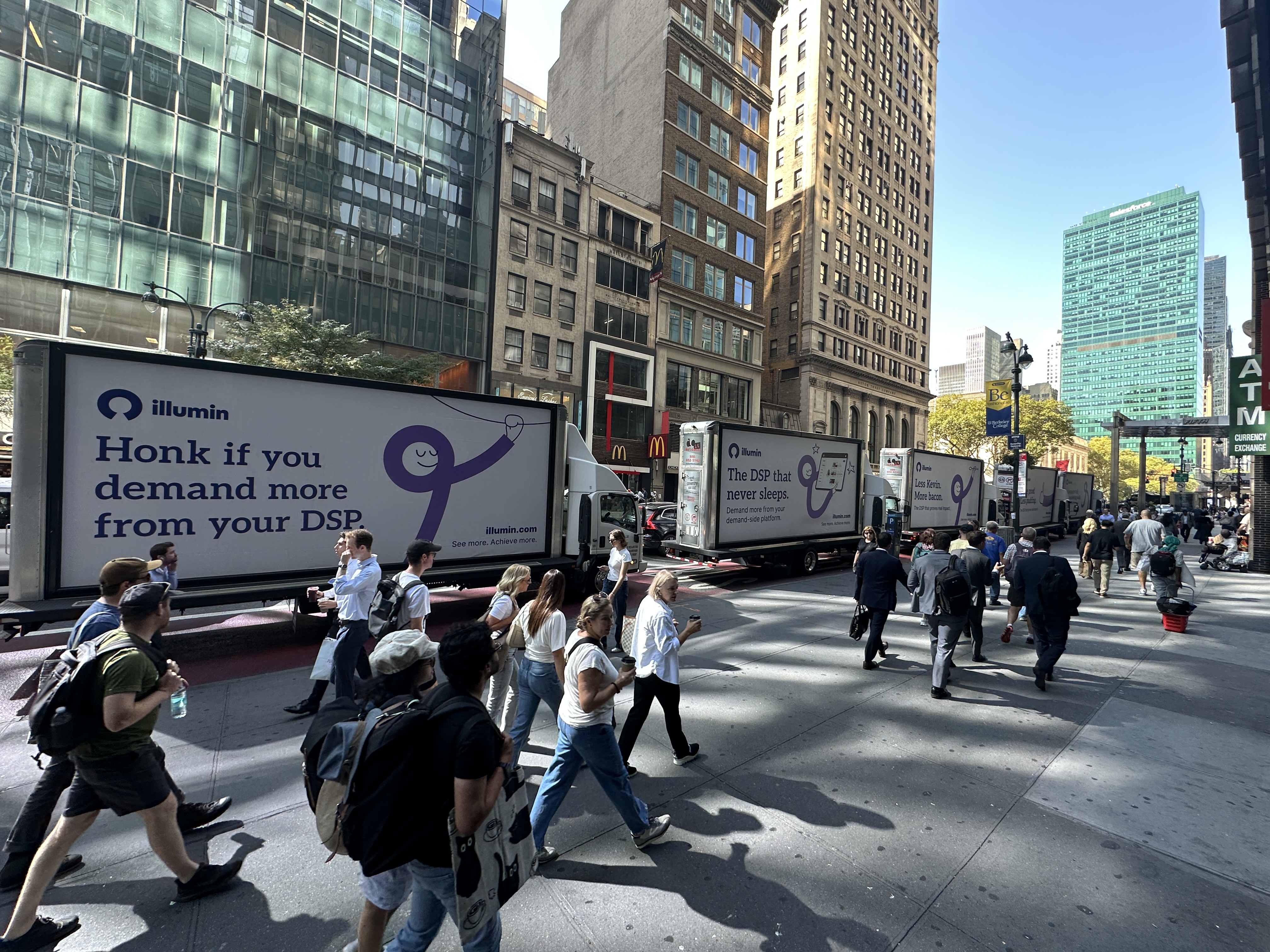
Westerholz arrived at illumin with experience from agencies and brands just as the company was working through a broader market pivot. In 2025, that transformation surfaced as a new identity and the line “See More. Achieve More.” During Advertising Week New York, five mobile billboards moved through Times Square, Hudson Yards, SoHo, Midtown, and the Javits Center. The campaign continued across connected television, digital out-of-home, programmatic display, and Meta.
The tone was playful, but the strategic promise was about control. One truck invited drivers to honk if they demanded more from their DSP. Another declared that the DSP never sleeps. Westerholz described the activation as a celebration of a company willing to challenge conventions. Beneath the street theatre sat a more sober change: illumin was repositioning around a unified campaign canvas, artificial intelligence, and measurable outcomes.
Her background gives that promise an unusual test. She has been the client looking at the report. She has managed agencies producing the work. She has run loyalty and ecommerce programs where customer response shows up quickly. She knows that adding another tool can increase fragmentation instead of reducing it. The useful question is whether a system brings performance, insight, and action closer together.
“Marketers don’t need more data or delayed post-campaign insights. They need clear performance signals they can trust while campaigns are live.”Bridget Westerholz, 2026
The return of the whole marketer
Westerholz’s recent writing has become more pointed about what the profession has lost. She sees teams rich in platform expertise but short on confidence about the total business. Attribution can make one channel look clear while the larger picture remains blurry. Campaigns get optimized in pieces. Ownership fragments across tools and teams. Activity begins to impersonate impact.
Her answer is not to reject performance marketing. It is to restore the rest of marketing around it. Product, price, distribution, visibility, identity, and storytelling compound. Distinctive brands are not built by a single message floating above the business. They are built when the parts reinforce one another in the market. A campaign earns its place in that system by changing an outcome, not merely recording a response.
This is where her two favorite subjects meet: consumer behavior and leadership. Both require listening past the obvious signal. A consumer’s click may not reveal why the brand matters. A team’s status update may not reveal the obstacle. The executive’s work is to make room for a more useful truth, then act on it.
There is a personal line running through all of it. Early in her career, Westerholz sometimes held back an opinion out of fear. Her advice now is to find a voice and use it. The same movement appears at every scale in her story: a colleague gets space to speak, a founder gets space on a shelf, a marketer gets a clearer view of a live campaign. Better information matters. So does the confidence to do something with it.