Profile - Construction Tech
Kojo
Kojo
builds the builders.
The procurement platform quietly running underneath America's electrical rooms, mechanical chases, and skyline-bound construction jobs.
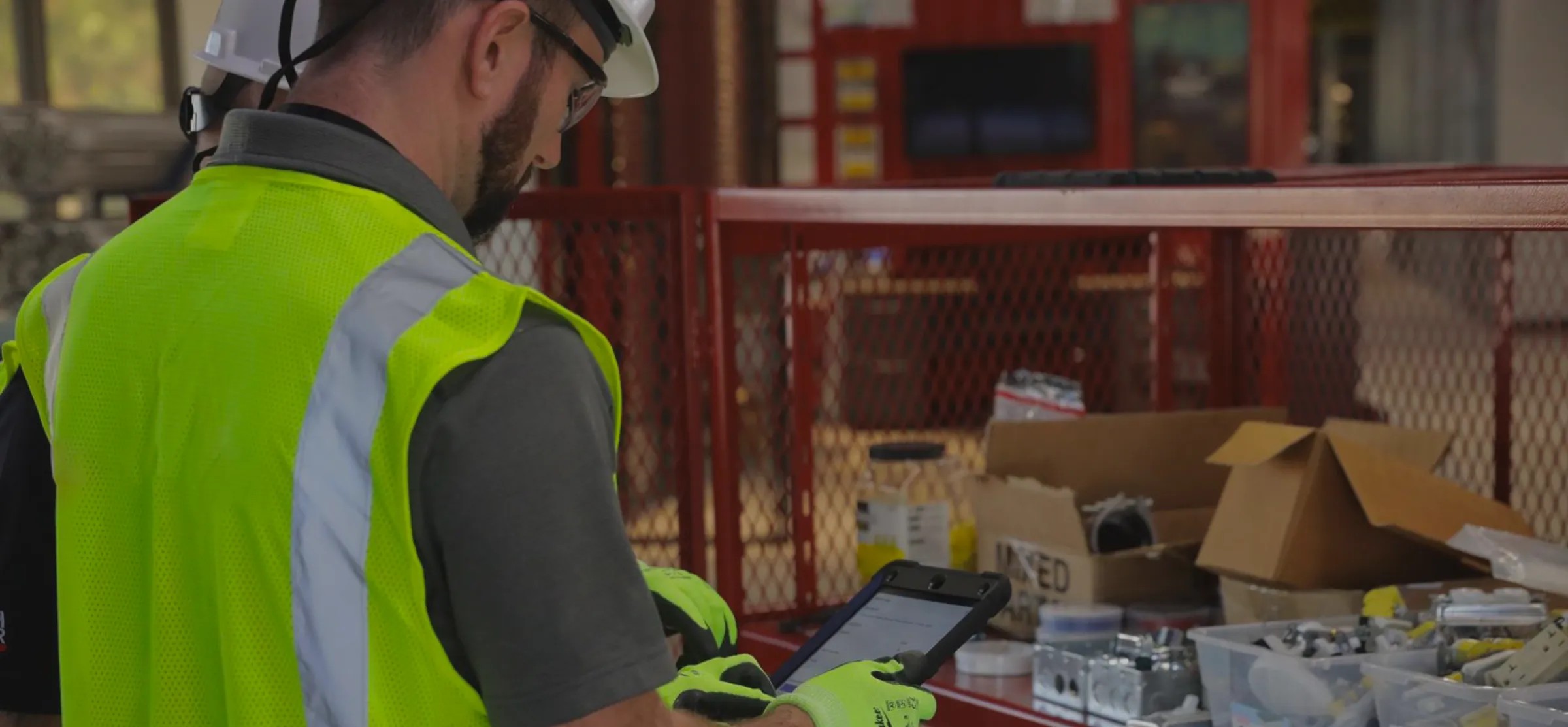
The procurement platform quietly running underneath America's electrical rooms, mechanical chases, and skyline-bound construction jobs.
At 5:42 a.m. somewhere in Houston, a foreman opens his phone. The truck is forty minutes out. Three hundred feet of conduit, two cases of fittings, a pallet of strut. He taps once, signs once. By 7:15 the gang is wiring. None of this used to be possible without a fax machine, a yelling match, and a missing PO. None of this used to be possible at all. Kojo made it ordinary.
That ordinariness is the whole point. Construction - thirteen percent of global GDP, the industry that puts the floors under your feet and the lights above your head - has spent decades running on the technology equivalent of a clipboard. Spreadsheets emailed at midnight. Quotes scrawled on yellow legal pads. Materials ordered twice because nobody could find the first PO. The waste is measured not in cents but in entire pallets.
The problem with construction procurement is that it doesn't look like a problem from any one seat. The estimator does her job. The PM does his. The foreman calls the vendor. The warehouse logs what comes in. Each link works. The system, taken together, leaks margin like a punctured drum - twenty percent here, fifteen there, a missed delivery that pushes a crew of nine into overtime. Multiply by every job in America and you get an industry that has historically lost more money to coordination friction than to bad weather, bad bidding, and bad coffee combined.
Maria Davidson saw it the way outsiders sometimes do, which is to say in a way that should have been obvious to everyone already working in it. She was twenty-six, a Goldman Sachs alum who'd helped build the venture firm 8VC, and had never set foot on a jobsite before she decided to start a company there. Construction insiders, gently, told her she was nuts. She kept making site visits anyway.
The bet Davidson and her co-founders - Micah Rodman, Ryan Gibson, Adam Williams, Michael Oliver - placed in 2018 looks small written down and enormous in practice. The company, then called Agora Systems, would not try to disrupt construction. It would not gamify the jobsite. It would not write a manifesto about reinventing how buildings get made. It would, instead, take the single ugliest workflow in the entire industry - materials procurement - and digitize it end-to-end, from the takeoff sheet through the invoice match, with field, office, warehouse, and vendor all looking at the same screen.
The unfashionable strategy turned out to be the durable one. By 2022 the company had rebranded as Kojo and closed a $39M Series C led by Battery Ventures. By 2024 it was showing up on the kind of lists - Inc. Best in Business, Fast Company's Next Big Things in Tech - that companies usually have to lobby for. By 2025 the strategic round closed with Wesco International, one of the largest electrical distributors in North America, writing a check that doubled as a distribution agreement.
- Five people, one industry, zero prior construction experience between them at the start.
What Kojo actually sells, stripped of branding, is a unified place to do the thing contractors already do: order stuff, receive stuff, count stuff, and pay for stuff. The cleverness is in how aggressively it refuses to be a single tool. Kojo Procurement handles quoting, comparison, and POs. Kojo Warehouse tracks inventory job-by-job, in real time, with barcode scans replacing the heroic Sharpie. Kojo AP automates invoice matching - the AR/AP equivalent of finding the missing sock - against the original purchase order. Kojo AI sits across all of it, parsing vendor PDFs, flagging price drift, forecasting what a job will need before the foreman asks.
None of these modules, on their own, is exotic. Glued together, they remove the seams where money historically falls through. That is the entire pitch.
- The milestones Kojo doesn't put on its homepage but probably should.
Investors do not, as a rule, write large checks for construction software unless something is working. Battery wrote one. Tiger wrote one. Then a strategic distributor wrote one with a contract attached. Read the bars.
- Five rounds, one thesis, zero pivots. Boring works.
Numbers are easy to print and hard to live up to. Kojo's are checked by people who own pickup trucks. Trade contractors using the platform report saving roughly seventy-five percent of the manual data entry they used to grind through; waste on jobsites has fallen by up to ninety percent on the high end. Five billion dollars in annual orders now flow through the system. Procore integrates with it. QuickBooks integrates with it. Sage and CMiC and NetSuite integrate with it. The accounting back office, the field-side super, and the warehouse manager all get the same numbers, at the same time, which is - to anyone who has ever worked in a back office, on a jobsite, or in a warehouse - a small miracle.
Kojo's stated mission is "to make it faster, easier, and more sustainable to build the world around us." The phrase is shorter than what it describes. Faster means the project finishes before its own delays compound. Easier means the foreman does not need a second computer in his truck. Sustainable means the conduit you ordered three times only gets ordered once - which is both an emissions story and a margin story, depending on who you are pitching.
Davidson talks about all three with the steadiness of someone who knows that fixing a real industry takes longer than a hype cycle. She has spoken at MEP conferences, sat for long-form interviews, picked up the EY Entrepreneur Of The Year Bay Area award in 2023, and managed to remain, in conversation, mostly unimpressed with herself. The company is the same way. The product is loud where it matters and quiet everywhere else.
Data centers are the new cathedrals - and they are being built at a pace that will break every supply chain not already organized. The Wesco partnership exists for exactly that reason. Power equipment lead times have stretched from weeks into quarters. Switchgear gets allocated. Contractors who can see, route, and stage materials with real precision will finish jobs that others physically cannot start. Contractors who can't will lose them. Kojo, by virtue of being in the system early, is positioned not as a vendor but as plumbing.
There's an old line about software eating the world, which by now is overcooked. The interesting question is which industries it eats last, and how. Construction is one of the last, because the work is real and the workers are not on Slack. Kojo's answer is to meet that reality where it lives - on the truck, in the warehouse, on the phone in a gloved hand - and to glue every transaction together behind it.
Back to Houston, 5:42 a.m. The conduit truck is forty minutes out. The foreman taps once. The warehouse counts it in. The invoice matches itself. By 7:15 the gang is wiring, the project is ahead by an hour, the margin is intact, and nobody remembers that any of it used to be hard. That forgetting is what good infrastructure does. Kojo is busy becoming infrastructure.