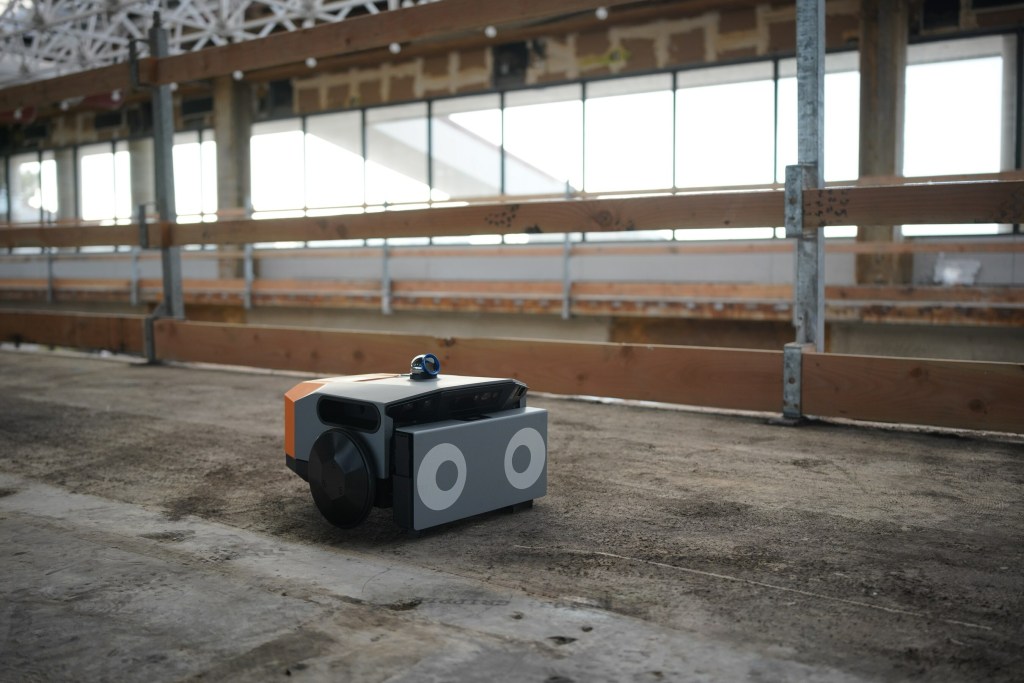
A concrete slab. Two friendly eyes. Then the lines appear.
It is 6:42 a.m. on the 14th floor of a building that does not exist yet. The concrete is dry. The walls are imaginary. A small wheeled machine - roughly the footprint of a beverage cooler, with two enormous painted-on eyes - rolls out of its dock and begins drawing. Not sketches. Not approximations. Full-scale, foreman-grade layout, pulled from a Revit model somewhere in a cloud and printed straight onto the slab in crisp black ink.
By lunchtime, a building plan has appeared on the floor like a tattoo. Every stud line, every door swing, every conduit penetration, every bolt hole. The framers walk in, point at the floor, and start building.
That machine is called the FieldPrinter. The company behind it is Dusty Robotics. And if you have not heard of either, that is mostly because construction does not advertise.
Construction is roughly 14% of global GDP and still routinely figures out where to put a wall using a chalk line and a tape measure.- THE PROBLEM, IN ONE SENTENCE
The most boring job on the jobsite is also the most expensive one to get wrong.
Layout - the act of translating a design drawing into physical marks on a floor - is the unglamorous spine of construction. It is what tells a drywaller where the wall goes, an electrician where the box belongs, a plumber where the riser punches through. Every trade, every floor, every project.
For most of the last century it has been done by hand. Two or three people with a chalk box, a Sharpie, a printed sheet, and a total station. The work is slow. The math is exhausting. The tolerances are forgiving until they aren't, at which point a misplaced mark in week four becomes a torn-out duct in week twenty-seven. The industry has a polite name for this, which is rework, and a less polite one, which is "where the margin went."
A small detail with a $3 million tail.
On Skanska's Sutter Health Samaritan Court ambulatory care center in California, the FieldPrinter handled layout on a 69,000 sq ft, three-story healthcare project. Skanska reports the project finished three months ahead of schedule with a reported ~$3M in savings - largely because nobody had to redo anything.
Tessa Lau, the company's co-founder, did not arrive at this problem from an architecture school or a McKinsey deck. She arrived at it from her own house. She was remodeling, watched a confused crew try to translate a plan, and clocked the obvious: the bottleneck in the most physical industry on earth is, in fact, information transfer.
What if the BIM model just... walked out of the laptop?
Lau is a former Willow Garage and Savioke researcher. Her co-founder, Philipp Herget, had led hardware at Savioke - the company that built Relay, the hotel-delivery robot that briefly tried to convince Americans to tip a machine. They had years of polite indoor robots between them.
In 2018 they made an impolite choice. Skip hospitality. Skip warehouses. Skip the demos-look-great-on-stage market. Go to a place where robots are unwelcome, the dust is real, the WiFi is bad, and the customer is wearing a hard hat. Build a robot for that.
The pitch is almost insultingly simple: take the digital plan, drive it around, and print it on the actual floor.- ON THE INSIGHT
That bet has aged well. Construction technology, long the cousin nobody invited to the SaaS Christmas party, has become one of the more interesting frontiers in industrial AI. And of the field's many startups, Dusty is among the few whose product you can actually photograph from above and see working.
Field Notes: a short company history
Seven years, three product generations, one stubbornly unchanged elevator pitch.
It looks like a tiny ice resurfacer. It thinks like a draftsperson.
The current robot, FieldPrinter 2, is a battery-powered, wheeled, autonomous mobile platform. It pulls a coordinated multi-trade layout from a BIM or CAD model, localizes itself on the slab using a total-station setup, and prints lines, text, dimensions, and trade-specific symbols at survey-grade accuracy.
The hardware is paired with the FieldPrint Platform - the software side - which does the unsexy but load-bearing work: Revit and AutoCAD plugins, model conflict resolution, multi-trade coordination, and real-time reporting back to the office. None of which makes for a thrilling demo gif, all of which is why contractors will sign a multi-year contract.
What FieldPrinter 2 can actually do.
Print at speeds roughly 10x manual layout. Handle multi-trade layout in a single pass (framing, MEP, drywall - all at once). Print closer to walls and columns than its predecessor. "Shadow print" obstructed areas. Print QR codes that link to install instructions for the trade about to step on that exact tile.
Speed gain, by reported case study
Source: Dusty Robotics customer stories, public case studies
Numbers borrowed from Skanska and Turner project disclosures. The "100%" is theirs, not ours.
The customers are the part most startups skip past quickly.
Dusty's investor deck is, mercifully, a list of names anyone in commercial construction already recognizes. DPR Construction reportedly runs four FieldPrinters across 16+ projects. Turner Construction printed multi-trade layout on a 20-story state office building in Sacramento, where it claims the work happened ten times faster than the legacy method. Skanska you have already met. Truebeck and Performance Contracting round out the bench.
The robot does not replace the worker. It hands the worker a perfect floor.- THE COMPANY'S OWN FRAMING, AND THE REASON CONTRACTORS LET IT THROUGH THE GATE
That framing matters more than it sounds. Construction labor has spent the last decade being told it is about to be automated away. Dusty's wedge is the opposite. The robot is the assistant. The framers still frame. They just stop arguing about whether the wall is supposed to be six and one-quarter inches or six and three-eighths from the column, because the answer is now drawn on the floor in ink that does not lie.
Robots in places where robots have, historically, not been welcome.
Dusty's stated mission is to bring robotic automation to the jobsite so builders can build better, faster, and with fewer errors. Spoken aloud, this sounds modest. Read against the backdrop of an industry where productivity has been roughly flat for forty years and labor shortages are forecast to get worse, it is closer to a structural argument.
The deeper bet is that the digital model - the BIM file the architect and engineer fight about for two years - should not stop at a PDF and a print room. It should walk out of the laptop, onto the slab, and check itself against reality. The FieldPrinter is the dumbest, most direct version of that idea: take the file, drive it around, and draw it. If that sounds obvious, that is part of the point. The best industrial products usually do.
Back on the 14th floor. The lines are already there.
Return to that empty slab. Same building, same hour, six months in the future. The robot has done its rounds and gone home. The framers arrive with coffee. There is no chalk box on the floor. There is no foreman squinting at a printed page taped to a column. There is just a building, drawn in ink, waiting to be built. The work that used to take a weekend takes a shift. The work that used to need three layout techs needs one operator and a charging dock.
None of this looks dramatic. That is its trick. Dusty Robotics is not selling a vision of construction without people. It is selling a vision of construction where the boring, expensive, error-prone middle layer between design and labor is finally just done - quietly, accurately, before anyone shows up.
A robot, drawing skyscrapers on the floor. The skyscrapers, eventually, drawing themselves up around it.
The future of construction will not arrive as a humanoid in a hard hat. It will arrive as a 200-pound printer with two friendly eyes that finishes its shift before the framers clock in.- YESPRESS, 2026