At McDermott, the engineering and construction company, six IT staff had to support 6,000 business users, according to Kissflow’s customer account. Finance, HR, and supply chain all needed applications. Each request joined a queue. The arithmetic suggests a familiar office predicament: the person who understands the problem has to wait for the person who can build the solution.
- The job: turn forms, approvals, and departmental know-how into working applications.
- The wager: business people can build; IT keeps oversight.
- The buying test: bring a real process, its exceptions, and its owner.
Kissflow sells a way to change that arrangement. Its platform combines visual app building, workflow automation, integrations, reporting, and AI assistance. A business team can put its process into software while IT controls access and governance. McDermott’s published case study reports more than 400 active workflows and over five million work items processed. Those are vendor-published results, but they give the proposition a useful scale.
01 / The third attempt had a smaller job
The Chennai company’s history begins with OrangeScape in 2003. Its first product, Dimension, arrived in 2005, offering business experts a way to create applications without writing code. In the company’s telling, users were not yet behaving as the product required. Visual PaaS followed in 2007. Cloud technology looked promising; the market category proved harder to establish.
That distinction matters. A technical idea can work before a purchasing decision makes sense. Kissflow’s next move gave buyers something easier to recognize: a workflow creator for Google Apps, launched at Google I/O in 2012. An approval request was a problem people could point to.

Founder Suresh Sambandam also changed how he listened. Inc42’s early account describes late-night customer calls from India and a two-person marketing operation. Paid subscriptions began in May 2013 at $3 per user per month. OrangeScape had raised $1 million from Indian Angel Network in 2012. The useful lesson is specific: shorten the distance between the person selling the product and the person trying to use it.
02 / Give the rule a place to live
Consider a purchase request. Someone enters the item, supplier, amount, and department. The workflow sends it to the right approver, applies conditions, and records the decision. A dashboard shows what is waiting. This is an illustrative use case, and it explains Kissflow more clearly than a promise to transform everything.
- 01RequestCapture the details
- 02RulesChoose the route
- 03ApproveAssign the decision
- 04RecordKeep the trail
Illustrative workflow, not a measured customer result.
Today, users can describe an application in plain language or upload requirements, then refine it through chat and visual tools. Kissflow says its AI generates structured application definitions rather than raw code. That gives the process owner something inspectable to edit. The company’s expertise lies in combining those definitions with workflows, data, interfaces, and permissions.
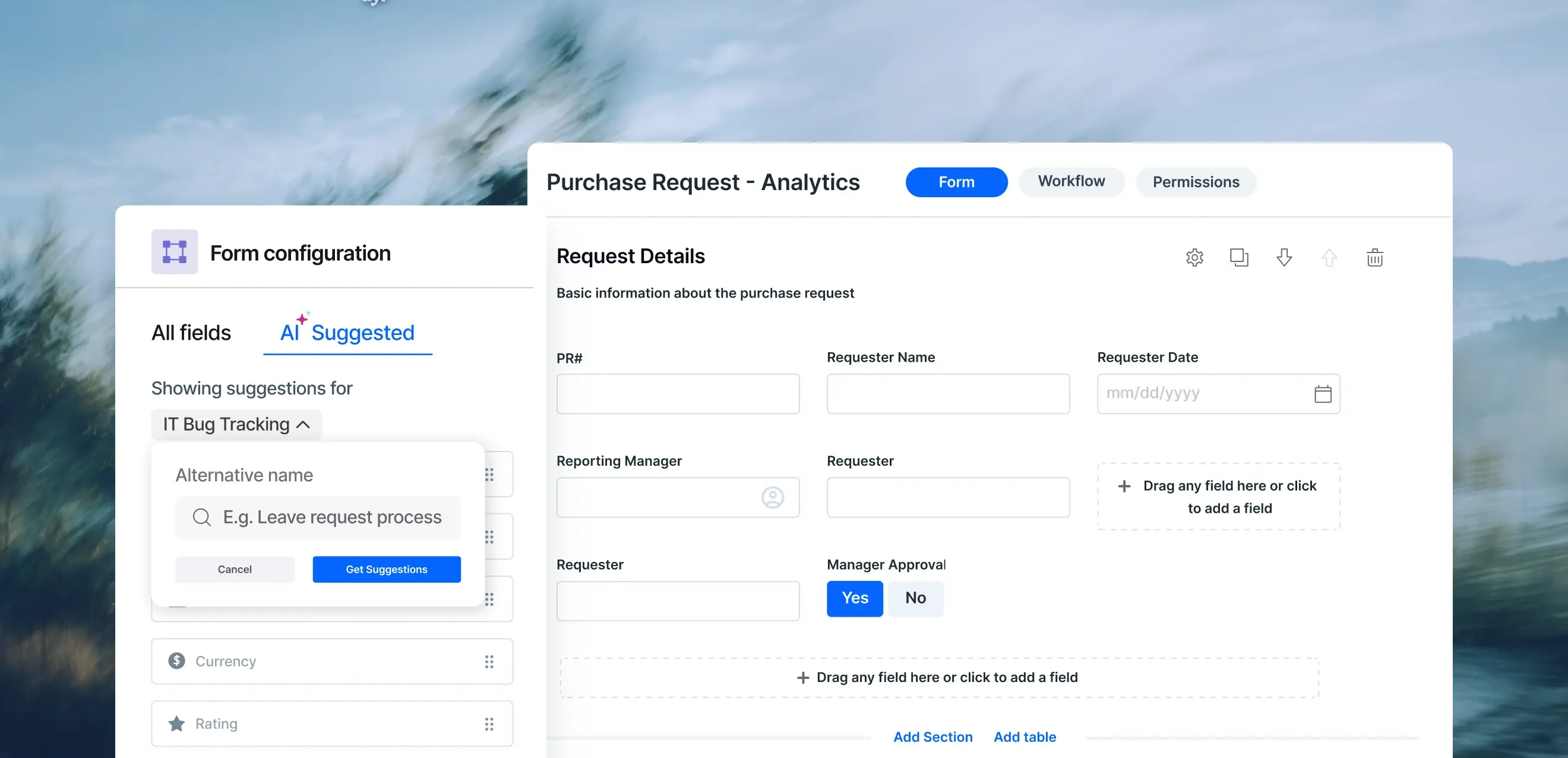
Connections to existing systems are part of the offer. Administrators can review users, apps, integrations, and logs centrally. This places Kissflow in the enterprise low-code market alongside Microsoft Power Apps, Appian, OutSystems, and ServiceNow. Its competitive argument emphasizes business participation with shared IT control. Buyers still need to compare ecosystem fit, integration depth, and the applications they actually need.
The same building blocks support different jobs: employee onboarding, supplier requests, claims, and service cases. Forms capture information; workflows assign responsibility; reports make the workload visible. The value depends on the handoffs around the form. A beautifully designed screen still needs a rule for what happens when an approver is away, a document is missing, or a request must return to its author.
03 / The pilot that met a pandemic
Puma Energy offers another revealing case. Its team brought in Kissflow around the end of 2019 or beginning of 2020. A pilot had roughly 200 users. Then offices closed. Paper processes and work that depended on people sitting together became difficult to execute. The company’s account describes the rollout growing to more than 1,500 users.
The revealing detail is the timing. A tool already being tested became useful under changed conditions. The bottleneck was suddenly visible to everyone. For another organization, the copyable move is to choose a pilot that carries actual work and has a named owner. That makes its usefulness easier to judge when circumstances change.
“I don’t need to call IT to do this.”
A finance-user reaction relayed by McDermott’s Renee Villarreal
04 / The price of handing over the pen
Kissflow’s present business is B2B subscription software. Its pricing page describes fixed annual agreements, no AI or API usage surcharges, and additional services available for purchase. Implementation, customization, training, and support feature prominently. The old $3 seat belongs to the company’s history; today’s buyer needs a scoped commercial proposal.
Cost therefore includes organizational work: mapping exceptions, assigning permissions, connecting systems, and deciding who maintains an application after its enthusiastic creator changes jobs. Those responsibilities remain even when the interface is friendly. A team with one simple form should weigh a full platform carefully. Highly specialized software needs may also require development beyond what a visual builder supplies.

The company describes a people-first culture. Its history also includes roughly 45 job cuts acknowledged in June 2024 across India, the US, and UAE, attributed to restructuring and performance reviews. That belongs beside the product story: changing a business model has consequences for the people delivering it.
05 / Start with the queue
Recent moves point toward more enterprise work. Kissflow announced a Houston operations center for energy customers in May 2026 and membership in FinTech Alliance.Ph in September. That release reported 1,200 customers across 87 countries, including 50 Fortune 500 companies. The dated figures offer a clearer picture than mixing historical registrations with current customers.
For a prospective user, the useful starting point is modest. Pick a request that repeatedly gets stuck. Identify its decision-maker, rules, and exceptions. Measure the waiting. Then ask whether the team that understands it can build and maintain a better route. That is a practical test of Kissflow’s central idea.