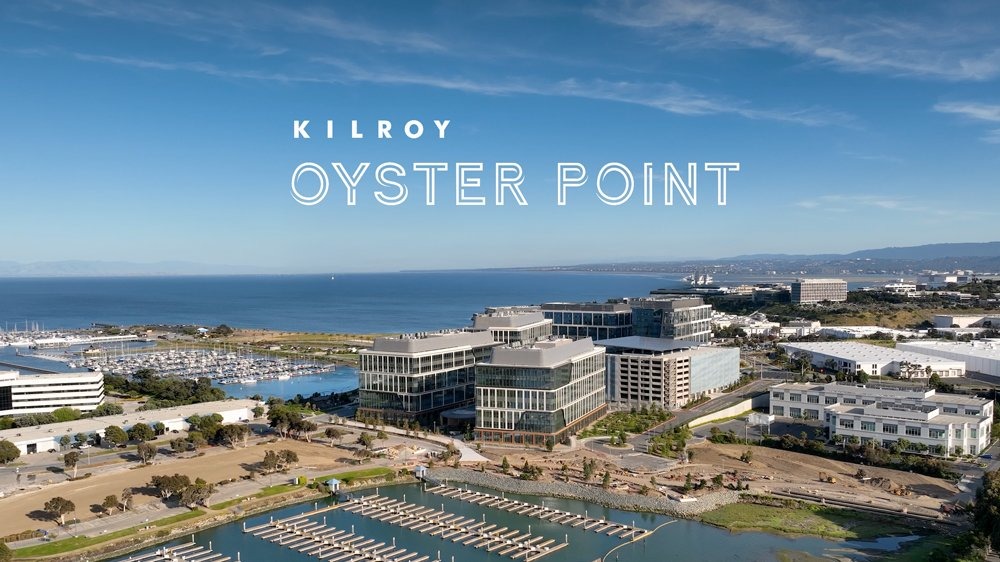
At Kilroy Oyster Point, the interesting numbers are 49 and seven. In June 2026, the second phase of the South San Francisco campus was 49% leased and 7% occupied. Most of the people had yet to arrive. Between those two percentages sits a surprisingly good explanation of the commercial property business.
Kilroy Realty Corporation owns, develops, buys and manages offices and life science buildings. Its customers include technology companies, entertainment businesses and drug developers. They need somewhere to work, but also someone else to handle the considerable trouble of owning the workplace. Kilroy supplies the space and the operating machinery behind it. The rent pays for both.
- A landlord for offices and labs, with customers including Stripe, Adobe and Netflix.
- Oyster Point Phase 2: $1.175 billion estimated investment; 49% leased and 7% occupied in June 2026.
- The copyable idea: test energy controls in a few buildings, measure savings, then expand.
01The office has to earn the commute
The company’s own language offers a clue to its ambition: “We understand how environments shape human creativity and productivity.” That is a large claim for a landlord. It also explains why Kilroy’s offering extends beyond floor plates to outdoor areas, fitness spaces, conference centers and restaurants.
For an employer choosing an office, the practical proposition is straightforward: lease a place that can accommodate the business, give colleagues reasons to gather, and leave building operations to a specialist. For a laboratory tenant, the requirements grow more exacting. A science building must accommodate equipment, infrastructure and technical work that an attractive ordinary office cannot simply absorb.
At Oyster Point, the marketing specifications include roughly 40,000-square-foot floor plates, typical 16-foot floor-to-floor heights and substantial floor-loading capacity. These are clues to the actual product. The waterfront gets attention; the building’s ability to support scientific work helps determine whether a tenant can use it.
Kilroy competes with office owners such as BXP and Hudson Pacific, and with lab specialists such as Alexandria. Its particular combination is offices, life science facilities and amenities across the West Coast and Austin. That combination defines a position, rather than proving an advantage. A prospective tenant still compares individual buildings, locations and lease terms.
02A long history meets a slow clock
Kilroy traces its beginnings to 1947 and founder John B. Kilroy Sr. The company entered the public REIT market in 1997. Angela Aman became chief executive in January 2024, taking responsibility for a portfolio built over decades.
The business model rests on recurring rental income, supported by property management, acquisitions and development. Public equity and borrowing help finance the assets; sales release capital for other uses. This is a company that must make decisions about years of demand while tenants are still deciding what they need next quarter.
The second phase of Oyster Point makes that mismatch tangible. Construction began in the second quarter of 2021. By the June 2026 supplemental report, total estimated investment stood at $1.175 billion for 871,738 rentable square feet. “Estimated investment” matters here: it is a project budget measure, not a claim that every dollar had already been spent.
A large commitment arrived from the University of California, San Francisco: approximately 280,000 square feet, with occupancy expected in late 2027. Meanwhile, a genomic sequencing foundry signed a much smaller, approximately 20,000-square-foot spec suite and moved in upon execution in late 2025.
The useful contrast is between a building ready for a customer and a customer ready for a building. Spec suites can shorten that interval for some users. An institution taking an entire building follows another timetable. A signed lease establishes a commitment; it does not mean the space is already occupied.
A signature comes before a move-in.
871,738 rentable square feet
03What gave way was the timetable
The public evidence points to slow absorption, rather than a demonstrated defect in the buildings. Reporting in July 2026 described weak lab demand and a second phase still working to fill its space. That distinction matters. Better finishes cannot manufacture a research budget. A campus can be technically suitable while the market takes longer than its owner would like.
Kilroy’s response is visible in its transactions. In April 2026, it sold two Hollywood residential towers for $202 million in gross proceeds. In June, it expanded its unsecured revolving credit facility to $1.25 billion. These moves increased financial flexibility. They show a change in the allocation of capital; they do not establish a private moment when management changed its mind.
Nor should every vacancy number be read as the same event. Oyster Point Phase 2 entered the stabilized portfolio in early 2026 despite its limited occupancy. “Stabilized” can mean a year has passed since substantial completion, rather than that a building is nearly full. Real estate has a vocabulary capable of making a waiting room sound settled.
04The smaller experiment worth stealing
There is another Kilroy story with a more approachable entry price: its early work with energy analytics company Gridium. Kilroy piloted the software in its two largest San Francisco buildings in 2011, then expanded it across eligible local properties in 2012. Its sustainability report attributed 402,407 kilowatt-hours and $77,642 in savings to the San Francisco deployment.
The mechanism was practical. Weather and load data helped operators anticipate expensive peak-demand periods and adjust building operations. In 2019, Gridium described a separate $26,000 utility credit after identifying a better tariff for a Kilroy building. Sometimes the innovation is discovering that the bill was on the wrong rate.
The lesson is portable: start with a small group of buildings, measure the result, then expand. It depends on usable meter data, tariffs that reward changes and operators able to act. Kilroy’s 2014 report described two buildings that could not yet use Gridium’s information because they lacked demand-response capabilities. An alert without a controllable building accomplishes little.
An alert without a controllable building accomplishes little.THE OPERATOR’S TEST · EDITORIAL OBSERVATION
05Read the carbon claim as carefully as the lease
Kilroy reports carbon-neutral operations from 2020 through 2025. Its stated approach combines efficiency, onsite generation, renewable electricity purchasing, renewable energy certificates and verified carbon offsets. The scope covers operational electricity and natural gas, including downstream leased assets. It does not mean every building operates without emissions or that constructing it carried no carbon cost.
That distinction makes the achievement more useful to examine. A tenant assessing Kilroy can ask about actual energy performance, technical fit and the timetable for moving in. An owner can copy the discipline of measuring before expanding. Neither should assume certifications or amenities eliminate exposure to weak demand. At Oyster Point, the architecture is already standing. The remaining work is getting people through the door.