A laboratory is an office in roughly the same way a grand piano is a table. Both may occupy a rectangle of floor. The resemblance does not survive contact with the work. Labs demand resilient power, carefully managed air, unusual plumbing, freight routes, adaptable benches and a tolerance for scientific equipment that arrives with the manners of a small industrial appliance. Get the room wrong and clever people spend their days negotiating with the building.
Dan Belldegrun built his company around that stubborn physical truth. He is the CEO and co-founder of Breakthrough Properties, a developer, owner and operator devoted to life-science research environments. The business began in 2019 as a partnership between Tishman Speyer and Bellco Capital. Its premise sounds almost modest: scientists should have places designed for science. In practice, that means stitching together real estate, laboratory operations, finance, hospitality, sustainability and the social chemistry of a research cluster.
Belldegrun arrived at the junction with an unusually tidy set of coordinates. He earned a Bachelor of Arts in Urban Studies from the University of Pennsylvania. He then spent eight years at Tishman Speyer, working in acquisitions and development across the Bay Area and New York. His official biography credits him with more than $575 million in completed transactions, along with the entitlement, design and financing of large projects in San Francisco. Meanwhile, he had grown up around the Bellco Capital family business and its close view of biotechnology. One side taught him how cities and buildings get made. The other showed him why a certain kind of tenant could never be served by generic space.
The useful thing hiding in the background
Biotech stories prefer the glamorous nouns: molecule, founder, trial, funding, breakthrough. The building is usually scenery. Belldegrun saw the scenery behaving like a constraint. A young research company may need lab space quickly but lack the time, capital or in-house expertise to build it. A large pharmaceutical group may require an entire facility with exacting technical standards. Both want to recruit scarce talent. Both benefit from being near universities, hospitals, investors and other scientists. Neither is helped by a landlord who thinks a freezer is merely a chilly filing cabinet.
Breakthrough's answer covers a continuum. StudioLabs offers lab-equipped, flexible environments for growing companies. Larger developments can serve established biopharma tenants at headquarters scale. Around them, shared spaces, fitness rooms, conference facilities, public areas and food are meant to make a technical building feel like a place where humans might willingly spend a difficult Tuesday. Belldegrun has described the company as supporting early-stage teams through to global pharma and everything between.
The continuum is more than a leasing strategy. Research companies change shape unpredictably. A result can make yesterday's floor plan obsolete. Equipment moves in. Teams double, contract, regroup. The useful building is not only technically capable on opening day; it can absorb a client's next act without turning every change into surgery.
“At the end of the day, science is global.”Dan Belldegrun, on serving research companies across markets
A cluster is a verb disguised as a noun
Breakthrough follows places where scientific activity already has gravity. Its work reaches San Diego, Boston, Philadelphia, Amsterdam and Oxford, among other markets. Those locations are not interchangeable dots on a map. They contain universities, established companies, experienced workers and capital networks accumulated over years. A cluster works because people keep meeting, hiring, teaching, financing and trying again.
One Milestone, the life-science component of Harvard's Enterprise Research Campus in Allston, makes the idea concrete. Designed by Henning Larsen and Studio Gang, the two-building complex places research space near Harvard's academic community and within a broader mixed-use district. It includes facilities for established companies alongside StudioLabs for younger ones. In January 2026, a global biopharma company expanded its planned innovation center there from 30,000 to 100,000 square feet, with work spanning discovery, artificial intelligence and data science.
Belldegrun called One Milestone a destination for partnerships between academia and industry. The phrase matters. A conventional property pitch sells square feet. This one sells proximity with a purpose: the possibility that institutions with different clocks and incentives might still find each other in the same neighborhood.
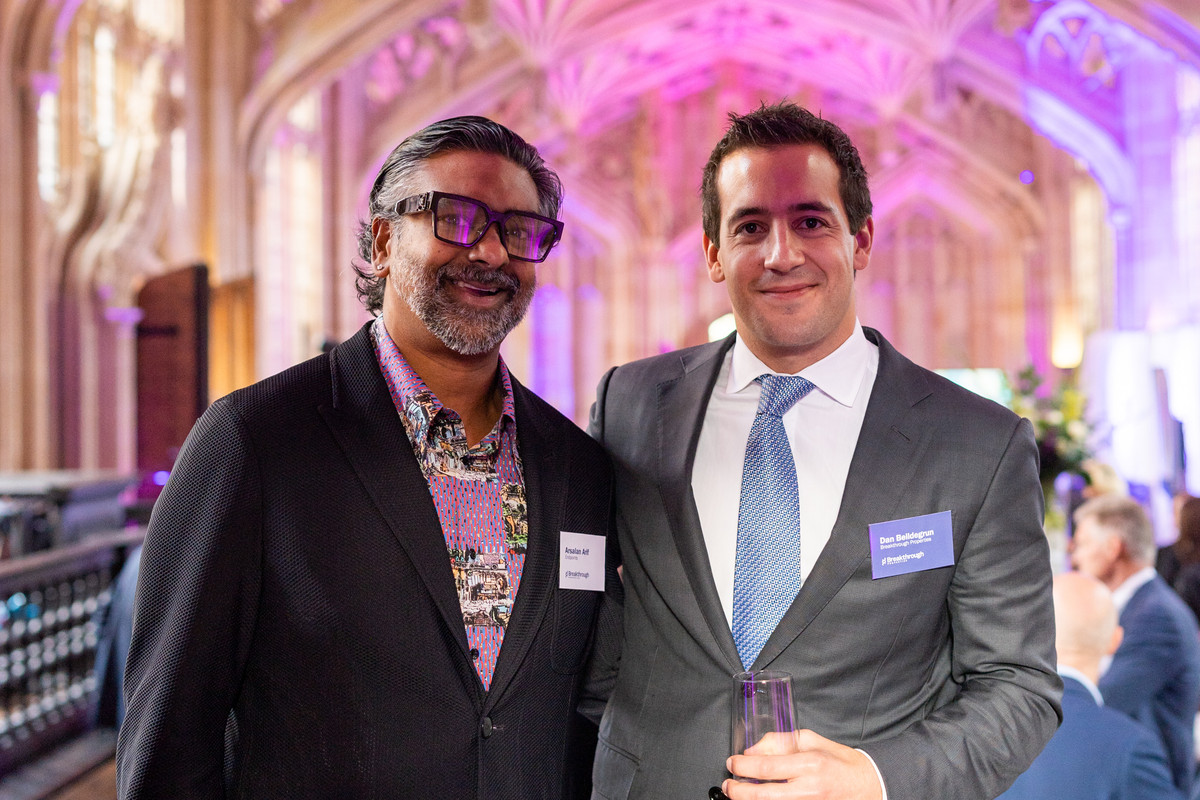
That concern for place also turns up in the details Belldegrun emphasizes: quality architecture, considered interiors, hospitality and creative placemaking. Lab real estate can easily surrender to machinery. There are ducts to hide, loads to carry and regulations to satisfy. Breakthrough's stated ambition is to keep the engineering rigorous without making the finished environment feel like a diagram of its own mechanical systems.
Patience after the party
The life-science property market has tested that ambition. Pandemic-era enthusiasm produced a building rush. Later came slower leasing, more vacancy and the awkward sight of speculative supply waiting for demand. By late 2025, Belldegrun was arguing that some of the clouds over the sector were lifting, while refusing the easy conclusion that every lab project deserved to be built.
His distinction was sharp: the opportunity was no longer broad speculative development. Breakthrough would focus on projects already in its pipeline and backed by tenants, while looking at existing properties available below replacement cost, structured deals and selected manufacturing markets. The company reported $430 million in commitments for its second growth portfolio. Earlier that year, it acquired Muse, a three-building, 186,000-square-foot campus in San Diego's Torrey Pines area, for $159 million.
This is the less photogenic part of a founder's job. A thesis must survive the moment when the market repeats it too loudly. Belldegrun's public position has been to keep faith with the durable need for scientific infrastructure while changing how and where capital is deployed. Conviction, in this version, wears a seat belt.
“Today, we do not believe that the opportunity set is in spec development.”Belldegrun on discipline in a softer property market
AI still needs somewhere to put the beakers
Artificial intelligence complicates the lab-space equation in useful ways. Belldegrun believes it will accelerate drug development and improve its efficacy. Yet faster computation does not make biology entirely virtual. Candidates still move into physical experiments. Samples need handling. Instruments need rooms. At a real-estate investor conference, he argued that AI could speed parts of discovery without replacing the critical infrastructure of laboratory work.
The balance suits him. Breakthrough is built on the merger of fields without pretending one field abolishes another. Technology changes the way research happens; the building must respond. The computer may narrow the search, but eventually someone in protective glasses opens a door.
The building keeps a second set of books
Research buildings are energy-intensive, which makes sustainability less decorative and more demanding. Breakthrough says eligible new construction should target at least LEED Gold, BREEAM Excellent or a local equivalent. Its published goal is whole-building operational net-zero carbon across the global portfolio by 2050 or sooner. Its impact framework also covers resilience planning, utility-data collection and tenant engagement.
Less embodied carbon
One Milestone reported an 18% reduction against comparable new local buildings. Published project figures include a 47% reduction in concrete carbon and a 12% reduction in steel carbon.
At One Milestone, Breakthrough reported an 18 percent reduction in embodied carbon compared with similar new buildings in the area. The work included lower-carbon concrete and design changes that reduced material use. The number is interesting precisely because it is not perfection. It is a measured improvement inside a building type with heavy technical demands. Sustainability becomes a set of engineering choices, procurement choices and operating habits, not an adjective near the reception desk.
The quiet craft of making discovery possible
Belldegrun's career offers a portable lesson. He did not invent a new scientific discipline. He noticed that two mature disciplines had failed to fit neatly together. Institutional real estate knew how to assemble capital and deliver complicated projects. Biotech knew what research demanded. The useful company appeared in the seam.
His own preparation looks obvious only backward: urban studies, large transactions, entitlements, financing, family exposure to biotech. Careers rarely announce which experiences will eventually lock together. His did so in a business where pipes, people, capital and ideas all need to arrive in the right order.
There is also something pleasingly grounded about the wager. Science promises futures that are hard to picture. Real estate insists on bolts, budgets and dates. Belldegrun operates between the two, translating aspiration into floor loads and fresh air. If Breakthrough succeeds, the building should recede at exactly the right moment. The researchers get on with the experiment. The room simply works.