The easiest way to understand Breakthrough Properties is to picture a scientist explaining a wet lab to a conventional landlord. The scientist needs backup power, precise air handling, tissue-culture rooms, chemical storage, vibration control and a move-in date that will not eat six months of runway. The landlord would like to discuss the lobby. Breakthrough was created to make that conversation less absurd.
The Los Angeles company is a 2019 joint venture between Tishman Speyer, the global real estate investor and developer, and Bellco Capital, the biotech investment and company-building firm founded by physicians Rebecka and Arie Belldegrun. Dan Belldegrun, their son, is Breakthrough's chief executive and co-founder. The marriage is unusually literal: one side knows how to finance and erect complicated buildings; the other knows why a biology company cares about where the autoclave sits.
Breakthrough buys, develops and operates laboratory and research properties in science clusters across the United States and Europe. Its named customers range from young venture-backed biotechs to Pfizer, BD Biosciences, CRISPR Therapeutics and Legend Biotech. By late 2025, the portfolio was described as nearly six million square feet. That makes this a story about concrete and capital, certainly. More interestingly, it is a story about packaging expertise so customers can rent it.

01 / The first bet
An $80 million building and a very specific tenant
Breakthrough's first Boston move was not timid. In July 2019, the venture reportedly paid $80 million for a former telecom property at 105 West First Street in South Boston. It broke ground on a speculative conversion before a tenant was secured. A 2020 construction survey listed the project at zero percent preleased. That was the first honest test: could biotech fluency turn an old RCN building into something a serious science company would trust?
Within a year of the acquisition, CRISPR Therapeutics signed for the entire 263,500 square feet. The public lease runs 12 years. Fixed rent begins at $21.08 million a year and steps up to almost $28 million in year 12, before additional operating charges. CRISPR said the building would consolidate several Greater Boston locations and support its expected growth. The 105 opened in 2022 as the company's US research and development headquarters.
The lesson is not that every founder should buy a building on spec. The lesson is that Breakthrough selected a costly, stubborn customer problem that its two parents were unusually equipped to solve together. It did not merely predict that biotech would need more space. It understood what kind of space a fast-growing gene-editing company could not fake.
“Breakthrough came out as someone who was problem solving for us.”Angie J. You · CEO, Architect Therapeutics
02 / The product hidden inside the property
Sell the first experiment, not the square foot
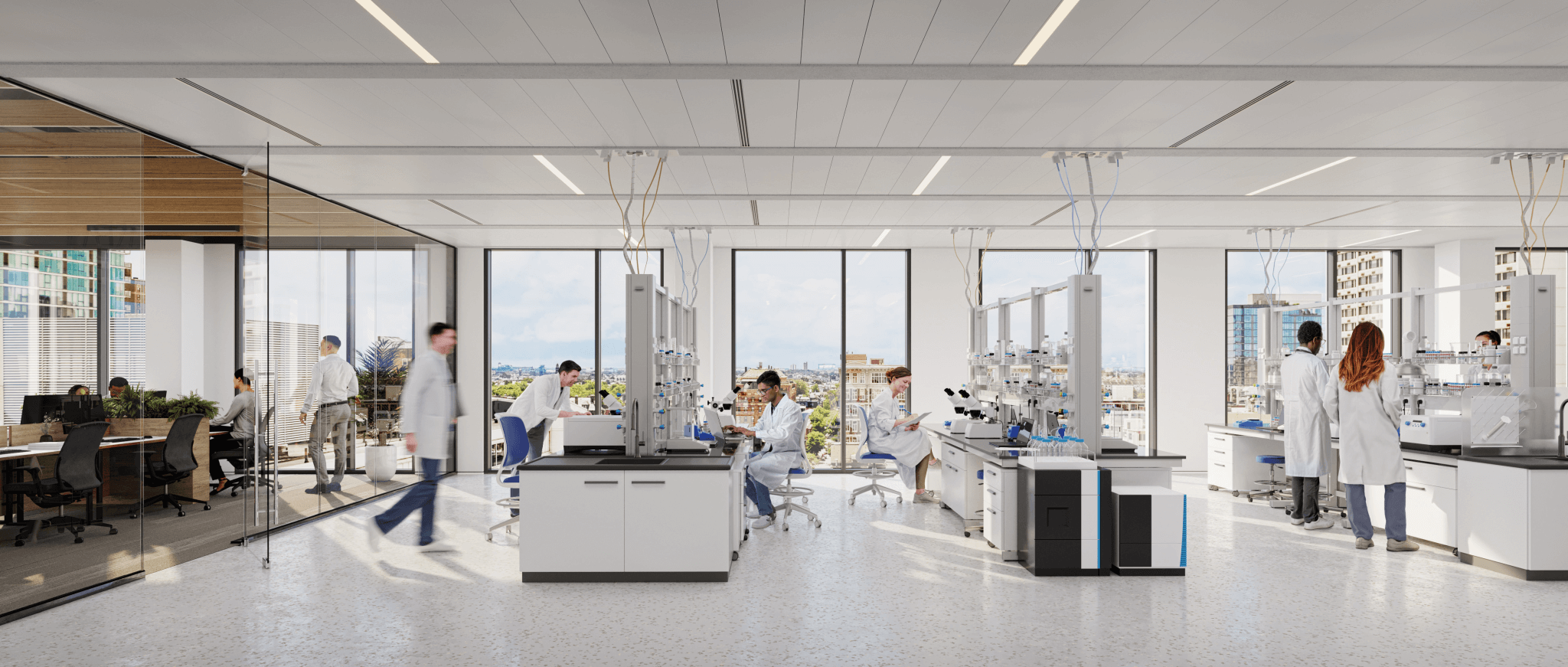
The sharpest expression of the model is StudioLabs, launched in 2022. Its private suites generally run from 4,000 to 15,000 rentable square feet. They arrive with functional wet labs, offices, lab utilities, starter equipment, shared autoclave and glass-wash facilities, backup cold storage, conference rooms and an onsite concierge. Lease terms are shorter than a conventional bespoke lab. The slogan is wonderfully practical: science happens on day one.
That offer targets the awkward graduation between an incubator bench and a permanent headquarters. At that moment, a young biotech may have financing and experiments to run but no desire to become an amateur facilities operator. Every month spent commissioning a lab burns payroll without producing data. Breakthrough absorbs the setup work, then sells back speed and certainty.
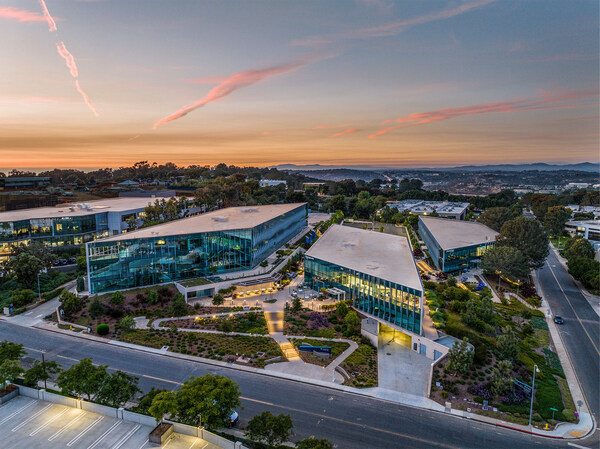
Actio Biosciences illustrates the ladder. It began in a StudioLabs suite in San Diego, then expanded into roughly 28,000 square feet at Torrey View. That campus spans 520,000 square feet and opened fully leased in 2024, with Pfizer Oncology and BD Biosciences among the occupants. Pfizer took 230,000 square feet for 15 years. For Breakthrough, helping a tenant outgrow the starter product is not churn. It is the funnel working.
The company also applies hotel instincts to serious infrastructure. Torrey View has dining, a clubhouse, fitness space, a 400-person conference facility, a pickleball court and storage for bicycles and surfboards. Underneath those photogenic extras are the expensive reasons tenants stay: power, lab systems, adaptable floor plates and operating teams that can discuss workflows without reaching for a glossary.
03 / The boom meets arithmetic
The first thing to fail was the scarcity story
Money loved this thesis. Breakthrough announced more than $1 billion in fund capital and co-investments in 2020. In 2022 it closed its flagship life science property fund with $3 billion, twice the original target, supplied by institutional investors, sovereign wealth funds and wealthy individuals. Capital made the company bolder because customer demand appeared to validate the model: The 105 was full; StudioLabs' first San Diego location was preleased; Torrey View later filled before completion.
Then nearly everybody discovered lab real estate. Developers converted offices, lenders financed projects and a pandemic-era biotech funding surge fed demand forecasts. The sector built for yesterday's shortage. By June 2026, JLL put collective vacancy across Boston, San Diego and the San Francisco Bay Area at 32 percent. CBRE said average vacancy across 13 major US markets had risen above 20 percent after years of overbuilding and sluggish demand.
JLL's combined vacancy figure for Boston, San Diego and the Bay Area. It is market context, not Breakthrough's portfolio vacancy.
There is no public evidence of a signature Breakthrough project collapsing. The more revealing failure was conceptual: “undersupplied” could no longer carry the whole sales pitch. In a tenant's market, a new lab competes against other new labs offering concessions. Premium finishes become table stakes. The landlord must prove that its service, design and flexibility create operational value, not merely nicer photographs.
Breakthrough's response looks less like retreat than tighter selection. Its second growth fund reached a reported $430 million first close in November 2025 - $330 million of commitments plus $100 million of co-investment - against a $1.5 billion target. The fund's stated playbook includes ground-up development, repositioning and acquisitions in established and emerging clusters, with as much as 30 percent eligible for core and core-plus properties through an income portfolio. In August 2026 it used that vehicle to buy a newly delivered, 270,000-square-foot biomanufacturing property near Seattle for a reported $78 million. A glut can punish builders and reward buyers with patient capital.
04 / The transferable bits
Four things worth stealing
Customers happily pay to avoid setup tasks that delay the thing they are actually funded to do.
A starter product works harder when customers can graduate without changing provider, systems or relationships.
Tishman Speyer and Bellco each supply credibility the other could not manufacture with a few hires and a brochure.
In a crowded market, the useful claim is not “premium.” It is fewer lost months, smoother moves and adaptable space.
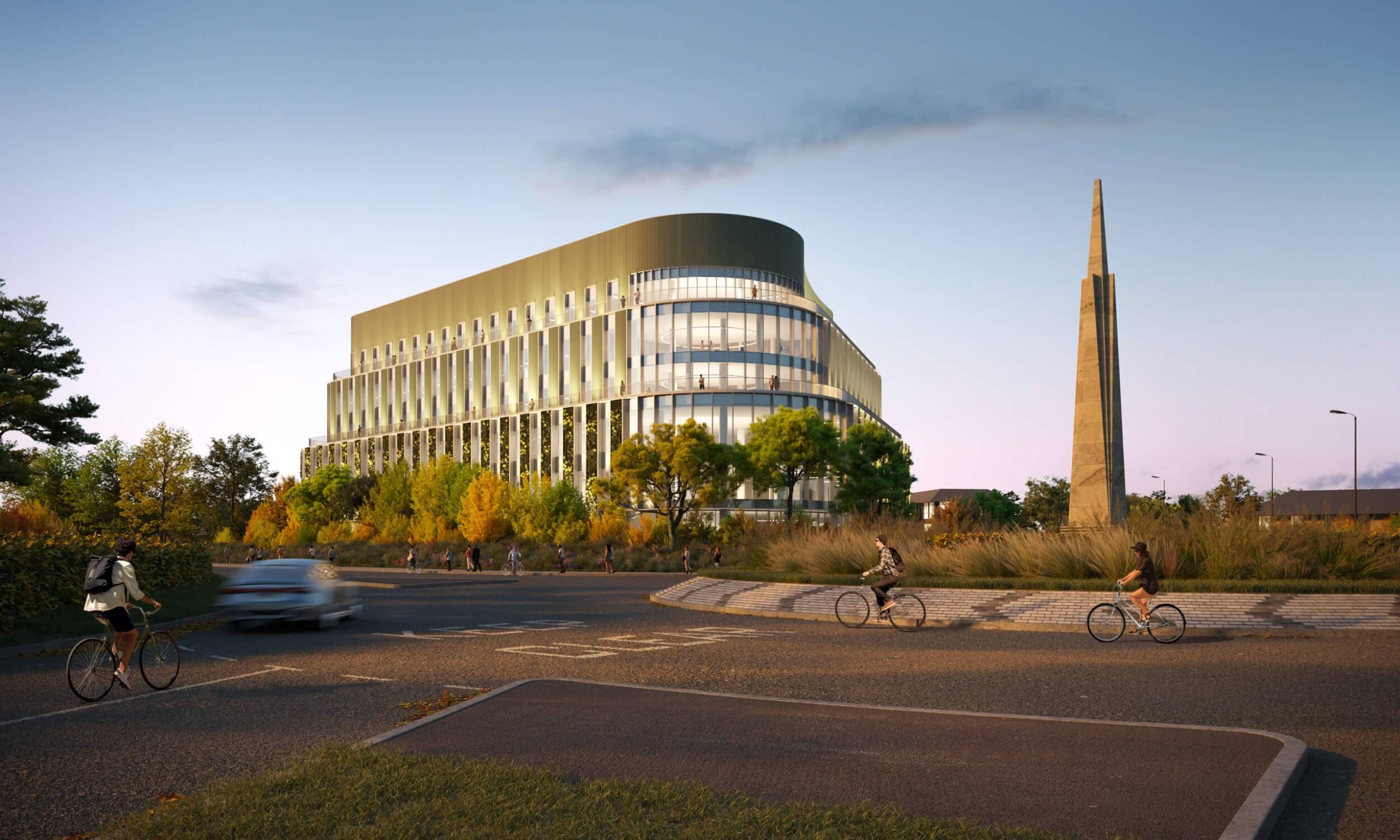
The sustainability work follows the same operational logic when it is concrete. Breakthrough says it targets at least LEED Gold for US developments and at least BREEAM Excellent in Europe, where achievable, and aims for whole-building operational net-zero carbon across its portfolio by 2050 or sooner. Vitrum, its 175,000-square-foot Cambridge, England project, secured a £104 million BGO construction loan and is designed with all-electric heating and cooling. The business benefit is not an abstract halo: energy use, resilience and regulatory performance affect an asset for decades.
This model will not work everywhere. A software team needs neither wet-lab plumbing nor a scientific advisory board. A biotech with stable headcount, strong facilities staff and cheap owner-occupied space may not value concierge service. And in a weak funding cycle, even a perfect laboratory cannot manufacture solvent tenants. Flexible suites also carry furnishing, equipment and operating costs that ordinary offices avoid. The premium must remain smaller than the customer's cost of delay.
That condition is the whole game. Breakthrough is most useful when science is moving faster than real estate: a funded team, an urgent program, uncertain growth and experiments that cannot begin in a laptop. Its buildings are different because the company tries to understand the work inside them. The lab boom may have broken the easy scarcity trade. It did not eliminate the pleasure of a landlord who already knows what a tissue-culture room is.