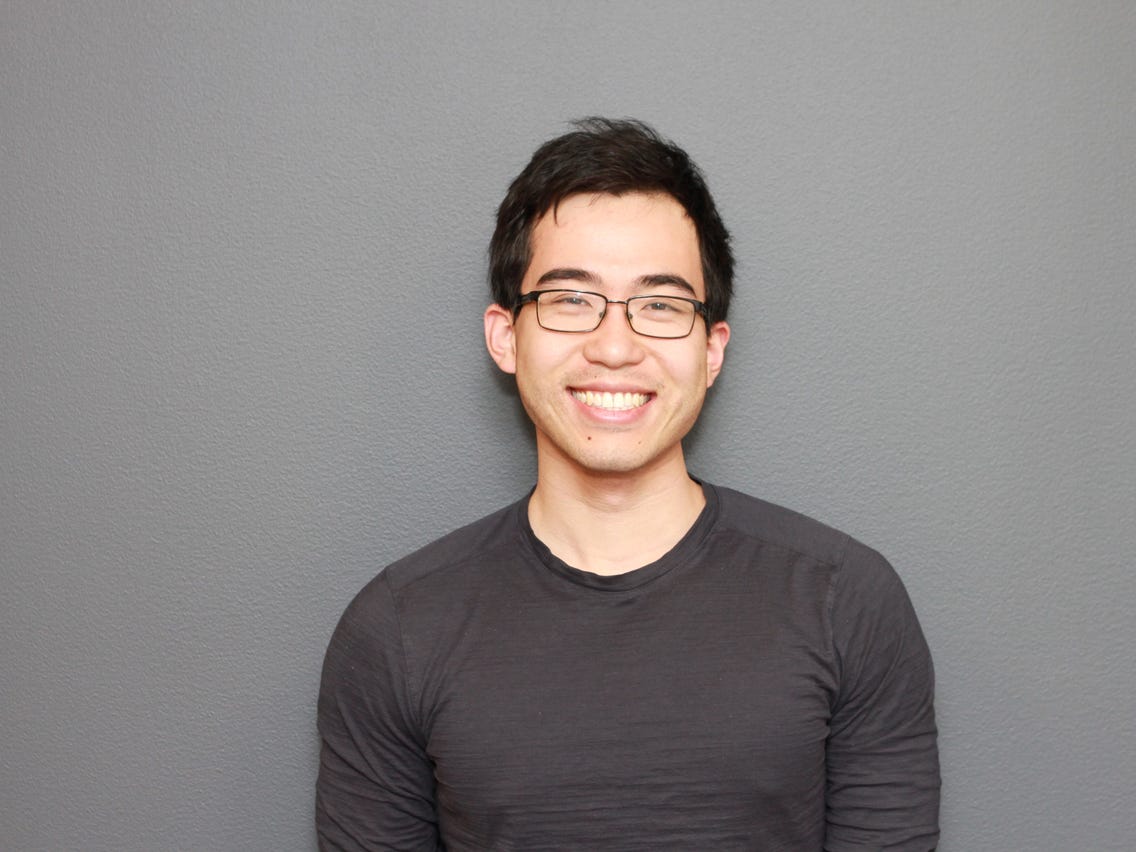
The Architect of Machine Sight
The story of Kiwi - a social Q&A app Kevin Guo co-founded with Stanford classmate Dmitriy Karpman that grew to 100 million registered users - should have been the headline. Instead, the inability to moderate what those 100 million users posted became the origin story of something far larger.
When Guo and Karpman couldn't find AI good enough to police their platform's content, they built their own. That internal tooling became Hive. The social app became a rounding error. By the end of 2017, the pivot was complete: Kiwi was gone; Hive was the company.
"The development of AI-generated media and AI detection technologies must evolve in parallel."- Kevin Guo, CEO of Hive, on the NO FAKES Act (2025)
Hive's founding insight was deceptively simple: the quality of an AI model is bounded by the quality and volume of its training data. While competitors were racing to build clever algorithms, Guo was building something harder to replicate - the world's largest human-labeled dataset. More than a billion pieces of content, assessed and annotated by a distributed global workforce of over 500,000 people. That's not a feature. That's a moat.
The company that emerged from this data-first approach became the invisible infrastructure of the social internet. Reddit trusts Hive to moderate its content. So does BeReal. So does Netflix. When you scroll through a feed and don't encounter certain types of harmful content, there's a reasonable chance that Hive's models made that happen without you noticing.
In April 2021, the market validated the bet. Hive closed an $85 million Series D at a $2 billion valuation - unicorn status - led by Glynn Capital with participation from General Catalyst, Tomales Bay Capital, Bain & Company, and Jericho Capital. The company had grown 300% in the prior year.
Guo brings an unusual educational foundation to a role more commonly held by former engineers or MBAs. He holds three Stanford degrees: a BA in Biology, a BS in Mathematical and Computational Sciences, and an MS in Computer Science. Before founding Kiwi, he was doing biomedical image processing research at both Washington University School of Medicine and Stanford's own medical school. He has more than a dozen peer-reviewed publications in that field. The jump from biomedical imaging to content moderation AI is, in retrospect, not much of a jump at all - both require teaching machines to see and classify visual information with high accuracy.
Between Kiwi and Hive, he did a stint as a Venture Associate at Mithril Capital Management from 2013 to 2015 - the Peter Thiel-co-founded fund - where he focused on enterprise software, consumer internet, and healthcare deals. That window into how investors evaluate companies likely shaped how Guo would later build one.
From Biology Lab to Billion-Dollar AI
When a Fake Photo Crashed the Stock Market
In May 2023, an AI-generated image of an explosion near the Pentagon circulated on social media. For roughly 30 minutes, it was taken seriously by enough people that the S&P 500 briefly dipped. The image was fake. The market movement was real.
Kevin Guo has cited this incident repeatedly as a crystallizing example of why AI content detection is no longer optional infrastructure - it's critical infrastructure. At the 2024 Semafor World Economy Summit, he stated that AI deepfakes represent "a global issue that transcends language and culture" and one that should occupy top-tier concern for every intelligence agency worldwide.
Hive's response has been to build detection into its API stack - the same cloud-based APIs that help clients moderate content can now identify whether that content was generated by AI. It's the same fundamental problem Guo has been working on since Kiwi: teaching machines not just to classify content, but to authenticate it.
"AI disinformation and deepfakes are a global issue that transcends language and culture - and a serious concern for every intelligence agency and government."- Kevin Guo, Semafor World Economy Summit, October 2024
That advocacy extended to policy in 2025 when Hive publicly endorsed the Nurture Originals, Foster Art, and Keep Entertainment Safe (NO FAKES) Act - a bipartisan bill addressing the unauthorized use of generative AI to recreate individuals' voices and likenesses without consent. It's a natural position for a company that has spent years sitting at the intersection of what content is and what content claims to be.
Hive by the Numbers
Achievements
Quotes
"The development of AI-generated media and AI detection technologies must evolve in parallel."
On the NO FAKES Act, 2025"AI disinformation and deepfakes are a global issue that transcends language and culture."
Semafor World Economy Summit, 2024"Content detection is the first line of defense for safer internet experiences."
Hive Company Blog"AI remains very much in its infancy, with few enterprise-grade products available."
Vator.tv Interview, 2018Kevin Guo on Video
Research Sources
- thehive.ai - Official Company Website
- TechCrunch - Hive raises $85M Series D (2021)
- Wikipedia - Hive (artificial intelligence company)
- Vator.tv - Interview with Kevin Guo (2018)
- Semafor - AI Deepfakes Global Concern (2024)
- Inc. Magazine - How AI Fakes May Harm Your Business (2023)
- Contrary Research - Hive Business Breakdown
- SiliconANGLE - Hive raises $85M at $2B valuation
- Hive Blog - NO FAKES Act Endorsement
- YouTube - Forbes: Kevin Guo on AI Decision-Making
- YouTube - Kevin Guo: Impact of AI on Visual Intelligence
- LinkedIn - Kevin Guo
- Crunchbase - Kevin Guo Profile