In February 2026, Keriann Strickland sat at the left end of a career-panel stage at the University of Montana, a microphone resting near her knee. The projected slide behind the speakers promised “Career Pathways,” the sort of phrase that can make a young résumé feel like a railway map: choose the correct track now or spend your life at the wrong station. Strickland offered a more forgiving, and more demanding, idea. Know your story. A grade-point average, a gap between jobs, an experience that looks awkward in a neat chronology - each can become evidence if the candidate can explain the connection.
She asked the students to show how a GPA could serve as evidence that they would succeed in a specific role. Then she widened the assignment: What did that gap on the résumé teach you? How might it serve you in a way another candidate's unbroken line could not? “I want to see you drawing those connections.”
It was hiring advice from Submittable's chief marketing officer. It was also the compact theory of her own career. Reporter. Instructor. Managing editor. Education-technology marketer. Content strategist. Product marketer. Executive. The titles look assorted until the connecting line appears: Strickland has spent her working life deciding what matters, for whom, and how to say it so another person can act.
“I want to see you drawing those connections.”Keriann Strickland, speaking to University of Montana students in 2026
The newsroom never quite left
Strickland was born in Billings and studied print journalism at the University of Montana. Early in her career, she reported for the Flathead Beacon and helped launch a newspaper in Montana. A launch is a useful education in the difference between admiring an institution and building one. Someone must fill the blank page, meet the deadline, verify the name, and do it again tomorrow. The romance of print gets very practical by press time.
She later described herself as a “recovering journalist,” which is a tidy joke with an untidy truth. Recovery appears incomplete. The newsroom's habits followed her: curiosity before certainty, specificity before ornament, and a suspicion of sentences that are dressed for a gala but have nowhere useful to go. An old Submittable biography added two more details, calling her a mountain lover and a “gifted spiller (and speller).” The parenthesis does a surprising amount of character work.
Journalism also gave her a durable subject: other people's working lives. By 2013, she was a senior features editor at I Want Her Job, a publication devoted to conversations with women about careers they loved. At the same time, she publicly called herself a side-hustle addict, stacking freelance editing, writing, and content strategy alongside her day job. There is glamour in the phrase “portfolio career.” There is also a laptop open after dinner.
The working edit · four accumulating chapters
The classroom became another place to test whether an idea truly traveled. Strickland earned a master's degree in communication studies at the University of Utah, later adding graduate work in integrated marketing, and taught there as an adjunct instructor. Teaching punishes fuzzy understanding. If the explanation falls apart at the lectern, the idea was never as finished as it looked in the notes. A future marketing leader could hardly ask for a better rehearsal.
Building the function before leading it
Before Submittable, Strickland joined Waterford.org as one of the first two people hired to build its marketing team and strategy from the ground up. That phrase can sound grand on an executive biography. In practice, “from the ground up” means the ground is often where the work is lying. Strategy and execution share a desk. The person planning the system is also naming the file, fixing the sentence, and deciding what can wait until Tuesday.
This is where a reporter's range becomes an operator's advantage. Small teams cannot afford preciousness about job descriptions. They need someone able to interview an expert, understand a product, shape a message, make a plan, and notice that the call-to-action button has developed delusions of invisibility. Strickland's route through reporting, editing, teaching, and content strategy gave her the complementary skills that tidy corporate ladders sometimes separate.
In 2018, she joined Submittable in Missoula. Her early public biographies there placed her in content and branding; contemporary records listed her as senior marketing manager. Other professional profiles trace the progression through director-level product and content marketing and vice president of product marketing. In October 2021, she became chief marketing officer. Today her brief includes both marketing and sales development, placing the promise a company makes beside the conversations that test whether buyers believe it.
The scale around that brief is unusually human. Submittable's customers use its software to manage grants, scholarships, applications, employee giving, and other programs in which a form is merely the front door to a consequential decision. The company says its customers have managed more than $5 billion in funds, supported more than 200,000 programs, and received more than 30 million applications. Those numbers are not Strickland's personal trophy case. They are the size of the translation problem her team must solve.
Software language loves abstractions: workflow, intake, review, automation. The people on the other side experience hope, judgment, funding, acceptance, and rejection. Marketing this category requires explaining the machinery without forgetting why anyone approached it. Here the former journalist's instinct is useful again. Institutions speak in systems. Readers listen for stakes.
Reporting finds the detail. Teaching tests the explanation. Product marketing connects a capability to a need. Executive leadership makes the connection repeatable across a team.
Montana is part of the operating model
Strickland's public biographies keep returning to mountains. She is described as happiest near them, working from Submittable's Missoula office. It is a small personal note that has survived several job titles, perhaps because it explains more than the standard executive adjectives. Place is not a decorative background in her story. It is a constraint she turned into a design choice.
Technology careers are still commonly narrated as departures: from the town that raised you toward the cluster that validates you. Strickland's route leaves Montana, for graduate school and work in Salt Lake City, then curves back. Submittable itself was founded in Missoula and now employs people across the United States and in India. Her C-suite seat therefore carries a local example: ambitious work can be built from a city better known for rivers and ridgelines than venture jargon.
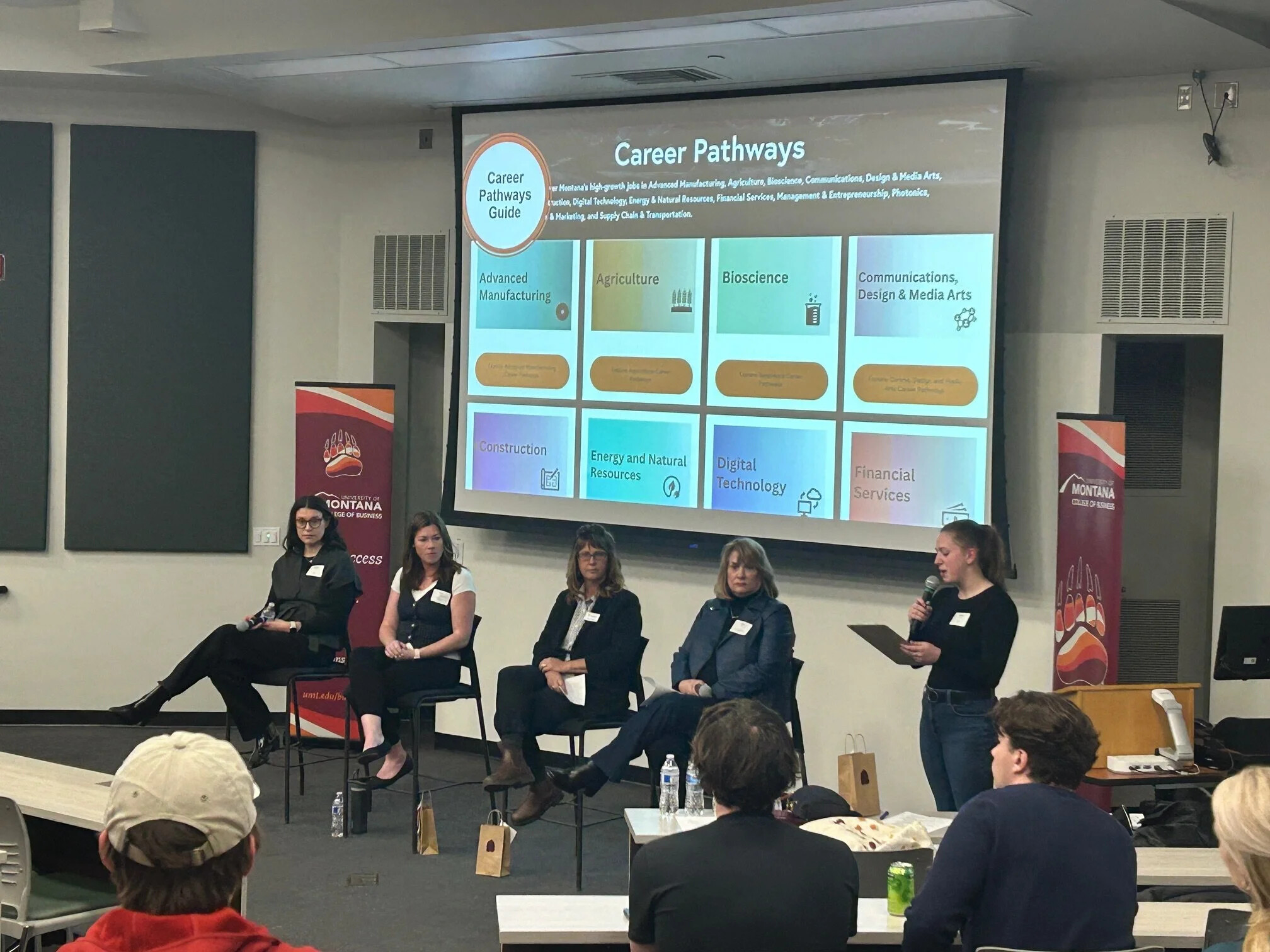
Her involvement with the Montana Jobs Network turns that example outward. The network's leadership page notes her support as a donor in 2024 and 2025, describes her commitment to empowering women in leadership, and places her among people working to expand technology opportunity in the state. Then came the 2026 student panel. She did not offer a secret handshake into the industry. She asked students to practice, take the risk of rejection, and interpret their own experience.
That last instruction is firmer than the usual encouragement to “be yourself.” The self does not arrive in an interview pre-edited. A candidate must decide which detail earns space, which connection needs stating, and which apparent weakness contains useful evidence. Authenticity, in this account, still requires preparation. Candor is not the enemy of craft.
The line that holds
Strickland's professional story is not a fable about following one perfect plan. The record is busier and more believable: overlapping roles, graduate study, freelance work, a return to Montana, and a climb inside a company whose market evolved around her. She has worked in journalism, higher education, education technology, and software. The continuity lies less in sector than in method.
She listens for the actual problem. She draws a line between experience and need. She makes language carry its share of the load. Even her public humor follows the pattern. When a colleague called her a pro in a post promoting a Submittable production, she replied that perhaps she was not a professional actor and should stick with marketing. An executive title need not confiscate the aside.
In the old newsroom formulation, every story needs a nut graf: the paragraph that tells the reader why the surrounding details belong together. Strickland's appeared years before the C-suite and remains visible now. The job has always been translation with consequences. First for readers, then students and customers, now teams and markets. The medium changed. The editor stayed.
That is why “know your story” lands as more than panel advice. A career will hand you facts. Some flatter; some confuse; a few look like detours until much later. The work is not to pretend the line was straight. It is to understand what the bends taught you, then tell the truth clearly enough that someone else can see the route.