Kate Austin arrived at the 2013 business awards ceremony with a run in her pantyhose, a wrinkled shirt and a reasonable expectation that somebody else would win. Seated beside marketing entrepreneur Sara Mannix, she confessed that she had no speech ready. Then Advokate’s name was called.
The Adirondack Regional Chamber of Commerce had named her company Independent Business of the Year. Austin went to the podium and produced an acceptance speech whose central finding was that she did not know what to say. Back home in writing, however, she had quite a lot. There were thoughts about wearing the plaque as a crown, gratitude for the people who had helped, and a gleefully grand telephone call to her father.
Recognition had caught up with her before her ceremonial manners did. The episode is a useful introduction to Austin: delighted by the work, conscious of her own awkwardness, willing to let both appear in public. Her company helps other people present themselves. Its founder has never been especially committed to sanding herself smooth.
“I don’t know what to say.”
Kate Austin, recalling her 2013 acceptance speech
An Atari education
She grew up in rural Killington, Vermont, with woods, bicycles, a sister and a computer. Her father was an early Atari owner. The machine offered another kind of landscape, one with puzzles, adventure games and considerably fewer rules about bedtime.
Austin wrote stories and newsletters with Creative Writer and made pictures in Microsoft Paint. Later came business games: Lemonade Stand, RollerCoaster Tycoon and the rather less school-approved Dope Wars. She eventually recognized their lessons in her working life. Watch costs. Listen to customers. Reinvest when you can afford it. Keep enough people around to do the work without exhausting the budget.
College followed an indirect route. She left art school, spent two years in AmeriCorps and later completed her degree at Empire State College. The interrupted route became part of the story she could tell students considering their own next steps.
The games did not supply a business qualification. They gave her repeated practice at making decisions and seeing consequences. Years later, she compared the competing demands of client work to Diner Dash. Anyone who has tried to answer messages while finishing three jobs may recognize the resemblance, even without having played.
The trouble with being busy
Before Advokate, Austin worked at The Chronicle in Glens Falls. When she was preparing to leave, its founder, Mark Frost, suggested that she start a business. She completed SUNY Adirondack’s microenterprise program and registered Advokate in October 2010. Seven clients and an old laptop were enough to begin.
October 2010
Recalled in 2015
Her first-anniversary account contains an awkward combination: plentiful work and dwindling money. Her SCORE mentors examined the finances. There were expenses she had not properly allowed for, including taxes, insurance, promotion and a wage for herself. Small rate increases helped keep the business going.
It was an education in the difference between being wanted and being paid enough. Enjoying a task could make it harder to recognize its value. Austin had to learn to charge for work she found pleasurable, while still serving people whose budgets mattered to her.
By the first birthday, she reported more than 70 customers. She also described skipping to her car after a successful meeting and celebrating a check arriving in the mail. The business was taking shape through invoices and referrals, with occasional choreography. Her early ambition was a workable livelihood doing useful things, rather than a vast corporation. That left plenty to learn about running the smaller one.
A place at the same table
One of the relationships that helped define her work began with an Etsy class. Batik artist Carol Law Conklin needed help getting her art online. Austin could supply the technical knowledge, but the arrangement became more sustained than a lesson followed by a polite goodbye.
They met regularly, working alongside each other. Early sessions happened around a modest laptop at Austin’s dining table. Over time, the questions moved through websites, images, newsletters and the ordinary digital complications of an artist’s working life.
Conklin’s Amity Farm Batik gave its name to Advokate’s Amity consultation program. A particular person’s needs had helped suggest a service. There is something revealing about that order of events. Austin could see what people needed because she spent time close enough to watch them work.
That closeness also gave the relationships room to become friendships. Her account of Conklin includes visits to the farm and its cow, Steppin. The computer work belongs in the business history. So does the willingness to keep showing up, week after week, for the questions that do not arrive neatly packaged as a project.
The arrangement remains recognizable in Advokate’s current approach. A first consultation costs $25. Clients can leave with work divided between what they can do themselves and what the studio can handle. The size of the assignment can follow the need and the budget.
The yellow building and the closed shop
Austin’s attachment to Glens Falls has never made every business decision easy. She ran a boutique at The Shirt Factory and imagined taking it downtown. Local handmade goods would give people another reason to shop in the city. It was an appealing idea with an uncooperative set of economics.
Her SCORE advisers brought her back to the profitable core: marketing, design, websites and public relations. She closed the shop in 2015 and worked from home. Returning artisans’ work and taking down custom curtains felt painful. She worried that operating from home would make the company easier to overlook.
In April 2016, she described finding an upstairs room at Milk & Honey on Exchange Street. She loved its light, floor, chimney and ceiling. The street held friendships and earlier jobs, with Rock Hill nearby as a familiar gathering place. There was also one architectural consideration that received its own delighted announcement.
“And, you guys. The building is YELLOW.”
Kate Austin, on finding the Exchange Street office
The episode gives ambition a physical address. She wanted a business that belonged in the town she loved, and a room that felt like hers. Getting there involved closing something she had loved, too.
In 2022, Advokate moved again, to Glen Street. This time the attractions included elevator access, two private offices and a conference room. Affection for a place had acquired some practical specifications.
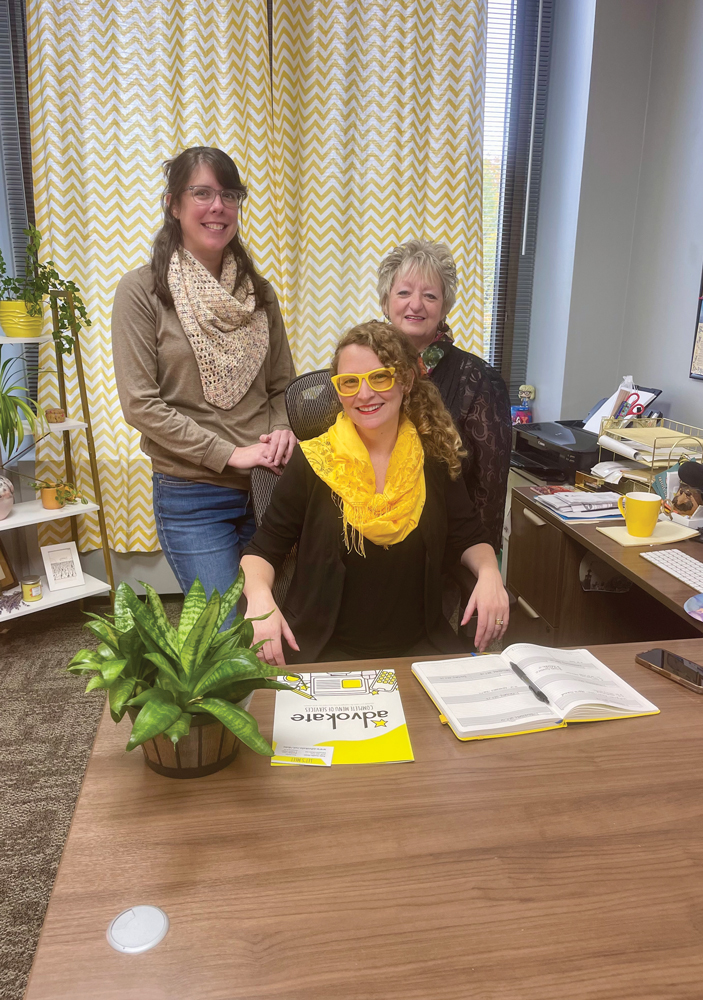
Sheila joins the company
Austin has a way of giving office life a soundtrack. When she acquired a water cooler at The Shirt Factory, she named it Sheila, after Ready for the World’s “Oh Sheila.” Owning the appliance made her feel like a proper business. Apparently the org chart had room for someone who dispensed water.
Her 2019 work playlist also remembered Friday billing sessions accompanied by Bachman-Turner Overdrive’s “Taking Care of Business.” Classic rock connected work with her father’s construction business back in Vermont. Petula Clark’s “Downtown” became a walking-to-work song. She taught her children the echo so the performance could become a group effort.
Music eventually entered the service list. In December 2020, Advokate announced jingles. The team could draw on singing, guitar playing, writing and audio production. It was another instance of available talents becoming a way to help a client.
Her explanation of the company’s adaptability borrowed from her children’s cartoon, My Magic Pet Morphle: a character changes form to solve the problem in front of it. Austin saw a resemblance to the business. A request could lead to another capability, provided someone worked out how to do it.
There is an artist’s habit in that willingness to try materials. Her own mixed-media practice includes ink, salt, cheesecloth and found objects. She also makes jewelry from discarded bits. The artist statement on her NorthCountryARTS page is a single, entirely serviceable word: “Wheeee!”
A city full of unfinished ideas
The other recurring material in Austin’s work is Glens Falls itself. Her involvement has included arts organizations, event promotion, downtown business groups and a stint as interim director of the World Awareness Children’s Museum. The company and the volunteer work repeatedly bring her into the same rooms.
In May 2025, she returned to a gathering from nine years earlier. Rich Cirino had led an Ideas Night at Davidson’s in 2016. People wrote suggestions on Post-its and put them on the window. Austin photographed the gathering and later republished the collected ideas.
The list was wonderfully municipal: murals, bike rentals, more trees, community gardens, better connections between places. It included proposals for a more walkable city and more chances to gather. Some ideas had come to fruition; others remained available for someone to pursue.
An editorial grouping of proposals Austin preserved and republished in 2025.
Preserving that list is a modest act, but a characteristic one. A town’s good intentions can disappear with the end of the meeting. Austin kept a record that people could return to and use.
Teaching provides another route for passing things on. She returned to the entrepreneurship program that helped her start, this time presenting marketing to new business owners. The student had become someone able to explain the next set of practical problems.
Room to keep doing it
In 2023, Assemblywoman Carrie Woerner recognized Austin as a Woman of Distinction. In October 2025, Advokate celebrated its fifteenth anniversary with a client showcase, music, refreshments and remarks from local representatives. The celebration gave the people around the company a place in its milestone.
A January 2026 radio profile found Austin reflecting on the mix of work she had built. “It’s creative, it’s never the same,” she said. She described learning to bring in people with complementary talents, allowing the business to involve more than her own individual effort.
The civic work continued, too. In March 2026, the city council approved her nomination to the Business Improvement District board for a term running through 2028. There would be more meetings, more local decisions, more of the patient work that surrounds a lively downtown.
The woman who once arrived without an acceptance speech has had years to explain what she is doing. Her career gives plenty of concrete answers: a website finished, an artist helped, a business introduced, an old list brought back into view. There is still room for the next request. And, when the billing is done, perhaps a song.