Karl Murphy wanted another car wash. He had bought one in Cary, North Carolina, in 2003 and built a second in Apex in 2006. Another plot of land, another building: the expansion plan had a reassuringly solid shape. Then the financial crisis made borrowing difficult, and the next building stayed an idea. Murphy eventually tried something with considerably less concrete. In 2011, he sent a single truck to the customers.
A truck is a modest answer to a financing problem. It also changes the question. A car wash owner usually asks how to bring more drivers through the entrance. Murphy was beginning to ask whether the entrance needed to feature in the transaction at all. By the end of 2012, his mobile operation had three vehicles. People still wanted clean cars. They were less enthusiastic about arranging their day around obtaining one.
“I needed to go out to my customers.”
Karl Murphy, recalling the mobile service’s beginnings
That decision runs through Murphy’s career at Spiffy, the company he co-founded with Scot Wingo in 2014 and has led as CEO since August 2024. Its work now reaches beyond washing cars to the software, equipment and operating knowledge that help dealerships deliver service away from their buildings. Murphy’s story follows an unusually tangible business problem: how much of the workshop can you put on wheels?
Eighteen hours to get moving
Long before the vans, Murphy worked with a different kind of deployment. His route into the Army began with ROTC at Georgetown University. He served as a rifle and scout platoon leader in the 82nd Airborne Division’s 3rd Brigade during Operations Desert Shield and Desert Storm, with postings that included Fort Bragg, Saudi Arabia and Iraq.
As his unit’s Air Operations Officer, Captain Murphy was responsible for preparing the airborne deployment of more than 3,000 soldiers and 200 vehicles, anywhere in the world, on 18 hours’ notice. That responsibility gives the word “logistics” some weight. Equipment, people and timing have to agree with one another. An excellent plan is of limited use if the equipment is elsewhere.
His civilian career included selling enterprise software and technology products at Parametric Technology, Abbott Labs, Geomagic and Plurimus. Then came ownership of Carolina Auto Spa. The sequence put him in contact with software buyers, vehicle owners and the practical work of running a service business. Spiffy would eventually bring those experiences into the same enterprise.
The customer was already somewhere else
The first mobile operation still relied on customers booking by telephone or in person. Taking the wash to a driveway solved one inconvenience; arranging the visit could still involve the familiar business of calling someone and hoping the diary cooperated. Murphy and Wingo developed an app to make booking and payment easier. Wingo brought experience from ChannelAdvisor and an interest in services coordinated through phones.
The launch operation had about ten vans, carrying the supplies needed to wash a vehicle where it stood. A special mat collected the water used during the job. The arrangement mattered in shared parking facilities: a service that arrives in someone else’s space has to account for what it leaves behind. Convenience for the driver could hardly depend on creating a nuisance for the property manager.
- 2003Buys a car wash
Cary, NC - 2006Builds a second
Apex, NC - 2011Goes mobile
One truck - 2014Co-founds Spiffy
App-based booking
The physical work also placed a useful limit on the app analogy. Someone still had to turn up, handle the vehicle properly and do the job. From the beginning, Murphy and Wingo agreed that Spiffy technicians would be employees rather than contractors. The company tied that decision to consistency, and described an initial training program of 100 hours at Spiffy University.
There is a pleasing inconvenience in that choice. A business selling an easier experience to customers accepts considerable work on its own side: hiring, teaching and coordinating the people who deliver it. The screen can make a booking look effortless. The training helps make the appointment live up to the screen. A clean interface has never, by itself, cleaned a car.
A deal measured in highway miles
Murphy’s work also brought him into the lives of other founders. When Spiffy was considering the Tennessee mobile oil-change business Pit Crew, he went to see its operation with two regional managers. The proposed itinerary sounded orderly enough: arrive in Knoxville, inspect the warehouse, drive to Nashville and Memphis, and leave from Memphis.
Across Tennessee, however, the word “drive” does quite a lot of work. The route meant roughly eight hours on Interstate 40. Pit Crew co-founder Adam Major recalled the dawning realization that the group would spend almost the entire day in the car. Facility visits had to fit around the considerable activity of getting to the next facility.
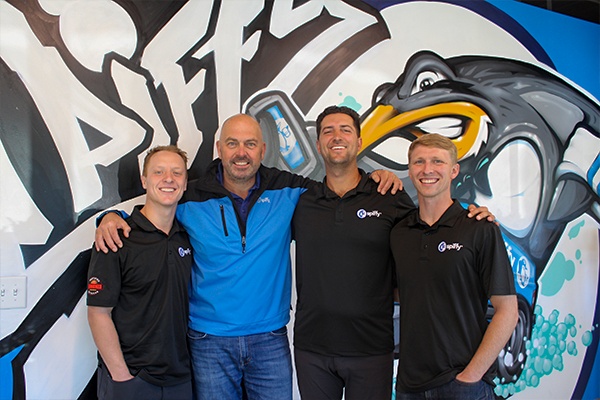
It became a shared experience rather than a failed itinerary. Collins compared the feeling by the end to The Breakfast Club. Later, a planned half-hour interview with Murphy and the three Pit Crew founders stretched to nearly four times that length. The acquisition story contains financial and strategic decisions, certainly. It also contains people discovering whether they could bear a long day together.
Murphy described his partnership with Wingo as a process of reaching agreement on consequential decisions, sometimes by persuading one another. For Pit Crew, the ability to work with its founders mattered. He also talked about helping them find satisfying roles after the acquisition. Joining a larger company would give them room to specialize after the broad responsibilities of running their own business.
Giving the microphone to the crew
That interest in people’s working lives had another outlet: Operations Underground, the podcast Murphy hosted for Spiffy. Its opening interview featured Max Carrera, a Los Angeles technician who had joined in June 2017. The premise gave employees across departments a place to describe where they came from, what they did and how their careers were developing.
The geography made the idea practical. When the podcast was introduced, Spiffy described a workforce of more than 550 technicians across over 40 markets. Those were the company’s figures at that point, rather than a headcount for today. A technician on one coast would have little ordinary reason to meet a colleague on the other. An interview could introduce them without a flight.
A separate account from Orlando supervisor Severnia Wynn offered a view of access to leadership. She described being able to call Murphy and other senior colleagues when she needed help, and remembered interviewing with the company’s president and vice president. Her account makes a concrete claim about support: she knew whom she could contact. That is something an employee can actually use.
In January 2023, Spiffy also described opportunities for technician development through ASE certification, tuition reimbursement, cross-training and mentorship. For a founder whose business depends on work done far from his desk, the person beside the customer’s vehicle carries considerable responsibility. Investing in that person is an operational decision with a human consequence.
The title changes; the problem travels
On August 16, 2024, Murphy succeeded Wingo as CEO. Wingo remained on the board. The transition came a decade after the company’s founding, with a co-founder already steeped in sales and operations taking charge. Murphy publicly committed to continuing their work, developing the company and serving its customers.
Wingo described the handover alongside a shift in priorities that included devices and software as well as the service business. That put Murphy in charge of a company offering other operators some of the machinery behind its own work. A dealership could buy help taking service to customers rather than create every piece of the operation itself.
By 2026, Spiffy described its platform as combining software, purpose-built van equipment, connected diagnostics, training and consulting, informed by four million completed mobile services. The components are revealing. A van needs tools; a technician needs a workable schedule; a manager needs to understand what the work produces. Selling the combination asks the company to make its experience useful to somebody else.
Schedule the workVan equipment
Carry the workshopTraining
Prepare the team
A diagram of Spiffy’s operating model, not a measure of financial performance.
Murphy’s own writing makes the commercial argument explicit. In “The Convenience Premium,” published in June 2026, he uses ordinary purchases, from delivered food to laundry services, to examine why customers pay to avoid doing a task themselves. Applied to vehicles, the attraction is recognizable: maintenance happens while the owner continues with the day.
In another essay, he argues that mobile service should make commercial sense beyond manufacturer incentives. His example uses a dealership’s reported results to examine the operation’s economics with and without those payments. It is a more demanding discussion than merely counting vans. Equipment can be purchased once; productive work has to be organized again tomorrow.
Somewhere to sit still
There are quieter details in Murphy’s account of life in the Triangle. In a 2020 interview, he named Caffè Driade as his favorite coffee spot, describing its espresso machine and setting beside green space in Chapel Hill. He also mentioned sunset drinks on the Durham Hotel’s rooftop followed by pizza at Pizzeria Toro. Living in Chapel Hill, he joked about Durham’s appeal as an excursion.
His public response to a 2025 video about Spiffy had a similar willingness to puncture the occasion. He thanked his team and the filmmakers, then supplied a brief review: “the acting is ok, and the actors need help.” A founder appearing in a company film is allowed a little quality control.
The work keeps returning to the same practical observation. People have places to be, and the service they need does not always have to make them leave those places. Murphy first acted on it with a truck when another building was difficult to finance. Years later, the question remains useful: if the customer is already somewhere else, what would it take to meet them there?
Follow the route
- Spiffy / Company website
- Karl Murphy / LinkedIn
- The early days / A car wash takes to the road
- The Pit Crew conversation / A Tennessee acquisition
- The Download / Murphy’s 2020 interview
- The handover / August 2024 CEO announcement
- Watch / On The Ground with Karl Murphy
- YouTube / Operations Underground with Max Carrera
- Read Karl / The Convenience Premium
- Read Karl / The economics beyond incentives