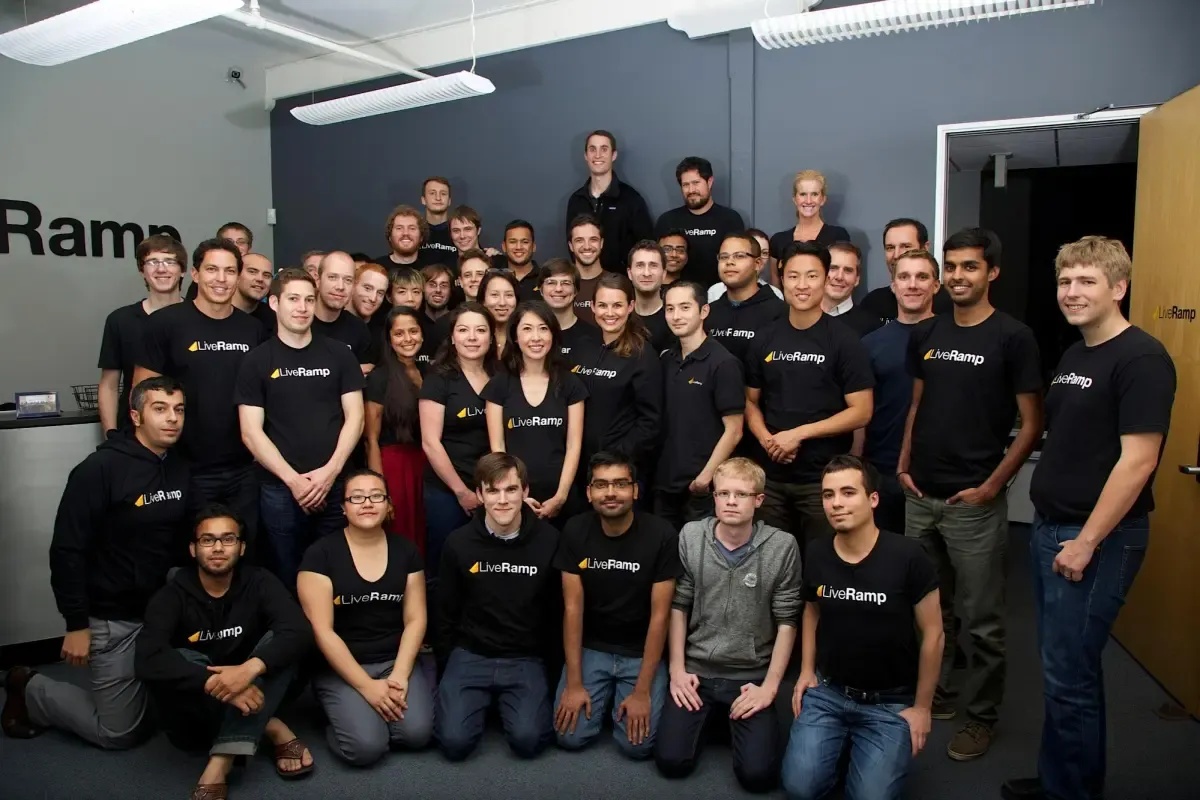
A group photograph can be a surprisingly patient business document. The LiveRamp team, gathered in its San Francisco office around 2014, wears the company name across a small forest of black shirts. People stand, kneel, lean in. It has the cheerful logistical difficulty of any office photograph: everyone must fit, and somebody has to surrender the comfortable chair.
Ten years after Acxiom acquired LiveRamp, Travis May returned to that early team. More than half of the first 40 employees, he wrote, had become startup CEOs or executives at larger companies. His pride settled on the alumni network: people still in touch, still brainstorming, investing, and starting things together.
May had helped build a business connecting data. The people had formed a network of their own. Both kept working after the photograph was taken. That parallel is a useful place to begin with the founder of Shaper Capital and cofounder of Protege, whose career repeatedly brings him to the space between things that ought to connect.
An early business in making introductions
Before there were data platforms, there were students with ideas and trouble finding the right people. At Harvard in 2007, May and Vivek Ramaswamy cofounded StudentBusinesses.com. The site connected aspiring student entrepreneurs with the entrepreneurial ecosystem. They also developed two supporting software products. In 2009, the Kauffman Foundation bought the business and later rebranded it iStart.
The problem already had the outline of May's later work. Useful things existed on both sides: ambition here, expertise and resources there. They needed a route to each other. A university can put many clever people within walking distance without making the necessary introduction. Geography is helpful; it rarely does the entire job.
May graduated from Harvard in 2009. He studied economics and mathematics, earned magna cum laude and Phi Beta Kappa honors, and had been involved in student entrepreneurship. His education supplied a vocabulary for markets and systems. The student business supplied practice in arranging encounters that a market was failing to arrange by itself.
There is something pleasingly consistent about that beginning. The earliest venture in this story concerned access to people. The later ones concern access to data. In either case, possession and availability are different matters, and someone has to do the work of bringing them closer.
The gap on the balance sheet
May cofounded LiveRamp with Auren Hoffman in 2011. Its work included data onboarding: making offline information usable in the digital marketing world. Acxiom acquired it for $310 million in 2014. By 2015, May was its president and general manager within Acxiom.
He described a retail landscape accumulating more ways to reach customers and more tools that needed integrating. Loyalty programs, stores, mobile devices, and advertising generated useful information in different places. A retailer wanted to understand the whole picture. Each additional tool could create another disconnected piece of it.
This is an awkward side effect of progress. Buying a useful system can improve one department while adding another translation problem for everybody else. The software has done what was promised. The organization still has to make the pieces speak.
May's interest lies in that inconvenience. The gap has an economic value if closing it saves enough work or makes enough new activity possible. Founding Datavant in 2017 gave him another company-building experience; Shaper would later make the accumulated lessons an explicit basis for building across industries.
Acxiom's acquisition price for LiveRamp in 2014.
By 2016, Forbes had included May in its 30 Under 30 marketing and advertising list, and Ad Age had named him to its 40 Under 40. The recognition arrived while the practical question remained the same: how do you make a connection useful enough that people keep relying on it?
A network needs somewhere to start
May's explanation of a network business begins with a familiar experience: a payment card is convenient when many merchants accept it. Acceptance attracts users; users make acceptance worthwhile. A data network has a related problem. Early participants need a reason to join before everybody else has arrived.
His operating vocabulary includes nodes and edges: participating organizations and the relationships between them. Counting both gives a team something more specific to pursue than a distant ambition to become ubiquitous. One new organization matters. So does one new connection between organizations already present.
He advocates beginning with a narrow network and a narrow set of features. A smaller community can become useful sooner. The grand ambition remains in the distance while the first group gets something that works. A dinner party with six guests can begin; a dinner party waiting for everyone in the city will serve very cold food.
At LiveRamp, he recalls, roughly 80 percent of revenue came from five channel partners when the company reached $30 million in annual recurring revenue. Partnerships helped the network spread. The route to the customer could be indirect if it made the whole system more valuable.
“Network density becomes the killer feature for network businesses.”Travis May
He is also particular about which connections can sustain a business. Reusable integrations, difficult integrations, and customers who need a common identifier feature in his analysis. Connecting two things once may be useful. Building a connection that many customers can reuse changes the economics of the work.
Fifty companies, one finite calendar
When May introduced Shaper Capital in September 2023, he set an aspiration: at least 50 companies over ten years. Shaper would cofound businesses with CEOs and help build them, drawing on experience with data fragmentation and middleware. He intended to work deeply with several businesses while each had a founder-CEO committed to it.
The scale of the ambition creates a mundane difficulty. Fifty companies require people, decisions, and attention. A calendar is an unsentimental opponent. It recognizes neither conviction nor an attractive slide deck.
In Shaper's second-year reflections, May described roughly 80 percent of his job as recruiting. One planned Special Projects hire had become three because he encountered enough promising candidates. The experiment expanded into a Builder-in-Residence program, with people working across portfolio companies before finding a fit.
That year, Shaper launched no new companies. It concentrated on the six already underway. The restraint is revealing beside the original numerical ambition: involvement was part of the model, and involvement takes time.
Shaper's partner Elyse Jones Benedicto describes the first ten hires as setting a company's pace and standards. The central team helps with the work surrounding those hires, including sourcing, scheduling, evaluation, and closing. Its contribution begins when a young company has little external evidence to offer a candidate.
A schematic of Shaper's approach. Each company has its own leadership and work to do.
Two-thirds optimism, please
May has a specific recipe for the emotional atmosphere of a company: roughly two-thirds optimism and one-third paranoia. Confidence gives people a reason to pursue difficult objectives. Vigilance keeps them asking where customers, colleagues, or competitors might surprise them.
In his account, leaders should modulate the balance. During good periods, remind people that success brings competition and higher expectations. During difficult ones, keep the opportunity visible. Different functions need different emphases. A sales team and a security team are unlikely to benefit from identical weather reports.
His culture principles make speed practical. He describes a norm of replying to emails within 24 hours, quick decisions on candidates, and fast contract turnarounds. He also emphasizes sharing information and clarifying who makes decisions. People can move more quickly when they know the priorities and do not have to locate the owner of every question.
Anneka Gupta, who worked closely with May at LiveRamp and later became Rubrik's chief product officer, recalls advice that stayed with her: do things that do not scale. A small company can join the calls and learn directly. The concern about serving 200 customers becomes more pressing when those customers actually exist.
Outside the operating manuals, there is a longer relationship. May and Holly Metter were best friends at Cary Academy and began dating at the end of junior year. Both graduated in 2005. They married on the school's quad in 2012. Some institutions provide an education, an enduring friendship, and a remarkably convenient wedding venue.
AI's awkward introduction
Protege, launched in 2024, brings May's recurring interest to AI training data. Bobby Samuels is its cofounder and CEO; May is a cofounder and chairman. Samuels had previously worked at both LiveRamp and Datavant.
May's launch argument described willing buyers and willing sellers struggling to transact. Developers needed data. Owners wanted to license it while retaining control over privacy, security, intellectual property, and downstream use. Finding the right material could involve expensive, prolonged negotiations.
He described Protege beginning with a privacy and security review before anyone wrote a line of code. That order fits a business whose supply depends on owners feeling able to participate. A license is part of the infrastructure: it determines whether the data can travel and what may happen when it arrives.
In January 2026, Andreessen Horowitz announced its investment in Protege. The firm's account named May and Samuels alongside fellow cofounders Engy Ziedan and Richard Ho. By Shaper's third-year review, May reported that Protege had reached nine-figure revenue within two and a half years. That is his stated company milestone, rather than a disclosed valuation.
“Motion creates information.”Travis May, on learning from the market
The next photograph
Another familiar colleague appears in Fractional AI: Chris Taylor, whose earlier career included LiveRamp. Taylor, Eddie Siegel, and May founded the company in 2024. In May 2026, an enterprise services firm backed by Anthropic, Blackstone, and Hellman & Friedman announced its acquisition.
May described the founding thesis as a shortage of the engineering talent companies needed to put AI to work. He also recalled skepticism about building a services business. The team pursued the demand it saw and concentrated on delivery and talent.
Across these ventures, the recurring characters matter as much as the recurring problems. Shaper's shared recruiting work, Protege's returning colleagues, and LiveRamp's alumni relationships show how experience can travel through people. An introduction made years ago can become the beginning of another company.
The old LiveRamp photograph catches one moment before those later careers unfold. May's current work gives it another meaning. The people crowding into the frame were learning how to build together. Years later, some are doing it again, with different names on the shirts and a familiar interest in what lies between.