The second Starbucks in Scotland was an education in expectation management. Customers would ask for a small cup of tea and receive a ceramic vessel of startling ambition. Karin Stevens, then a barista, watched the mismatch play out across the counter. Years later she remembered the shock with affection. Every marketer eventually learns the same lesson in a tidier slide deck: what you offer and what a customer imagines are rarely identical.
Stevens has spent her career closing that gap. Today she is EVP and Chief Marketing Officer at Overhaul, an Austin company that turns the restless movement of global freight into something companies can see, assess and act upon. The work involves location signals, temperature thresholds, theft patterns, partner data and the uncomfortable truth that a shipment can be perfectly visible while still heading toward trouble. Her role sits where language meets operations. She must explain the machine, but she also helped shape it.
A career with a good shuffle button
The route began in Scotland, passed through an international school in Barcelona and returned north for the University of Edinburgh. There, Stevens studied entrepreneurial management, rowed with the university boat club and ran programming for Fresh Air student radio. The combination now looks almost suspiciously neat: endurance, scheduling, taste and a willingness to put something on air. At the time, it was simply university.
Her professional start was in music, working on brand and licensing projects. She then moved into broader marketing and the B2B agency world, handling technology and logistics accounts. The industries changed; the useful habit did not. Stevens learned to study the customer and the product closely enough that the marketing could survive contact with reality.
One client made the lesson literal. During work with Domino's Pizza, onboarding required her to make pizzas and deliver them. It is difficult to hide inside a brand framework when the cheese is uneven and somebody is waiting at the door. Stevens later used the experience to explain why marketers should get near the actual work. A persona can be polished. A delivery address cannot.
and Barcelona
licensing
work
Austin
Coffee with a company that had no revenue
In 2016, Stevens was consulting after years in agencies. A personal connection introduced her to Barry Conlon, the founder of a new supply-chain company. They met for coffee. Overhaul was pre-revenue, which is a polite business phrase for a place where the future has more furniture than the present.
She began with messaging, positioning and investor materials. Then the boundary around marketing became porous. Customer language affected product choices. Product choices changed the pitch. The pitch led back to the customer. Stevens became involved in product strategy and eventually joined full time as the first employee outside the founding group, technically the fifth person in the company.
Early-stage titles can suggest order that the day itself does not possess. Stevens took on marketing, product and operating responsibilities as Overhaul found customers and built its system. A 2022 industry profile credited her with helping secure the first Fortune 50 customer and coordinating onboarding across more than 20 distribution sites. She also helped recruit leaders across client management, operations, sales and marketing as the company expanded.
By 2025, she described a company of more than 600 people, with offices including Austin, Dundalk, Prague, Mexico City and São Paulo. Her own team had grown to roughly 24 people across brand, demand generation, partnerships, product marketing and UX design. The woman who arrived to find the words was now leading functions that influenced how the product looked, how demand was created and how customers experienced it.
“Listening is huge for me.”Karin Stevens on leadership
The executive art of giving things away
Growth created a different problem. At one point Stevens carried both chief marketing and operating responsibilities. The useful early habit of picking up whatever needs doing can become a bottleneck when a company matures. Her phrase for the transition is “give away your LEGO bricks.” New leaders need real pieces to build with, not ceremonial titles beside a tower somebody else refuses to release.
Stevens handed operating responsibilities to specialists and concentrated on the territory she found most compelling: connecting customer problems, product strategy and market position. The move reveals an operator's view of marketing. The department is not a decorative broadcast booth. It is a listening station, a translator and, when it works, an early-warning system.
Her management rituals are equally practical. In weekly check-ins, everyone shares one win and one challenge. The format came from a junior colleague, which Stevens regards as part of the point. Good ideas do not become less useful when they arrive from lower on the org chart. The win makes progress visible. The challenge makes a blockage discussable before it acquires a committee and a euphemism.
Stevens describes her approach as servant leadership, emphasizing accountability, integrity, empathy and fairness. She reads every word of employee engagement surveys. She wants direct reports to have autonomy and to know support is close. Colleagues have publicly described her as resilient, open and able to keep client conversations light without losing rigor. An internal Overhaul program once matched her attributes with Captain Marvel. Office mythology is often unbearable; this one at least comes with a cape.
A dot on a map is not a decision
Overhaul's subject is freight in motion, but Stevens frames the problem in terms of tolerance. What happens if this product is late? Can it survive a temperature deviation? Is it valuable on a black market? Which partner has the data needed to recognize trouble, and who can act when an alert fires? A shipment of ordinary household goods and a load of sensitive electronics may travel the same road while carrying entirely different definitions of risk.
That distinction separates visibility from useful awareness. Knowing where cargo is matters. Knowing what its circumstances mean, then coordinating a response, matters more. Stevens has argued that resilience requires cooperation beyond the first ranks of suppliers. Data needs to move across the ecosystem because disruption is notoriously indifferent to reporting lines.
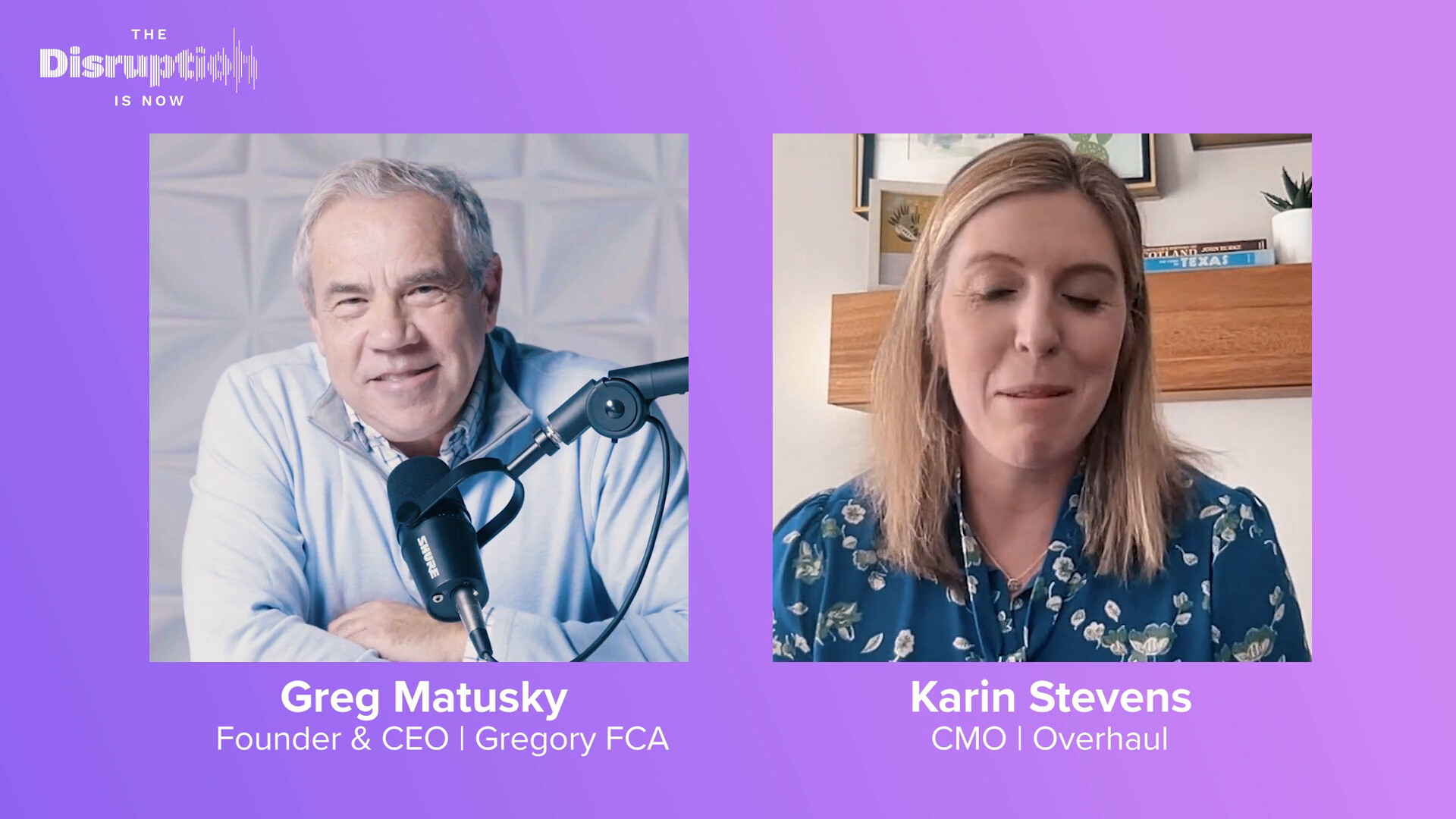
In a 2023 conversation about Overhaul's RiskGPT, she applied the same operating logic to artificial intelligence. Historical shipment data, context and proprietary risk profiles could help generate a more useful response to an alert. Inside the company, AI could also absorb scheduling, follow-ups and other administrative work. The aim was augmentation: clear the small tasks so people can spend more time on strategy, critical thinking and the incidents where judgment earns its keep.
Her approach also gives marketing a less glamorous but more consequential assignment. A claim about real-time control has to remain true at three in the morning, when a load stops unexpectedly and nobody is admiring the campaign. Product marketing must understand the rules that distinguish delay from danger. Demand generation must attract buyers whose problems the system can actually solve. UX design must make the next action legible under pressure. Bringing those disciplines into one team allows the promise, the interface and the operating reality to correct one another. It is marketing as a closed loop rather than a megaphone.
The human premium
By late 2025, Stevens was predicting that authenticity and community would become stronger business differentiators in 2026. It sounds almost quaint beside predictive systems and automated alerts, yet the two ideas reinforce each other. When machines make routine production cheaper, trust and original judgment become more noticeable. Efficient tools increase the premium on a person who can convene customers, partners, product teams and security experts around the same problem.
Her public updates in 2026 follow that theme. At LogiPharma Europe in Austria, she focused on human-led automation and the shared goal behind life-sciences logistics. Around Overhaul's tenth anniversary, she named resilience, curiosity, creativity, intuition and integrity as the values that carried the company from a whiteboard idea into a global operation. Later in the year she promoted security gatherings in Mexico City and customer events across the Americas, places built for the kind of cross-company conversation she believes the industry needs.
The career makes a compact argument about modern marketing. Start close enough to the product that you can see where the promise might fail. Listen widely enough that a junior colleague can improve the management system. Use technology to increase the time available for human discernment. And when the company grows, give away enough LEGO bricks that other people can build.
There is a straight line from the Scottish coffee counter after all. Expectations are operational facts wearing emotional clothes. The customer who ordered tea, the shipper watching a temperature alert and the employee naming a weekly challenge all need roughly the same thing: somebody who hears what they meant, notices what is actually happening and acts before the surprise becomes expensive.