The customer wanted to know when the truck would arrive. Jett McCandless was the person who answered. In Portland, working dispatch at Roadway Express for $12 an hour, he supplied the missing information between people whose businesses depended on one another. He worked swing shift and attended university in the morning. It was an education with two timetables.
The job gave him a close view of an expensive habit: people repeatedly asking other people what a computer ought to know. An arrival estimate had to travel through a conversation before it could become useful. Freight moved through the city. Information needed a little personal assistance.
McCandless would eventually found project44, a Chicago company connecting transportation data across carriers, customers and software systems. Its November 2022 funding round valued the business at $2.7 billion. Yet the more revealing measure of his career may be how often he returns to that dispatch desk. For all the changes in the vocabulary of technology, the problem has remained remarkably recognisable.
Find the shipment. Tell the customer. Decide what to do if something has gone wrong. A considerable amount of modern commerce can still be reduced to those three instructions, followed by someone reaching for a telephone.
Twelve dollars and a telephone
McCandless dates his start in dispatch to 1999. His equipment included faxes, two-way radios and his own knowledge of Portland. He remembers suggesting to his boss that the internet might connect the systems they were using. The reply, as he tells it, was brisk: “Shut up, kid. Keep answering the phone.”
It is an unusually economical origin story. The proposed improvement and the reason it would not happen arrived in the same conversation. There was a shift to finish. The phone needed answering. A better system would have to wait.
His account of growing up includes food stamps and Section 8 housing. The early hourly wage belongs in that context. The journey into freight began with ordinary work and limited resources, well before the company announcements and financing rounds that would later make him a public figure in logistics.
He also learned the physical business. He has described sleeping in warehouses to help recover troubled projects and working dock shifts that lasted 24 hours. Experience supplied a practical objection to the suggestion that logistics would become simple if everyone downloaded the right application. Somebody still had to move the freight.
“Relationships are what matter.”
Jett McCandless, 2017
The job he chose to leave
Before project44 came GlobalTranz, where he served as an executive and principal, and CarrierDirect, the consultancy he founded in 2011. His career took him through operations, sales and management. Each position offered a different view of the same handoffs: who had the information, who needed it, and how long the transfer took.
He has recalled going through roughly 25 job interviews after leaving GlobalTranz. There were attractive offers. He chose to build companies. In his telling, the attraction included the chance to improve the industry and create opportunities for people working in it. Entrepreneurship offered a way to put his accumulated complaints to work.
project44 began in 2014. For a time, his responsibilities overlapped. Then, in June 2016, he resigned as CarrierDirect’s CEO to devote himself to the software company. Peter Rentschler succeeded him. McCandless explained that he could no longer be an executive at multiple companies simultaneously.
That decision gives the story a useful piece of friction. Founder biographies can make expansion sound like a matter of adding another line to a résumé. Here, progress required taking a line away. Someone else would run the consultancy. McCandless would concentrate on the connections.
Dispatch work in Portland
CarrierDirect founded
project44 begins
A full-time focus on project44
A network has to learn the local dialect
The early software connected participants in less-than-truckload shipping, where different customers’ freight shares a vehicle. By April 2017, project44 was adding full-truckload visibility. The expansion sounds straightforward until one considers how differently those markets operate.
Large LTL carriers offered a relatively concentrated set of businesses to connect. Truckload involved a much more fragmented collection: large fleets with enterprise software, smaller operators using electronic logging devices, and owner-operators relying on mobile phones. A location could arrive through several kinds of equipment. The customer still expected a coherent answer.
McCandless’s approach has been to accommodate carriers’ existing systems and standardise what comes out of them. It places the burden of translation on the technology provider. The carrier can retain its operating habits; the customer gets information it can use. It is a practical expression of his regard for the people already doing the job.
In 2019, he discussed another form of translation: a European carrier team speaking 13 languages, compared with three in the United States. Connecting a network meant hiring people who could communicate across it. The same conversation ranged from recruiting to the weekly dashboard of 25 company measures. Behind the outward expansion sat the less photogenic work of organising a team.
project44’s reported valuation after its November 2022 funding round, which raised $80 million.
Knowing is only the first shift
By June 2025, McCandless was discussing Movement as a decision intelligence platform. The language signalled a broader ambition. A customer who could see a delay would reasonably ask what the software could do about it. Visibility made the next piece of unfinished work easier to identify.
That August, project44 launched Intelligent TMS, adding transportation planning and execution within Movement. Its announced functions included choosing carriers, booking shipments, managing documents and checking invoices. These are activities with consequences in the physical operation. An accurate location is useful input; arranging what happens around that location is another job.
There was also a change in audience. In June 2025, McCandless and colleagues had visited the White House to advise on tariffs. The dispatcher who once supplied truck arrival estimates was now participating in conversations about trade policy. The scale had changed, while the underlying concern remained the movement of goods through uncertain conditions.
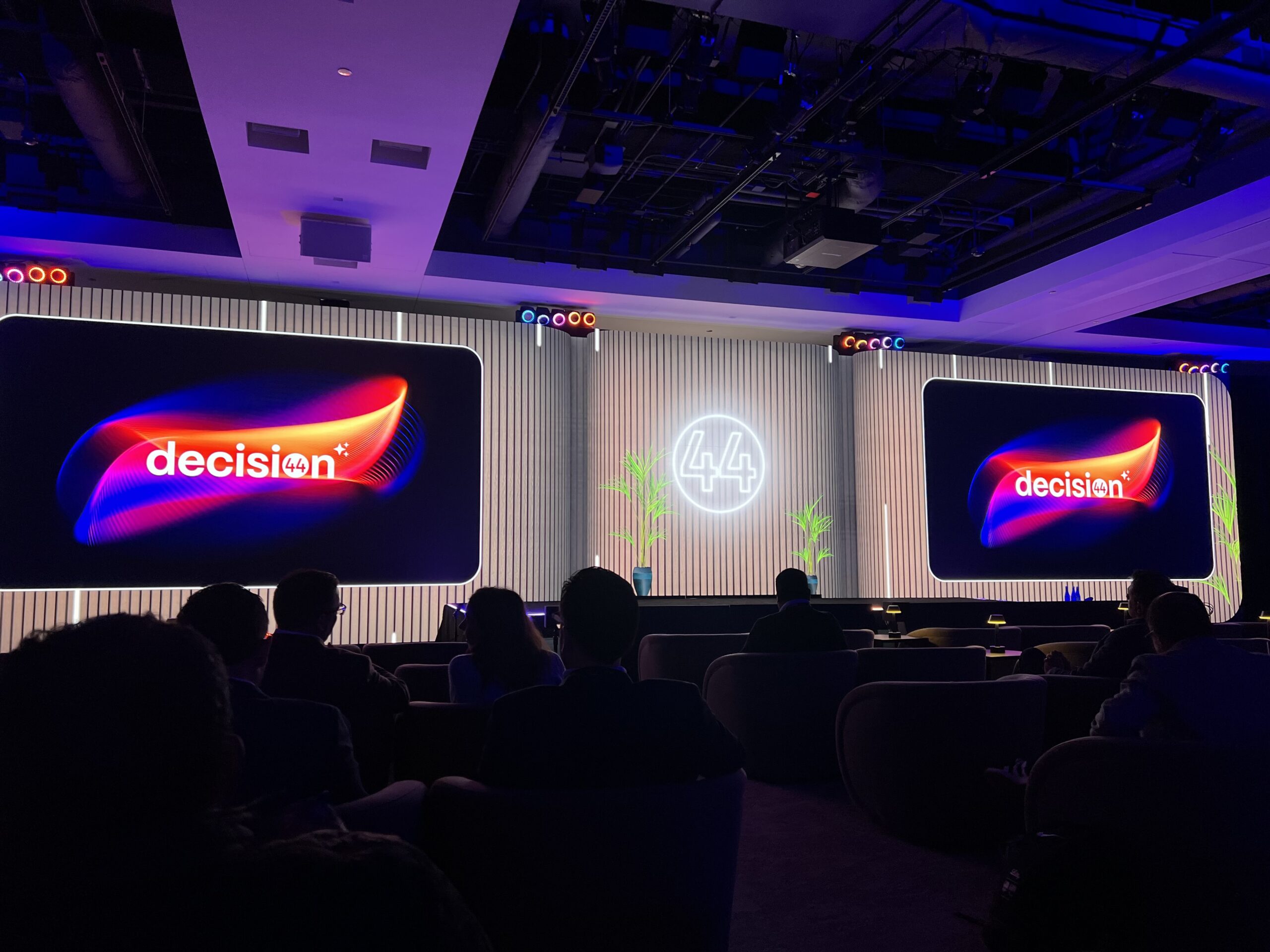
At Decision44 in April 2026, McCandless used a history of logistics to frame the next stage. His account of the company’s first decade came down to five words: “We turned the lights on.” The achievement brought a further problem. Seeing many exceptions also meant having many exceptions to handle.
His proposed response involved AI agents, with customers controlling how much authority they received. That distinction matters in freight. A recommendation can sit on a screen; a booking changes an obligation. His phrase for the arrangement was simple: “Agency is a dial you control.”
- 01ConnectBring carrier and shipment information together.
- 02DecideIdentify the exception and the response it needs.
- 03ActRun a workflow, or escalate to a person.
Autopilot, launched in May 2026, made that ambition more concrete. Customers could configure workflows triggered by logistics events, define escalation paths and examine records of agent actions. Early tasks included chasing missing shipment identifiers and confirming arrival estimates with carriers. The original dispatch workload was finding its way into a different kind of system.
The ordinary nature of those tasks is part of the appeal. A missing document rarely makes a stirring keynote. It can still consume somebody’s afternoon. McCandless is betting that software earns its place by completing the follow-up work, with enough control for customers to trust what it does.
Two desks, two roadmaps
The next organisational change returned him to an old constituency. In July 2026, he announced LSP44, a dedicated business for logistics service providers: brokers, forwarders and third-party logistics companies. It would use the underlying infrastructure built at project44 while having its own sales, marketing and research and development teams.
By October, he was explaining the arrangement as two businesses with separate customer priorities. project44 would serve shippers. LSP44 would focus on the companies providing logistics services. Shared infrastructure could support both, while each team worked on the decisions its customers actually faced.
The distinction suits a career spent moving between different parts of the industry. The owner of the goods and the provider arranging their journey can look at the same truck and have different questions. A shared data network does not remove those differences. Product development has to make room for them.
McCandless now leads both businesses. His earlier decision to focus on project44 makes the new structure especially interesting: this expansion comes with explicitly separate teams and roadmaps. The question of where to spend attention has returned, this time inside a larger organisation with years of infrastructure beneath it.
A bicycle, and another use for capital
There is a less formal picture of McCandless in an outdoor Tech Scenes interview: lakeside, wearing a project44 jacket, a bicycle and helmet beside him. The setting fits his documented interests. Downhill mountain biking, whitewater stand-up paddleboarding and heli-skiing all appear in his public biographies. His leisure activities require rather more equipment than a comfortable chair.

He also has work beyond project44. Blue Water Companies, founded in 2011, combines investments, real estate and philanthropy. Its stated priorities include sustainability, opportunities for underserved communities, and support for women in crisis. Its venture activity extends into logistics, AI and other emerging businesses. Capital can fund a software roadmap; it can also be directed toward people whose next opportunity depends on something else.
These interests give a fuller sense of what he has chosen to do with the career. The dispatch experience remains central, but it has not supplied his only project. Alongside the companies are outdoor pursuits, parenting and an investment business with an expressly social purpose.
Still, the phone provides a useful way back to the beginning. In Portland, a customer needed an answer and McCandless supplied it. More than two decades later, he is trying to build systems that can carry the answer further, through a decision and into the next piece of work. The check call has proved surprisingly difficult to retire. He keeps finding another part of its job.
Keep the conversation going
Explore McCandless’s work and hear him tell the story.
- Jett at Blue Water Companies ↗
- project44 ↗ · LSP44 ↗
- LinkedIn ↗ · Twitter / X ↗ · XING ↗
- Watch: Tech Scenes Chicago ↗
- Watch: Movement and the White House visit, June 2025 ↗
- Jett Unfiltered: keynotes and conversations ↗
- Read: the value of firsthand industry experience ↗
- Listen: the project44 and LSP44 story, October 2026 ↗
- Read: Decision44 in April 2026 ↗