A contractor’s insurance certificate has an awkward social life. It belongs to one company, but several customers may want to see it. Each has requirements. Each wants the current version. Somewhere between the office and the jobsite, someone must decide whether the paperwork actually permits the work. ISN built a business inside that small, consequential gap.
- The job: collect, review and monitor contractor qualifications.
- The mechanism: reusable records, human reviewers and a shared network.
- The trade-off: both hiring companies and contractors pay to participate.
Its platform, ISNetworld, connects organizations buying services with contractors and suppliers providing them. The setting is usually an operation where mistakes carry physical consequences: an energy facility, a manufacturing plant, a construction project. Procurement teams need evidence; safety teams need qualifications; contractors would rather avoid answering the same questions repeatedly.
The first problem was a training record
In 2001, William Addy and Joseph Eastin identified a need to track pipeline contractors’ employee training and qualifications. That was the original problem. As Eastin later described it, the system grew to collect company-level material, including insurance, safety programs and questionnaires previously handled on paper. Other oil and gas businesses adopted it; Canadian operations followed in 2006.

The revealing step came in 2005, when ISN launched Review and Verification Services, or RAVS. Collecting a document and understanding it are separate jobs. A database can tell you a file arrived. A reviewer can assess whether its contents match the requirements. ISN put safety professionals into the process, making review part of the service.
That combination still explains the company better than the label “software.” ISN employs expertise in health and safety, insurance, sustainability and risk management alongside its platform. Its stated values include integrity, service, innovation and collaboration. Those values have a practical test here: can a contractor get useful help when a qualification question blocks progress?
Both sides get a bill
The business model rewards a particular kind of repetition. Contractors submit information that multiple hiring clients can use. Hiring clients get a common place to examine records and monitor requirements. The more relevant business relationships already live in the system, the more useful that shared place becomes. That is the network’s commercial logic.
Qualification → ongoing monitoring → updated evidence
Both sides pay. Contractors and suppliers face annual subscriptions and a one-time setup fee per country, based on their three-year average employee count. Hiring clients pay annually per global region. ISN describes subscriptions as all-inclusive regardless of tools used or connection count. The worker app, Empower, is available without an additional user fee.
For a contractor, the calculation is concrete: does access to these customers justify the subscription and the work of maintaining the account? Reusing records can save effort, but someone still has to keep them accurate. The useful comparison includes staff time as well as the invoice. A subscription buys participation, not a promise of winning contracts.
This also creates an unusual sales dynamic. A contractor may first encounter the platform because a customer asks it to join. ISN’s own FAQ begins addressing that situation early. For the hiring organization, standardization is the attraction. For the supplier receiving the request, the immediate question may be much simpler: what must we submit before this customer will consider us?
Avetta and Veriforce offer overlapping qualification, verification and monitoring services. ISN’s distinction rests in its particular network, review operation and product mix. A sensible buyer would examine existing contractor overlap, regional requirements and support before comparing feature lists. A beautifully configured portal with few relevant connections may still create another administrative destination.
Four sites in Mexico
Honeywell Mexico supplies a useful example of what changes. Before adopting ISNetworld in 2019, it faced inconsistent contractor-management processes; manual qualification and compliance reviews limited visibility. By October 2026, its seven-year relationship included document verification, worker qualification checks, training and QuickCheck scanning and badging across four Mexican sites.
“Maintaining clear expectations for contractors is a key part of Honeywell's approach to risk management.”
Emiliano Cabrera / Honeywell
Those are reported activities, rather than proof that software alone prevented accidents. But they show the intended connection: a contractor’s written program, a worker’s training record and the decision at the gate can become parts of the same process. That is more operationally useful than collecting a folder nobody opens again.
More recent customers show how far the original pipeline use case travels. Renewable-energy operator IPX Power selected ISNetworld in September 2026 for contractor oversight, insurance review and analytics. In October, ABARTA Coca-Cola Beverages selected it for evaluation, handbook acknowledgements and contractor data. Different industries; familiar coordination problems.
From the filing cabinet to the pocket
ISN’s expansion has followed the evidence in two directions. Empower, introduced in 2022, lets workers access jobsite requirements, training and a digital ISN ID card. Transparency-One, acquired in 2023, maps product supply chains for responsible sourcing. One follows the person doing the work. The other follows the materials behind the product.
that travels
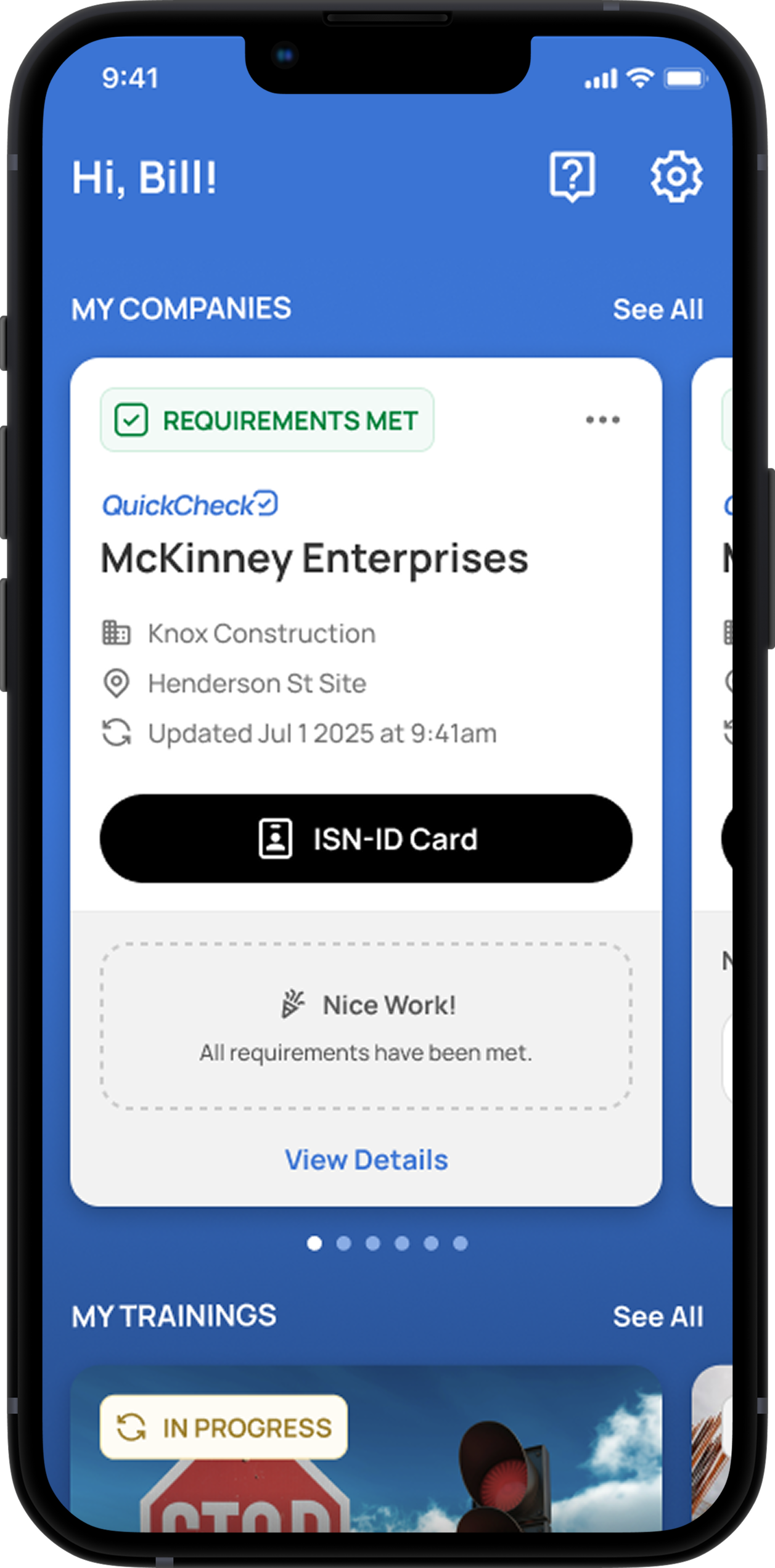
The acquisition also reveals a selective change of mind. Eastin said ISN had evaluated dozens of potential purchases that did not fit culturally or financially. Blackstone introduced Transparency-One; confidence in its team and technology grew during evaluation. Blackstone itself had taken a minority stake in ISN in December 2020, valuing the company above $2 billion. The investment amount was undisclosed.
In May 2026, ISN added Hazard Assistant to Empower. Workers can provide jobsite photographs and contextual descriptions; AI analysis suggests possible hazards, energy-source classifications and controls. ISN explicitly positions it as support for human judgment. The photograph starts a safety conversation. It cannot contain everything a person on site needs to know.
A record is only the beginning
For a buyer, a useful demonstration would follow one real contractor through the whole sequence: submission, review, renewal and worker readiness. Ask which steps your team still owns. The answer will say more about the service than a screen full of green indicators.
The lesson readers can copy is procedural: standardize the evidence, make it reusable, assign responsibility for checking it and keep checking as circumstances change. That approach becomes less compelling when contractor relationships are few or seldom overlap. And even excellent records cannot perform on-site supervision. ISN’s continuing move toward workers, training and implementation makes that boundary especially interesting.
Its mission centers on protecting people and responsible sourcing. The ambitious part is the distance between a document and a decision. ISN keeps building ways to shorten it.