The modern cargo heist may begin with a forged document, a stolen identity or a driver sent to the wrong loading bay. The first visible clue can be absurdly small: a truck drifting off route, a seal opening early, a refrigerated trailer warming by a few degrees. Barry Conlon has arranged his career around that sliver of time between the signal and the consequence. His company, Overhaul, collects the dots. Its real product is what happens after one of them misbehaves.
Conlon’s office is in Austin, but the operating instinct was formed far from Texas. Born in Palmerstown, Dublin, he spent 11 years in the Irish Defence Forces, including the Army Ranger Wing. In a later telling of his career, he described the move into civilian life as a search for a new challenge. Conversations with executives at American multinationals in Ireland supplied one. They were losing cargo. He understood risk, teams and the cost of a late response. Freight looked less like an industry than an unguarded perimeter.
The result was FreightWatch International, co-founded in 1997. It grew around the awkward truth that goods become unusually vulnerable once they leave a controlled building. A laptop in a warehouse is inventory; the same laptop in a trailer is a moving target. FreightWatch helped formalize the security practices used around high-value shipments, and Conlon became closely associated with the discipline as it moved from guards and phone trees toward connected technology.
The sale, the gap and the return
FreightWatch was acquired in 2012. Founders are supposed to enjoy an exit, preferably from a beach and within sight of an extravagantly unnecessary drink. Conlon instead noticed a widening gap. Trackers were multiplying. So were transport systems, weather feeds, temperature sensors and route data. Yet the industry still risked confusing a bright dashboard with a solved problem. Knowing where a shipment sat did not say whether it should be there, what was going wrong or who had the authority to intervene.
In 2016, Conlon founded Overhaul with a data-agnostic premise. The company would not demand loyalty to one tracking device. It would ingest signals from many sources, add context, identify a deviation and help coordinate the response. That final verb matters. A location ping is a noun. Recovery is a series of actions, often involving analysts, drivers, customers and law enforcement across different jurisdictions.
Conlon’s questions for FreightVerify’s technology later captured the logic neatly: “Do I know where it is? Do I know what’s happening? Should it be happening that way?” The first is visibility. The second is intelligence. The third opens the door to control. Overhaul’s 24-hour operations model is built for that sequence, including the inconvenient hours when a valuable load takes an unscheduled turn and nobody wishes to admire a dashboard.
A founder’s perfect loop
The second act developed a pleasing piece of narrative geometry. FreightWatch’s business had eventually become SensiGuard within Sensitech. In 2023, Overhaul acquired SensiGuard. Conlon’s former operation, now a competitor with reach in Brazil, Mexico and the Czech Republic, became part of the company he had created to pursue the next version of the idea. The deal expanded customers, staff and geography while uniting two eras of cargo security.
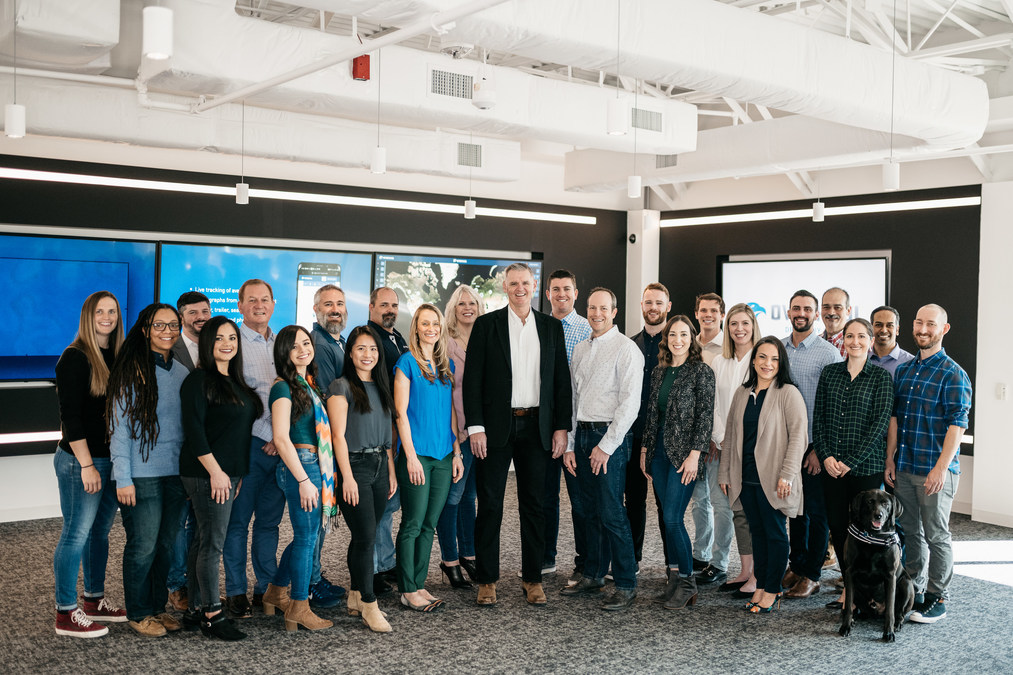
Another acquisition followed. In August 2025, Overhaul bought FreightVerify, adding item-level tracking and inventory intelligence. A delayed component could now be connected more directly to the factory, store or customer waiting for it. The next day, the company announced a $105 million Series C led by Springcoast Partners with participation from Edison Partners, alongside a new debt facility. Overhaul said the capital would support AI development, platform expansion and further acquisitions.
The circularity makes good copy, but Conlon’s more useful lesson is linear: experience should narrow the next bet. Overhaul did not begin as a general logistics bazaar. It focused on high-value, high-risk and time-sensitive freight, where the cost of being passive was easiest to calculate. Pharmaceuticals, electronics and temperature-controlled goods made demanding early customers. Their edge cases forced the product to become specific.
Candor as infrastructure
Conlon speaks about leadership with less polish than one might expect from a chief executive raising nine-figure rounds. He has joked about his weakness with financial spreadsheets. He argues that a leader should build a team whose strengths occupy the blank spaces. The joke is part of the mechanism. Admitting a limit gives someone else room to own the work without waiting for ceremonial permission.
He applies a similar test to advisers. “You need a place where you know candor is a given and your ideas will be challenged,” he said in 2020. A board, in this view, is not ornamental governance. It is another response system. During Overhaul’s growth, Conlon brought investors into customer conversations and treated the chairman as a bridge between directors and management. The architecture resembles his product: useful information needs a path to the person able to act on it.
His preference for communication is charmingly analog. He chooses a call over an email and video over a call. Human connection, he says, is worth the additional effort. The habit sits comfortably beside a platform full of telemetry. More data does not abolish judgment. It raises the value of context, especially when a terse message can conceal doubt, urgency or disagreement.
Small systems for large uncertainty
For a man whose working canvas includes global freight, Conlon’s personal systems are pleasantly ordinary. He keeps strategic goals in mind-mapping software, branching each priority into strategic and tactical steps. The map acts as a North Star when novelty arrives disguised as necessity. During the dislocated workdays of 2020, he said the absence of casual office conversation made his calendar more crowded but also clarified which meetings deserved him.
After work comes motion. Conlon has described an hour of intensive daily exercise, often cycling outside or riding a Peloton, followed when time permits by a few chapters of a book. His summary has the efficiency of a decent slogan: “spin before gin.” One suspects Oscar Wilde would have reversed the order, but Wilde was never responsible for temperature-sensitive freight.
The lighter routine belongs to a career containing genuinely high-pressure episodes. Conlon served in Mogadishu in 1993. Eighteen years later, during his U.S. citizenship process in San Antonio, the officer across the desk recognized him from that deployment. Both men had been there in different uniforms and met again in a government office half a world away. Conlon became an American citizen in 2011. It is the kind of coincidence that makes a global map feel suddenly small.
The alert must belong to someone
Conlon is named on patent filings for shipment tracking, unexpected door openings, cargo-theft alerts, emergency response and the monitoring of time-sensitive deliveries. Read together, they reveal a persistent fascination with abnormal events. The recurring pattern is not merely to detect a deviation, but to classify it, notify the relevant people and prescribe a response. The patents turn his operating philosophy into diagrams and claims.
That philosophy travels well beyond freight. Most organizations can already see more than they can absorb. Metrics flash, inboxes swell and dashboards announce their own importance. The scarce capability is deciding which signal deserves interruption, then placing it in the hands of somebody with context and authority. Overhaul applies the idea to a trailer door. A manager might apply it to a customer complaint or a slipping deadline.
Theft itself is also changing. Fake pickups and manipulated documents move cargo crime toward the territory of social engineering. Locks still matter; identity and information now matter beside them. Conlon’s response has been to join software with people rather than pretend one replaces the other. Machines watch without blinking. Experienced operators understand the difference between an odd event and an expensive one. Law-enforcement relationships turn coordinates into recovery.
Overhaul’s latest chapter is broader inventory intelligence, more AI-assisted monitoring and selective acquisition. Yet Conlon’s central question has barely moved since those early conversations in Ireland: when valuable goods leave the building, who is paying attention? Three decades later, his answer is a network of sensors, analysts, customers and responders. The dot on the map remains. Now it has somewhere to go.