Enterprise software is easiest to notice when it stops working. A customer record refuses to reach the billing system. A factory dashboard goes stale. An old application cannot speak to a new one. Until then, integration is the quiet plumbing of a business: essential, mostly hidden and notoriously difficult to make interesting. Karin Netzer has spent the latest chapter of her career making that hidden work visible.
Since 2020, Netzer has led worldwide marketing at Magic Software Enterprises. Her formal brief is broad and admirably unsentimental. She oversees the planning, development and execution of marketing, with responsibility for helping generate revenue. In practice, that means turning low-code development, data integration, automation and cloud transformation into language that can travel from an engineer to a buyer, from headquarters in Israel to teams and customers around the world.
This is a job built around connections. The products connect systems. The company connects regional offices, partners and thousands of enterprise customers. Marketing must connect a technical capability to a recognizable business result. Netzer arrived with more than two decades of experience and a career that had already crossed several borders between the tangible and the abstract.
The route inA career that kept moving closer to the machinery
Her early public résumé begins with Kodak Winning Fotos and HOT, the Israeli telecommunications company. Photography and television are products people can see, touch and discuss without a glossary. Both also depend on technology humming behind the experience. At Infor, where Netzer worked in marketing and customer relations, the machinery moved to the foreground. Enterprise resource planning software is not bought for charm. It earns its place by coordinating the unglamorous, consequential work of an organization.
Metro Control brought another shift. As vice president of marketing, Netzer worked around smart-city and Internet of Things solutions. Here the story stretched across physical infrastructure, public spaces, sensors and services. A smart city is an enormous promise. A marketer has to shrink that promise to credible uses without shrinking its ambition into a list of features.
The sequence gives her career its shape. Each move increased the number of systems, stakeholders and explanations involved. Consumer marketing asks what a person wants. Enterprise marketing asks that question while also satisfying procurement, IT, operations, finance and the people who will live with a platform after the sales presentation ends. Global enterprise marketing adds local markets, partners and languages. Clarity becomes less a writing preference than an operating requirement.
Netzer's education fits the same pattern. She studied communication and political science at the Hebrew University of Jerusalem, then added an MBA focused on business and marketing. The pairing is apt: messages and institutions on one side, execution and commercial outcomes on the other. Her public biographies also note work as a business-unit manager, a board member in technology and communications companies, and a marketing consultant to TSG IT Advanced Systems. Those roles widened the view beyond campaigns to the organization carrying them.
“Our dedicated team was proactive, responsive, and most important - highly creative.”Karin Netzer, describing an agency partnership
The operating ideaCreativity with a destination
Netzer's available public comments are not grand declarations about the future of marketing. They are more useful than that. In a testimonial about agency work, she praised a team for being proactive, responsive and creative, then described a journey from identifying company and product strengths to building strategy and executing in a “challenging, dynamic and multi-national market.” The nouns form a compact operating system: strengths, strategy, execution, market.
She also put brand awareness and lead generation in the same sentence. They run on different clocks. Awareness accumulates slowly, often beyond neat attribution. Leads arrive as rows in a system and invite immediate judgment. A global CMO has to keep both clocks without pretending they tell identical time. The brand must become familiar; the pipeline must move; the story cannot promise what the product cannot deliver.
The connective work inside the title
- Translate technical platforms into operational outcomes.
- Give regional teams a common strategy for distinct markets.
- Join brand awareness to lead generation and revenue.
- Turn customer results into stories other buyers can recognize.
Her own LinkedIn activity shows where she looks for proof. In one customer story, she emphasized automated critical processes, better data connectivity, faster responses to customers and more precise supply-chain management. The software mattered because work changed. In posts about manufacturing, she pointed toward knowledge gaps, intelligent operations and the practical strain created by disconnected systems. The language keeps returning to movement: data moving, businesses responding, people acting on clearer information.
That emphasis makes sense for an integration company. A connector is rarely the star of a customer's day. It is the reason several other tools can perform as a system. Marketing it requires a kind of narrative modesty: start with the job, not the plumbing. Explain what becomes possible when the handoffs cease to be a daily argument.
One room, several countriesThe human layer of a global plan
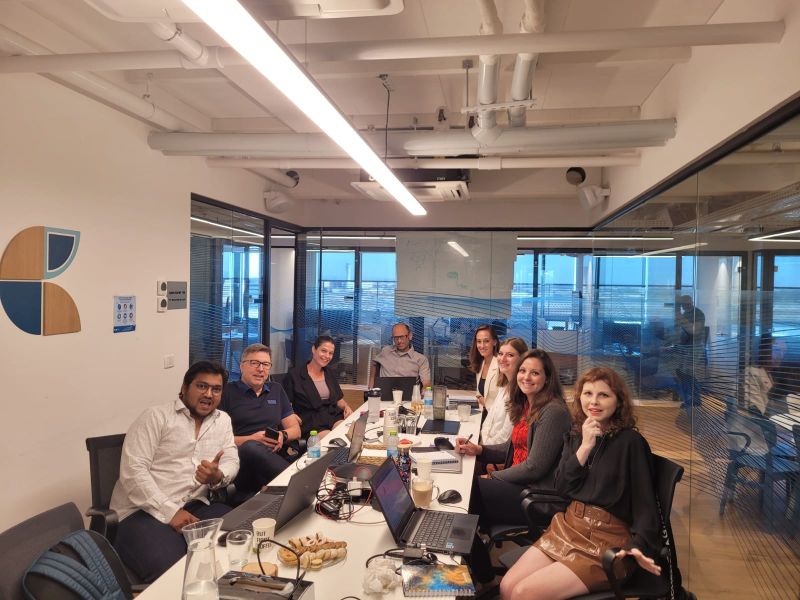
A photograph from a 2022 marketing meeting offers the most revealing public anecdote about Netzer's management style without requiring any mythology. Colleagues from Germany, France and India flew to Israel. They worked through the marketing strategy, the plan for the second half of the year, new training and upcoming launches. The visit also included Jerusalem, the Mount of Olives and shared meals. Magic's company account thanked Netzer for arranging a balance of business, culture and pleasure.
It is a small scene, but it catches the difficulty of global work. A distributed team cannot live entirely inside slides and video calls. Strategy needs context; colleagues need memories that do not fit in a project tracker. Bringing people together does not solve the structural tension between a central brand and local judgment, but it gives that tension a human scale. People can disagree more intelligently once they know the person on the other side of the calendar invitation.
Netzer had joined Magic during 2020, when even routine office contact became complicated. By December of that year she was presenting marketing in a worldwide virtual event alongside R&D and support teams discussing product roadmaps, cloud offerings and continuous improvement. Marketing was not treated as a decorative closing act. It sat in the same program as engineering progress and product direction, which is where enterprise marketing belongs if it is going to speak accurately.
In enterprise software, the message is strongest when it behaves like the product: it connects things that otherwise remain separate.
A changing companyKeeping the story coherent while the platform expands
Magic's vocabulary has widened during Netzer's tenure. Low-code application development and enterprise integration now sit beside data management, cloud transformation, artificial intelligence, manufacturing intelligence and governance. MagicTouch, introduced as a cloud-first integration and data platform, gathered several of those strands into one market story. A colleague later credited Netzer among the headquarters team that helped a multi-year cloud-transformation effort reach that point.
The corporate structure changed too. In February 2026, Magic became a wholly owned subsidiary of Matrix IT. The combined operation began the work of integrating two established Israeli technology businesses. For a marketer, a merger is partly a problem of nouns: which name carries which promise, how two histories meet, what customers should expect to remain stable and what can become newly possible. Magic's leadership page continued to list Netzer as chief marketing officer, while current executive directories identify her global remit.
Her task is therefore not merely to simplify a complicated product category. It is to maintain continuity while the organization around the category changes. The temptation in such moments is to write a larger adjective. The better move is to sharpen the line between capability and consequence: this connects to that; this delay disappears; this team sees what it could not see before.
Netzer's career has prepared her for precisely this kind of sentence. Photography taught the power of an image. Television taught scale and audience. ERP taught systems. Smart cities taught networks of public and private actors. Global software marketing asks for all of it at once, usually before breakfast in at least one time zone.
The work beneath the workMake the connection worth noticing
There is a neat symmetry in an integration company's marketer being an integrator herself. Netzer connects engineers to customers, a central plan to regional realities, brand memory to lead generation, and technical possibility to operational evidence. None of those connections stays finished. Markets shift, platforms expand, teams change and yesterday's plain language becomes tomorrow's jargon.
The aspiration stated in her role is direct: lead marketing worldwide and use it to help the organization grow. The interesting part is the method visible around that mandate. Find the product's strengths. Build the strategy. Execute with people who know their markets. Show the customer's work changing. Leave enough room for creativity, but give it somewhere useful to go.
Good infrastructure disappears into the result. Good enterprise marketing does something almost opposite. It reveals the infrastructure just long enough for a buyer to understand why the result is possible. Karin Netzer has made a career in that interval - between the system doing its work and a person finally seeing what the system is worth.