A brochure, in Karen Thomas-Smith's telling, could behave like an overeager first date. It introduced itself and, before the coffee had cooled, asked for marriage. The image was funny because everyone in the room recognized the crime. In business-to-business marketing, companies often hurry past curiosity, trust, and usefulness to reach the proposal. Thomas-Smith wanted her Optum team to slow down long enough to earn the next conversation.
The dating analogy became an internal map: cruise the bars, buy a drink, date, become engaged, marry. Behind the joke sat a serious redesign of marketing inside a vast healthcare organization. The team would begin with the subjects customers needed to understand, make useful material around those subjects, and only then build campaigns to carry it. Promotion had been demoted from author to distributor.
This reversal is the most revealing episode in a career of more than two decades across healthcare and technology. Thomas-Smith has worked in systems, training, sales, product, customer success, operations, and marketing. Today she is Chief Marketing Officer at Arcadia, the Boston-based healthcare data and analytics company. The titles have changed. Her public language has remained unusually consistent: listen for the customer's problem, organize people around it, translate complexity, and insist that the work prove useful.
What story does the market need?
At Optum, Thomas-Smith inherited the habits she called “one and done” marketing: a trade show here, a brochure there, an email sent because sending email was what the calendar prescribed. The activity was visible. The journey between activities was harder to see. She and her team graded their maturity across messaging, market knowledge, measurement, references, sales engagement, and client intimacy. The assessment made the gap plain. Product expertise was plentiful; buyer understanding needed a larger desk.
“We were not really thinking about a campaign; we were thinking what story do we need to tell in the marketplace.”Karen Thomas-Smith, on the Optum redesign
Changing the sequence changed the organization. A thought-leadership and content director would focus on the narrative. A new sales-liaison role sat close to the field, gathering the questions and friction that polished messaging tends to miss. People could raise their hands for roles that matched their interests. In Thomas-Smith's account, team members blossomed when the job fit. Customer-first began as an internal design principle before it appeared as external prose.
The proposal still made some colleagues nervous. The content-first group earned the label “rogue,” a word that sounds romantic only after the quarterly review goes well. Thomas-Smith chose a contained analytics pilot and attached it to two practical measures: lead generation and sales acceleration. The team would learn whether marketing created viable pipeline and whether prospects used its material as they moved toward a decision.
The results gave the rogue idea a passport. One reported campaign produced 5,300 form submissions, $106 million in pipeline, a 17 percent click-through rate, and an 89 percent email open rate across 500 pieces of unique content. The broader program later passed 12 million impressions, 10,000 gated-content downloads, and $120 million in sales pipeline. MarketingSherpa calculated $52 in closed-contract revenue for every dollar invested. The work won Best in Show at the 2016 MarketingSherpa Awards.
Numbers this tidy can seduce a case study into sounding inevitable. It was not. The team was changing familiar roles in a large company, asking colleagues to approve an unproven order of operations, and trying to educate a market about analytics while that market was still learning the category. Thomas-Smith's method was less grand revolution than disciplined permission: run one pilot, give it an honest scoreboard, and let the evidence earn room for the next one.
A systems analyst learns to translate
Thomas-Smith's earliest public career trail places her at SAS as a systems analyst, followed by leadership work in sales and training at SAS and Allscripts/Misys. That sequence explains some of her range. Systems work teaches respect for how pieces connect. Training reveals where explanations break. Sales supplies a daily referendum on whether a promise survives contact with a buyer. Marketing, done well, borrows from all three.
She graduated magna cum laude from North Carolina Wesleyan College, now North Carolina Wesleyan University, with a Bachelor of Science in Business Administration. By January 2012, she had joined Optum as a vice president of marketing charged with building a team for a new product line in a relatively new category. A year later she was a finalist for the MarketingProfs B2B Luminary Award. Twice, TopRank Marketing included her on its list of influential women in digital marketing.
Systems, sales, and training roles at SAS and Allscripts/Misys.
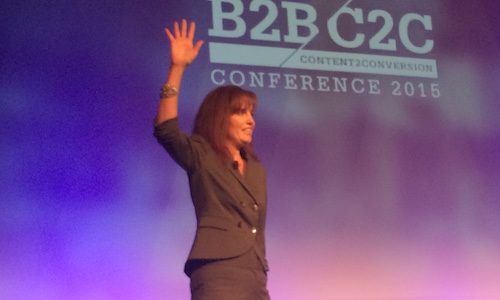
At Optum, built a content-led marketing model and took the customer-first case to national stages.
Marketing leadership across Ciox Health, M*Modal, 3M, and Optum.
Joined Parata as SVP of Marketing and later led sales and marketing at BD Parata.
Chief Marketing Officer at Arcadia, leading market strategy and customer storytelling.
Her official Arcadia biography also records appearances on Oprah and 60 Minutes to discuss leadership, talent development, and corporate culture. That detail fits the larger pattern. Thomas-Smith's subject is marketing, but her mechanism is often organizational: how talent is placed, how teams listen, how an institution learns, and how a complicated idea becomes legible without being flattened.
The fine art of “nuggyifying”
Every durable operator deserves one homemade word. Thomas-Smith's is “nuggyifying,” her term for turning a substantial body of thought into smaller pieces that can travel. It sounds like something done to a potato at a state fair. In practice, it solved a distribution problem. A large argument could become a short article, a sales conversation, an email, a video, or a useful answer at the moment a buyer needed it.
The word also shows her instinct for making process memorable. A maturity model can disappear into six columns of corporate gray. A dating story sticks. “High customer” and “high self” reduce a foggy debate about orientation to a choice anyone can recognize. Her language does the same work as her marketing: it gives complexity a handle.
At Parata, where she arrived in 2021 as Senior Vice President of Marketing, the vocabulary changed but the center held. She said the company's customer successes drew her to the role. The appeal was not merely the machinery. It was the story of what pharmacy teams could do with more time and better tools. By 2024, as Senior Vice President of Sales and Marketing at BD Parata, she was leading an executive roundtable on the changing role of specialty pharmacy. Once more, customer experience supplied the raw material and market education supplied the form.
At Arcadia, the story is made of data
Thomas-Smith joined Arcadia in January 2025. The company's platform unifies healthcare data and turns it into operational insight for payers, providers, and other organizations. Her mandate is market strategy, with a particular emphasis on helping customers understand how the platform supports population health and value-based care. This is fertile ground for her kind of translation. The product is technical, the buying group is broad, and the outcome must be explained in both analytical and human terms.
Her published work at Arcadia leans on proof. In September 2025, she wrote that Arcadia-supported organizations participating in Medicare's Shared Savings Program and using third-party benchmark data collectively earned $1.2 billion in shared savings for 2024. More than 90 percent achieved shared savings, she reported. The argument connected data infrastructure to financial performance, then connected that performance to the durability of the public program.
A month later, her recap of Arcadia's Aggregate conference counted more than 250 attendees from over 50 organizations. It highlighted peer exchange, real-world workflows, and the event's first AI Showcase. In May 2026, she announced a MedTech Breakthrough Award for Arcadia's contract-analytics technology, pointing to forecasting and a reported potential reduction of up to $60,000 a month in outside actuarial spending. The specifics do the persuading. Adjectives are spared the embarrassment.
“How do we tell what we do to the marketplace in a way that matters to them?”The question that keeps following the work
In 2026, Thomas-Smith was named a finalist for MM+M's inaugural Leadership Award. Her response distributed the credit to teammates, mentors, customers, and friends who had challenged and encouraged her. It was consistent with the design of her earlier teams: leadership as a system of relationships rather than a solo pose at the top of an org chart.
That may be the more durable achievement beneath the impressive funnel metrics. Thomas-Smith learned how to make listening operational. She gave field intelligence a job, gave content a sequence, gave experiments a scoreboard, and gave people room to move toward their strengths. A decade after the Optum case, she is still arranging complicated material around the person who must use it.
The impatient brochure still waits in every company, ring in hand. Thomas-Smith's career offers it civilized advice: ask a better question, tell a useful story, and earn the second date.