Amy King entered college expecting science to tell her what came next. Then an art history class interfered. The images made a more persuasive argument than the plan. She left the pre-med track at Davidson College, earned a degree in art history, continued into a master's program at the University of North Carolina at Chapel Hill, and began working in the art world. Careers are often narrated backward, with each turn polished until it looks inevitable. King's is better left with its elbows showing. The useful thing about the route is that it was not straight.
Her first professional chapter included Sotheby's and Artnet. At the auction house, expertise lived in attribution, provenance, condition, and the small clues that alter value. At Artnet, the art market met the database and the subscription product. King helped manage software and information products, and the work nudged her toward a question that would follow her into every industry after it: how do you bring hidden value into view?
That question survives the jump from paintings to platforms. An art historian learns to look, then look again. A software marketer has to do something similar with a product most customers cannot touch and few want explained at the level of its machinery. The task is to understand the context, decide what deserves the frame, and make an intricate object feel clear without making it false.
A cereal box and a glimpse of the future
In the early 2010s, King sat in an ANA conference audience while General Mills executive Mark Addicks presented a campaign that invited people to photograph cereal boxes in places around the world. The brand would share those pictures on Facebook. It now sounds quaint, like explaining the wonder of a fax machine. At the time, Facebook was not yet ten years old and the iPhone was about five. Digital marketing still meant, to many companies, persuading banner ads to behave on mobile screens.
King saw both sides of the new arrangement. Brands could gain an unusually direct channel to people; people could gain control over the public conversation about brands. She liked the uncertainty, the shift in attention, and the possibilities. She also wanted to be the CMO on the stage. Ambition occasionally arrives wearing a suit and carrying a five-year plan. Hers arrived holding Cheerios.
By 2012 she had left the art world for Ghostery, then a small digital-privacy and marketing-technology company. King has described her résumé at the time as odd-looking. Ghostery took the chance. Ed Kozek, her boss, answered her steep learning curve with patience, introductions, and a calm manner under stress. It gave King a model for how a leader can absorb anxiety rather than distribute it.
From there came MaxPoint and Valassis Digital, followed by product marketing at Pixalate. These were technical businesses operating inside the fast-changing economics of digital screens. King moved from product management toward product marketing, then toward the wider work of running marketing. At Zaloni in 2019, CEO Susan Cook supplied a second model: meet financial difficulty plainly while celebrating people's strengths and describing a future worth working toward. Vanguard Software followed in 2020, with predictive supply-chain planning as the next translation problem.
“Marketing is most effective when it brings clarity to complexity.”
The reset at Relias
King joined Relias in 2021. The company builds software and education products for healthcare organizations, and marketing had not been a large organizational priority. She later described what followed as a full marketing reset. The work began with strategy rather than decoration: understand where the business intended to go, then build the marketing structure capable of going there.
That meant leadership hires, new skills, clearer measures, and a deliberate relationship with the rest of the business. King calls marketing a service organization for sales, client care, and other partners. “Service” can be a dangerous word when it is used to reduce marketing to a request desk. Her version is more exacting. A good partner listens to what another team needs, contributes expertise, makes the work visible, and earns enough trust to retain judgment.
The company itself was also changing its story, from a point solution to a connected workforce enablement platform. The marketing challenge was architectural. A collection of products can easily become a collection of descriptions, each accurate and together bewildering. King's team had to establish a shared language across learning, performance, compliance, quality, and recruiting, while keeping the customer rather than the portfolio chart at the center.
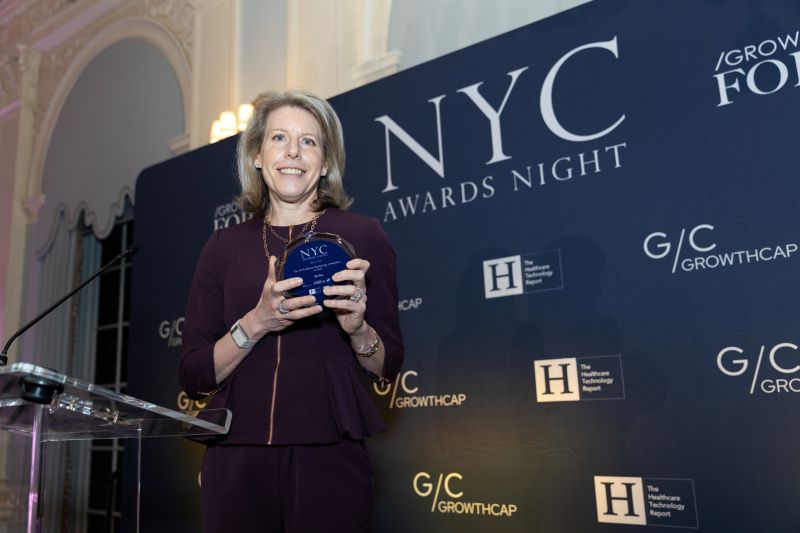
By 2026, the marketing and growth group had grown beyond 100 people. Relias credited King with portfolio repositioning, sharper go-to-market work, closer alignment between marketing and growth, and clearer customer-centered messaging. The Healthcare Technology Report named her among its Top Women Leaders in Healthcare Technology of 2025. The following spring, she entered the B2B CMO 100.
Please bring your failure to the meeting
A reorganization can change reporting lines quickly. It takes longer to change what people feel safe saying. King's most memorable management mechanism is a monthly exercise called “The Bellyflop.” During a marketing all-hands, a person or a small group presents something that went wrong and what they learned. The title helps. “Postmortem” can make a conference room sound like a municipal basement; “Bellyflop” admits that failure stings and can also be survivable, public, and a little ridiculous.
The ritual is consistent with King's interest in intelligent failure. She has brought books and group discussions into the team's learning, asked colleagues to practice difficult conversations, and emphasized that adaptability is a skill rather than a slogan. In a later public conversation about failure, she pressed on the hard question: when results disappoint inside a complex, cross-functional system, how does a team separate a flawed campaign from an external change it could not control? There is no clever metric that cancels the need for an honest debrief.
Her position on data is similarly balanced. Numbers matter. Dashboards, return on investment, active users, and conversion rates all matter. But a target can become a small prison if it prevents a team from entertaining a better route. When the Nurse.com team was frustrated by a checkout conversion goal and a long backlog of product requests, King asked a wand-waving question: if the digital marketers could have one thing that would move the number, what would it be? The answer was mobile payment. Possibility narrowed into a practical priority.
“There is no silver bullet to success.” The work, in King's telling, is process plus trust.
The leader who hires her counterweight
King is unusually frank about the inconvenience of her own strengths. She enjoys new options, paths for improvement, and environments of constant change. Those qualities can expand channels and modernize operations. They can also exhaust colleagues, scatter attention, and leave projects unfinished. So she prizes managers and team members who prefer process, foresee hazards, troubleshoot, and stay with the strategic path. Self-awareness becomes useful only after it affects the org chart.
That instinct extends to varied backgrounds and points of view. King has argued that a marketing team cannot remain relevant if its work comes from too narrow a set of experiences. The practical benefit is not an abstract virtue pinned to a presentation. It is better creative work, more empathy, fewer blind spots, and communication that resembles the customers who receive it.
She is also happy to be taught downward, sideways, and from outside. When influencer marketing became important to Nurse.com's community work, King acknowledged that others on her team and within Bertelsmann's companies knew more. When new marketing technology appears, she relies on specialists and advisers while doing her own homework. Fluency, in this model, does not require the executive to perform omniscience. It requires her to recognize expertise early enough to use it.
This may be the art historian's most durable contribution to the C-suite. Looking closely is an act of humility. The viewer begins by accepting that the object contains more than the first glance revealed. King's career has crossed auction rooms, databases, privacy tools, advertising systems, enterprise data, forecasting software, and workforce platforms. The materials keep changing. The habit does not.
Her stated development goal is to get better at decisions made across complicated organizations, especially when reasonable people disagree about the route to a shared goal. It is not a cinematic aspiration. No trumpets, no moonshot, no whiteboard photograph in which everyone has mysteriously perfect handwriting. It is the daily puzzle of modern work: who gets heard, what the evidence can prove, which uncertainty must be tolerated, and how a group moves before consensus turns into delay.
The résumé that once looked odd now reads like a coherent education in translation. Art taught context. Product work taught systems. Ad tech taught speed. SaaS taught repeatable growth. Relias added scale and the challenge of aligning a large team with a consequential customer mission. King kept the curiosity and built processes around it. She wanted to be the CMO onstage. Having arrived, she seems most interested in what her team is willing to say in the room.