The most revealing sentence in Kabir Nagral's startup story is only six words long: “Craze is dead, long live Craze.” It is part obituary, part launch note, and just cheeky enough to make the bad news sit still. The HR and payroll company he built with Deepit Patil was ending. Craze AI was beginning. The cofounders kept the company name, the partnership, and their appetite for making software perform useful labor. Almost everything else was available for revision.
Founders usually narrate change as destiny discovered a little late. Nagral's version has more seams showing. Craze began as a sports prediction experiment. It became a broad system for HR, payroll, compliance, expenses, and IT operations in India. Then it moved toward an AI agent that could act across apps. Today, its public proposition is narrower and more visual: an AI video maker that plans, edits, and turns creative direction into finished work.
Four products could be hiding in that paragraph. One operating instinct joins them. Nagral prefers the moment when a person stops managing the task and receives the outcome. Payroll is not a dashboard problem when salaries are due. Video is not a prompting problem when an edit must ship. His language keeps returning to verbs: do, build, pay, direct, finish.
Before the famous exit
Nagral's standard biography begins at Harvard, where he studied computer science before leaving to build Craze. The more instructive prologue happened at Phillips Academy Andover. In 2016, as a Grade 10 student, he received a fellowship to examine how technology and education could improve work prospects for visually impaired students in India and the United States.
The project moved outside the library. He met students, educators, advocates, and organizations including the Xavier's Resource Centre for the Visually Challenged and Perkins School for the Blind. He studied accessible mathematics and computer learning, then presented a panel at Andover under the title “Blind Justice.” His framework was blunt and memorable: education, equity, and employment.
One encounter stayed with him. An administrator at a school for blind students doubted that those students could learn mathematics and science beyond the eighth grade. Nagral said the comment initially shook him. It also gave him something concrete to push against. The project ended with a public call for more students to turn an interest into action, a teenage formulation of the bias that later shaped his company-building.
“There's always something that everyone is interested in… an interest that leads to actions.”Kabir Nagral, speaking as an Andover student
At Andover he also belonged to DREAM, a disability rights, education, activism, and mentoring club. With the IndoPak club, which he co-led, he helped bring Bollywood screenwriter Shibani Bathija to campus. This was not a teenage founder rehearsing a pitch deck. It was someone practicing a recurring move: find the abstract claim, introduce it to people living with the consequences, and ask what could work better.
A degree meets a decision
Harvard supplied computer science and an interruption. The pandemic broke the usual rhythm of college halfway through Nagral's time there. His sister Avanti, a musician and creator who balanced her own Harvard studies with a professional career, later described him juggling assignments, work calls, sprints, and sleepless nights. Eventually, the two schedules stopped pretending to be compatible.
There is a family joke folded into the decision. Kabir had spent years urging Avanti to leave Harvard and pursue her pop career full-time. Then he became the sibling who actually left. She did not claim that his route would have suited her. She respected its clarity, and teased that her two completed degrees could be divided between them.
Nagral left to build with Patil, who had departed IIT Delhi. Their company entered Y Combinator's Summer 2022 batch. The accelerator label made the choice legible, but did not make the work glamorous. Craze settled into the machinery founders tend to postpone until it becomes urgent: payroll calculations, tax compliance, reimbursements, attendance, employee records, and IT assets.
The 7 PM test
Payroll software earns trust at the least forgiving moment. Nagral once recounted an afternoon demonstration with a founder whose previous system was breaking. The prospect wanted to switch that day. By 7 PM, Craze had onboarded the organization, put its team on the system, configured payroll, and paid salaries. The customer later grew past 100 employees while continuing to use Craze.
His conclusion was not a boast about code. “We're not just proud of our tech,” he wrote. “We're proud of how fast we show up when it matters.” The distinction is useful. Speed can be a vanity metric until another person's payday depends on it. Then it becomes service.
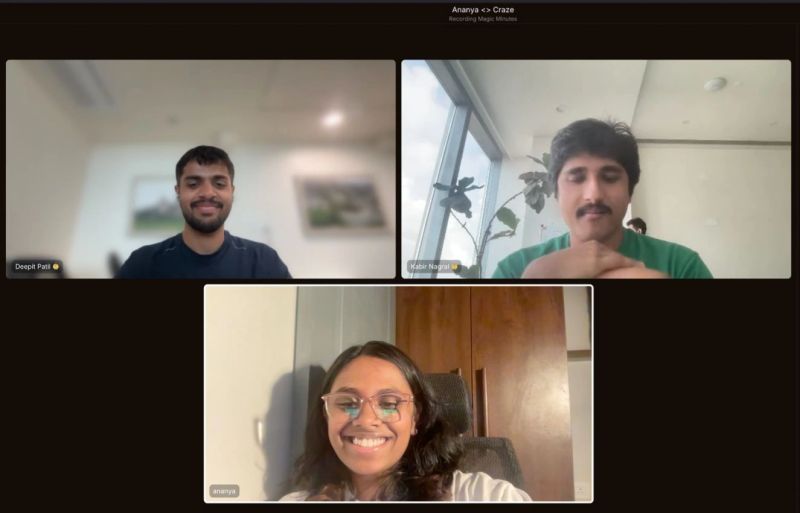
Craze presented itself as a founder-friendly alternative to spreadsheets and older systems, wrapping several administrative jobs into one product. Nagral drove business and product direction; Patil led technology and engineering. Their public exchanges suggest a partnership comfortable with absurdity. When Nagral later announced the old company's end, Patil's response was a banking joke: “Banks are closed, but not Craze AI.”
A funeral with the lights on
The payroll chapter did not receive the soft-focus language of a strategic realignment. Nagral announced that the company had made the tough decision to shut down. “Craze is officially dead,” he wrote, thanked the people involved, and immediately introduced Craze AI. Because the post appeared around April Fools' season, some readers waited for the punchline. The punchline was continuity.
Keeping the name was more than a joke, though the joke helped. A startup's identity is often overfitted to its first product. Craze was roomy. It could describe the hectic bundle of HR chores, a general agent coordinating tools, or a creative machine assembling video. The word survived because it promised energy, not a feature.
The first AI incarnation pushed against the chatbot as the default interface. Nagral and Patil argued that models should use browsers, company resources, and third-party applications to carry out longer tasks, sometimes proactively and with approval. Nagral compared chat-only AI to speaking with a person who had no ability except talking back. His preferred AI had hands.
“Don't just chat with AI. Actually get things done.”Kabir Nagral on Craze's product premise
From doing everything to making one thing
General-purpose agents offer a large promise and a large explanation problem. Craze's current site converts that ambition into a recognizable job: make videos people watch. A user brings footage or creative direction. The system researches and plans, assembles a cut, generates video, audio, music, or motion graphics, and allows human editing when needed.
The menu is broad - user-generated content, product visualization, micro dramas, music videos, wedding highlights, YouTube reviews - but the transaction is simple. One plan costs $19 per month. The headline tells users to stop prompting and start directing. It is a creative version of the 7 PM payroll story: reduce the distance between an expressed need and finished work.
That focus also places Nagral's operating style in a different theater. Payroll punishes errors with anxious employees and compliance trouble. Video punishes dullness with indifference. One requires exactness; the other requires taste. Craze now promises both automation and judgment, including access to current AI models and a human editor when desired. It is a demanding combination, and a clearer test than the invitation to ask an agent to do anything.
Loyalty and the useful kind of quitting
Outside work, Nagral identifies himself through teams: Manchester United, the Boston Celtics, Indian cricket, Mumbai Indians, and the New England Patriots. It is a crowded fixture list, united by devotion to competition. Sports fandom rewards loyalty across seasons. Company-building requires a more awkward balance. The founder must persist through ordinary setbacks and still notice when persistence has become expensive theater.
Nagral's public persona is direct, competitive, and fond of a gag. His X biography has carried the phrase “You can just do things.” His LinkedIn feed mixes customer stories, product clips, earnest arguments about founder intensity, and satire sharp enough that some readers miss the joke. Underneath the performance is an uncomplicated preference for motion.
The danger of that preference is motion without memory. Craze's history suggests another possibility. Each product left behind a usable lesson. Sports supplied the competitive vocabulary. Payroll taught reliability and service under a deadline. The general agent phase expanded the sense of what software could execute. Video asks the team to package those instincts into something people can judge in seconds.
It is too early to turn the latest chapter into a victory lap. The current company is active, small, and newly focused. Its own story argues against declaring any product shape permanent. What can be said is that Nagral and Patil have become practiced at preserving collaboration while revising the proposition.
The teenager who organized a panel around education, equity, and employment wanted technology to widen the set of work people could do. The founder now wants creative software to perform more of the tedious work between an idea and a finished video. The markets, stakes, and language have changed. The impatience has not.
A clean founder myth would make every turn point toward the present. Nagral's path is more useful with the wrong turns intact. It shows a company learning in public, a cofounder pair willing to bury their own product, and a name elastic enough to attend both funeral and launch. Craze died. Craze continued. The verb was always the valuable part.