The product video begins, as so many small corporate operas do, with optimism. Someone opens a screen recorder. A notification arrives. The cursor circles the wrong button. A sentence goes missing halfway through its own grammar. By take six, the feature being demonstrated feels less like a triumph of software and more like a personal adversary. Then comes the timeline, where an innocent minute of explanation can consume an afternoon.
Jasper Story has chosen this mild, expensive misery as his company’s material. He is the co-founder and CEO of Yarn, a New York-based startup from Y Combinator’s Winter 2024 batch. Yarn began with a clear proposition: let founders, marketers and salespeople make polished product videos without becoming video editors. In its newest form, the company describes itself as the video product for agentic go-to-market teams. The user supplies a brief, a product and some judgment. Software agents pick up more of the production.
This is an automation story with an unusually apt protagonist. Story’s public career has moved through roles that require translation. He studied at Durham University from 2006 to 2009. He worked at Google, where his founder biography says he made ads. He taught high-school mathematics. At early-stage startups, he worked as a developer, designer and product manager. Those labels are different uniforms for the same basic task: understand a complicated system, decide what matters, and help another person see it.
2006-09
ads + product
classroom
2023-now
The generalist arrives with a red pen
There is a useful distinction between making video and making a point. Traditional editing software is excellent at the first. It gives the operator exquisite control over cuts, tracks, keyframes, color and sound. It is less interested in why a salesperson needs a 45-second clip for one account by Thursday. The machinery is neutral. The deadline is not.
Story’s background makes that gap hard to ignore. A developer sees what can be automated. A designer notices when the result looks wrong. A product manager asks who needs it and why. A teacher watches for the moment an explanation lands. Yarn folds those instincts into one workflow: product demos that can record themselves, talk tracks generated or recorded inside the project, on-brand graphics, a real editing timeline, and comments that can become instructions for an agent.
“You provide the spark, agents do the rest.”Jasper Story, launching Yarn’s agentic video product
The phrase is neat, but “the rest” contains nearly everything that makes video annoying. A product changes after the screen recording. A voiceover needs one corrected sentence. The brand team wants a different treatment. A demo for one prospect becomes five demos for five industries. Each revision can reopen the whole little factory. Yarn’s wager is that these jobs can become instructions instead of manual operations.
Story calls the idea “Waymo for video production,” a metaphor that makes autonomy sound both practical and faintly mischievous. You name the destination. The system handles more of the route. Crucially, the passenger still knows where they intended to go. Creative software fails in a particularly visible way when it produces competent motion around a confused point.
A physicist walks into the edit
Yarn is a two-founder story. Story built the company with Nicole Atack, its CTO, whose own route includes quantitative work and particle physics. Their original YC introduction made the contrast compact: Jasper had made ads for Google; Nicole was a former quant and particle physicist. One brings a career across product, design and explanation. The other brings a scientific and technical discipline. Together they picked a medium in which taste and systems engineering are obliged to share a desk.
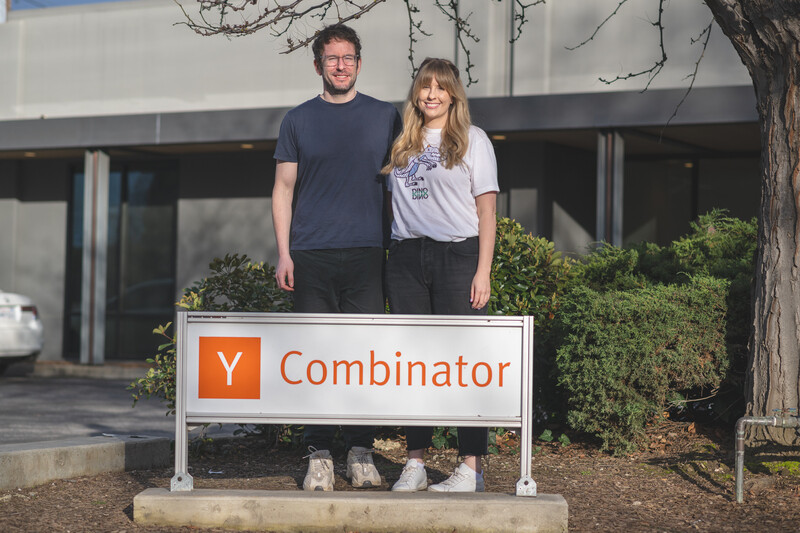
They founded Yarn in 2023 and joined YC’s W24 batch. The first launch focused on product and sales videos made with AI. Users edited as if working in a document, used synthetic or matched voices, and applied a company’s branding without building every scene from scratch. Teams used the product for sales collateral, feature launches, demos, training guides and social updates. The promise was speed, but the interface choice mattered more: editing should begin from language and structure rather than from a thicket of tracks.
By 2026, the vocabulary had shifted from AI assistance to agents. The current product is aimed at teams whose go-to-market work already crosses human and automated systems. Story says the growth teams at Clay and Faire have made hundreds of videos with Yarn. The launch video was itself produced in Yarn, a useful demonstration because software companies are never more charmingly vulnerable than when they use their own product in public.
The change is more than fashionable naming. An AI feature waits inside a tool. An agent is expected to carry a task across steps. In video, that could mean understanding a script, navigating a product, recording the right interactions, laying out scenes, applying a visual system, adjusting timing and returning when a human leaves a comment. The editor becomes less an instrument panel and more a workplace.
Yarn’s product lesson is portable: map the entire annoying workflow, not merely the glamorous artifact at the end. Generation is one step. Revision, reuse, personalization and approval are where teams surrender their afternoons.
The stubborn human in the machine
There is an obvious danger in making video easy: the world acquires more video. Story’s answer is not an argument for volume alone. In his launch note, he wrote that relationships and storytelling are the remaining lever in a world of viral videos and agents. Yarn, he said, was built to help teams scale their stories “authentically.” It is an unfashionably human word to place beside autonomous production, and therefore the important one.
Authenticity cannot be selected from a dropdown with much conviction. It comes from specificity: a founder’s peculiar phrasing, a salesperson’s knowledge of one customer, the moment a product finally solves an old irritation. An agent can assemble those ingredients, but the ingredients have to exist. Yarn can lower the cost of turning them into scenes. It cannot make a company have something to say.
Story’s years in the classroom offer a quiet analogy. Teaching mathematics involves repeatable structures, but no class is entirely repeatable. The proof on the board can be correct while the explanation fails. A teacher changes the example, pauses, tries another route, notices the face that has gone blank. The work is partly knowledge and partly attention. Good creative automation has the same division of labor. Let the system remember every step. Keep the person alert to whether anyone will care.
“We built Yarn to help teams scale their stories - authentically.”Jasper Story
This also explains why Story’s generalist career reads less like wandering than preparation. Video for software teams sits at the intersection of code, interface design, marketing, sales and instruction. A narrow tool can automate one track. A product has to understand the handoffs. Someone must know why the engineer’s technically perfect screen capture does not help the buyer, and why the marketer’s handsome animation does not explain the feature.
Public reviews from independent creatives who worked with Story add a small offstage detail. They describe clear project requirements, professionalism and a smooth process. Testimonials are never a complete portrait, but these fit the product thesis: say what the work needs to do, make the collaboration legible, and spare everyone avoidable theater.
After the timeline
Yarn now offers a free entry point, a standard plan for growing teams and an enterprise tier with integrations and controls. The commercial shape is familiar SaaS. The behavioral change underneath is newer. If a product marketer can ask for a revised demo the way they would ask a colleague, the scarce skill moves upstream. Operating the timeline matters less. Giving precise direction matters more.
That shift favors people who can see the finished point before the machinery starts. It rewards a clear brief, a strong example, a sense of pacing, knowledge of the audience and the nerve to delete a scene that merely looks busy. Agents may democratize production. They do not repeal taste. In fact, when output becomes abundant, taste receives a promotion and a larger inbox.
Story’s aspiration is straightforward: anyone on a team should be able to make video and tell the company’s story. The difficult clause is the second one. Making a video can become a sequence of automated actions. Telling the story requires a choice about what is true, relevant and worth another person’s minute. Yarn is building around the possibility that software can shoulder the former while encouraging more people to attempt the latter.
The exhausted screen recorder may soon look quaint, like correcting typewriter ribbon with a pocketknife. Yet the final question will survive every interface. Does the viewer understand? A former maths teacher would recognize it immediately. The machines can fuss over the cut. Someone still has to watch the room.