Antonia San Martín Sola’s team had money to invest and a company to reinvent. A fintech would take neither their investment nor their business account. Its refusal exposed a problem that became Plutto’s work: before a financial institution can serve a company, someone has to establish what that company is, who represents it and whether the relationship makes sense.
Today Antonia is Plutto’s co-founder and CEO. Its software helps businesses evaluate other businesses across Latin America. The route there included corporate marketing, a travel startup that closed, an unsuccessful product idea and several people willing to keep trying together. The company name survived a change in purpose. So did the working relationships.
The team outlasted the idea
After Milla Travel closed, Antonia and Ignacio Márquez joined Felipe Domínguez and Sebastián Margozzini. They initially explored software for managing subscription payments. That version of Plutto failed to find its footing. By late 2021, the founders were investigating other possibilities.
Trying to protect their remaining cash led them to Fintual. The service was not accepting company accounts. A conversation with its co-founder Agustín Feuerhake helped direct their attention toward digital business verification. They built a minimum viable product and began operating in March 2022.
The opportunity required a fairly unromantic skill: making documents and business records useful. A signature, a company’s legal status, an unpaid account - each can affect whether another business agrees to work with it. Checking those details is a job with consequences, however modest the paperwork looks.
Later that year, Antonia took Plutto’s Y Combinator interview remotely from a small meeting room at Fintual’s Mexico offices, separately from her partners. The company joined the Summer 2022 batch and raised a reported US$500,000 round. The room was small. The next assignment was considerably larger.
A marketing education put to different use
Antonia studied Ingeniería Comercial at Universidad de Chile, specializing in business administration. Her early career took her to Nike Chile and then CCU, where she worked in marketing. Her founder biography describes nearly three years at CCU before she resigned to start a corporate-travel business.
She began that venture as a solo founder. Ignacio later joined as CTO. Travel demand collapsed, and the company closed. A business built to help people move between places had encountered a world in which movement had abruptly become difficult.
Her corporate experience remained relevant. At CCU, product development, pricing and distribution had required attention to what customers needed and what a market would support. In software, those questions return wearing different clothes. The buyer still has a budget. The product still needs a reason to exist.
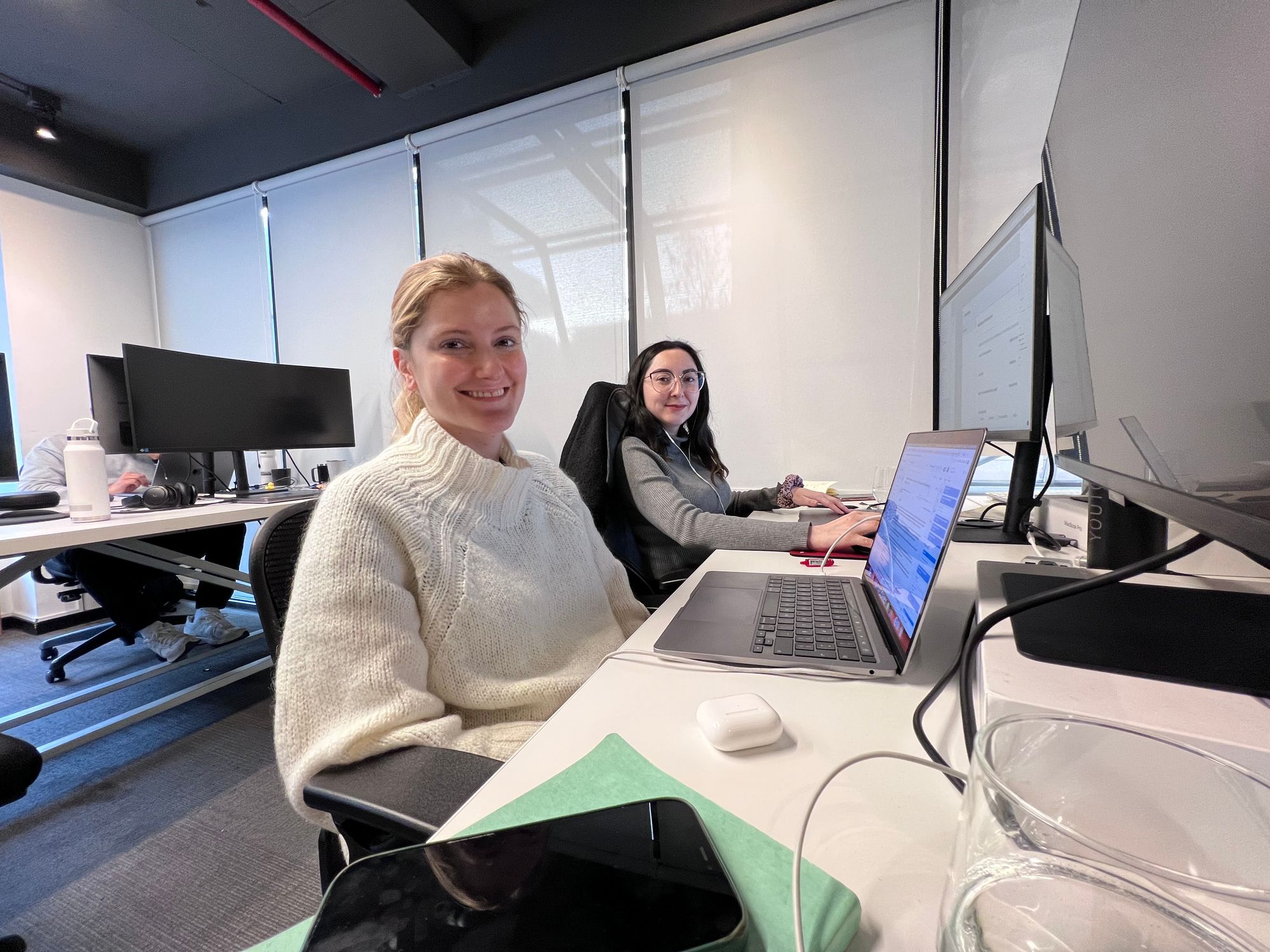
By November 2023, she described an ordinary start to the day: around 7:30, a walk with her adopted dog, then usually the office. She favored working in person and settling at her desk to organize the hours ahead. The routine is pleasantly free of founder theatre. The dog gets a walk; the work gets a plan.
“Me ayuda a entender qué voy a hacer en las próximas horas y así no divago.”
Antonia, on organizing her working day, 2023
A deadline before the next beginning
Antonia’s account of 2022 includes a limit. The team had given itself until March to find a new idea. Without one, they would look for jobs. That detail puts a useful boundary around the familiar instruction to persist. Persistence had a calendar.
By December, she described the swing from a stalled venture to Y Combinator and a funding round as a roller coaster. Revenue was growing. Yet she also anticipated tighter conditions in 2023 and explained that the team had avoided hiring aggressively.
Her ambition and her caution occupied the same interview. She wanted more growth while preserving the months of operating time the round had bought. She spoke of the possibility of a Chilean company expanding across Latin America and selling into the United States.
“En 2023 hay que apretarse el cinturón,” she said. The sentence means tightening the belt. It is a decidedly practical accessory for a company whose next destination is still being worked out.
When more data was still too little
Another change followed. In July 2023, Antonia explained that Plutto had started by combining information from different sources and delivering it through an API. Customers received the data, but many lacked the technical or analytical teams to make fuller use of it.
They kept asking for the same few points. Conversations revealed the gap: supplying information left a substantial job unfinished. Plutto moved toward helping customers create risk analysis, decision models and alerts. The product became more involved in the customer’s work.
For Antonia, the lesson included a distinction between listening and simply implementing every request. A company needed its own view of where the product should go. She also described becoming more structured and revising her assumption that a larger team necessarily moved faster.
There is a recurring problem here for anyone selling information. A well-stocked cupboard does not make dinner. The customer still needs a way to choose, combine and use what has arrived. Antonia’s team had to decide how much of that remaining work it should take on.
The people on either side of the pivot
The founder relationships are part of Antonia’s story. Ignacio brought software-building experience; Felipe had worked as a developer and scrum master at Platanus. Sebastián was part of the original founding team. Their backgrounds gave the venture several ways of approaching a customer’s problem.
Platanus also appears repeatedly. It helped develop the earlier travel product, supplied an accelerator community and remained a place where founders shared what they had learned. In 2023, Antonia joined a kickoff conversation with founders including Leo Soto of Shinkansen, Cristóbal Griffero of Fintoc and Ian Lee of Examedi.
By October 2024, Mexico Tech Week listed her as moderator for an ask-me-anything session with Pedro Pineda, Fintual’s co-founder and CEO. The event opened a founder conversation to additional participants beyond the accelerator community. Antonia had moved from asking for help to helping frame the questions.
Her May 2023 Fundadores appearance covered the earlier travel venture, a rejected purchase offer and the value of seeking help as a first-time founder. Its recommended reading included Dale Carnegie’s How to Win Friends and Influence People. For a career built partly through conversations, the choice has a certain consistency.
Ten days, and a different denominator
A customer case makes the work more concrete. Buda began using Plutto for business-client verification and onboarding in June 2024. In an update Antonia shared, Buda reported that the process had shortened by ten days. It also reported that conversion among companies approved as customers rose from 12.5 percent to 25 percent.
These are reported results from that customer relationship. They describe a particular process rather than a universal promise. Their usefulness is that they bring the discussion back to an operational question: how much time and effort does it take for a business to become a customer?
A company can have an interested buyer and still face a queue of checks. Someone must request information, review it and decide whether the relationship can proceed. In this case, the published figures suggest that changing that sequence mattered to both speed and conversion. The paperwork had a measurable place in the business.
Customer-reported figures shared by Plutto; one case, not a forecast.
A wider desk by 2025
By 2025, the work was reaching beyond the original financial-client checks. Antonia participated in a contract-management webinar with Plutto product manager Flavia Cuneo and Andrés Arriagada. The discussion covered administration, risk and the use of technology. Another update described Plutto’s collaboration with Entel on customer evaluation and digital onboarding.
A growth-marketing vacancy she shared described corporate customers in Chile, Mexico and Peru. Her year-end account added an automated conflict-of-interest product, tools for internal purchasing requests and further AI products. The company was gathering more of the activities surrounding a business relationship.
PluttoConnect 2025 brought purchasing and compliance teams together, with speakers from Google and Oracle and more than 100 corporate attendees. Antonia thanked her colleagues and the participants. The event suggests another part of her job: giving people who face similar problems a place to talk about them.
Plutto’s current platform includes document review, official-source checks, risk analysis, monitoring and records for audits. A supplier portal lets vendors submit information. The customer defines its risk criteria. Those details matter because a decision has to be explainable to the people who inherit it later.
Antonia’s career keeps returning to that practical territory. A product closes. A team stays. A customer asks for information, then needs help using it. The next direction emerges through the work. For someone who began in marketing, she has spent a good deal of time learning what must happen before a business can say yes.