A modern supply chain is a magnificent liar. The label says one company made the product. The invoice names another. Underneath sit contract factories, brokers, smelters, software libraries and owners nested inside owners. When a port closes, a government adds a company to a sanctions list, or a sub-tier factory uses forced labor, the neat spreadsheet on the procurement director's laptop suddenly looks like fiction.
Exiger makes software for the moment the fiction collapses. Its 1Exiger platform pulls together corporate records, watchlists, trade data, news, customer files, bills of material and software components. It resolves the names, maps the relationships and scores the risk. The practical questions are blunt: What touches this supplier? Which product stops? Is the alert meaningful? Who can replace the source?
That makes Exiger part data company, part workflow system and part institutional memory for investigators. More than 550 organizations use it, the company says, including 150 Fortune 500 businesses and more than 60 government and Defense Industrial Base organizations. The user is usually not browsing for fun. She is clearing a vendor, chasing a tariff exposure, defending an audit trail or trying to keep a production line moving.
The consultancy that outgrew consulting
Exiger did not start in a procurement office. Michael Cherkasky and Michael Beber founded it in 2013 amid a surge of regulatory enforcement against banks. The early firm sold financial-crime expertise, investigations, remediation and monitorship work - careful, expensive labor for institutions that could not afford another compliance failure.
That origin still matters. Many software companies begin with a database and go hunting for a use case. Exiger began with investigators making consequential decisions and went hunting for a way to repeat their work. The first constraint was human throughput. Researchers had to bounce among watchlists, media archives, corporate registries and internal systems, then assemble a defensible account of what mattered. Exiger now calls this the “swivel-chair effect.” It is a good phrase for an ugly operating model.
The company's first decisive technology move came in 2017, when it bought Toronto startup OutsideIQ for a reported C$30 million. OutsideIQ brought DDIQ, a machine-learning system built to search and organize due-diligence evidence. A year later, Carrick Capital Partners invested $80 million in minority growth capital. Exiger says the money backed technology development and acquisitions. In 2021, a $70 million Monroe Capital credit facility added more fuel.
What changed management's mind was less a single epiphany than a customer signal that kept getting louder. Third-party and supply-chain risk could be encoded as a repeatable software workflow. Advisory work could not scale the same way. CEO Brandon Daniels later described annual recurring revenue growing above 65 percent during the Carrick era. In September 2023, Exiger agreed to sell its financial-crime compliance advisory division to Capgemini. Three months later, Carlyle and Insight Partners announced a majority investment. The consultancy had not failed. It had become the raw material for a software company, then ceased to be the main event.
The first thing Exiger outgrew was labor. The thing it kept was investigator-grade evidence.YesPress analysis
A map that goes below the supplier
The cleanest way to understand 1Exiger is as a layered map. At the top are the people and companies that compliance teams screen. Under them sit facilities, ownership structures and transactions. Go deeper and the map reaches products, components, raw materials and software. Risk data - sanctions, cyber vulnerabilities, forced-labor indicators, financial health, disasters and adverse media - flows across those links.
This is the distinction Exiger pushes against competitors such as Everstream Analytics, Resilinc, Interos, Prewave and Sphera. All can monitor supplier risk in some form. Exiger's argument is that an alert is only useful when it can be tied to the product, part or software dependency that creates exposure - and then to a possible action. Its acquired XSB database alone contains more than 100 million parts and 400 million attributes. Supply Dynamics added the ability to follow outsourced parts and raw materials through multiple tiers. Ion Channel and aDolus brought software bills of material and provenance into the same picture.
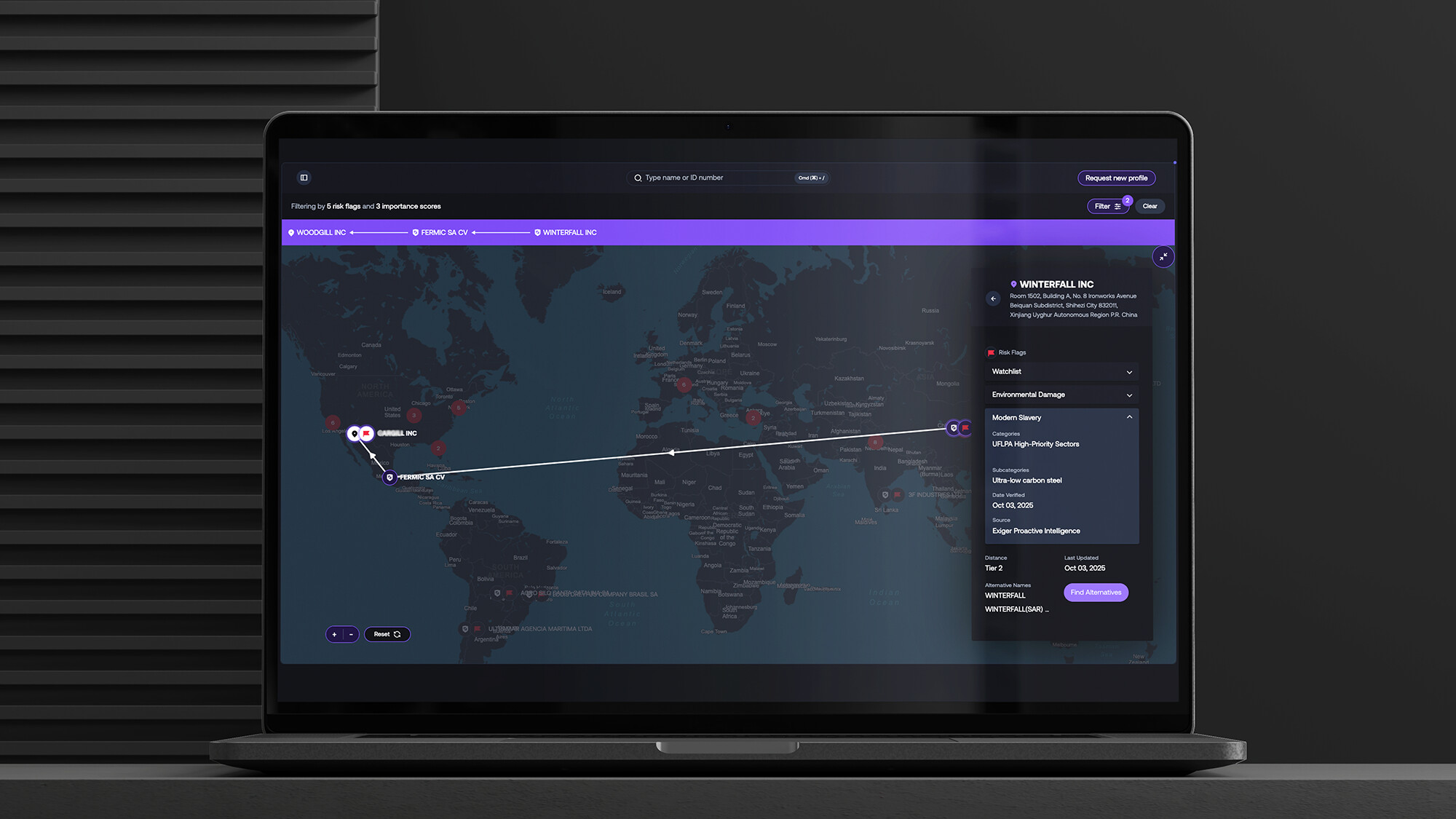
The image is not merely a prettier version of a vendor master. A procurement team can start with a finished system, ingest technical drawings and bills of material, infer the materials inside specific parts, and trace a critical mineral toward its geographic source. A legal team can start with a prospective distributor and find hidden ownership or sanctions exposure. A cyber team can start with a software component and see where a vulnerable dependency appears.
The payoff is measured in stopped surprises
Risk software often sells fear and reports activity. Exiger's sharper cases sell economics. For a large aerospace manufacturer, the company says it illuminated more than one million part numbers across 6,000 tier-one suppliers and more than 600 raw-material sources. The mapping supported a directed-buy program that produced $200 million in savings. Another aerospace and defense case reported parts-cost savings of 15 to 35 percent through Part Attribute Characterization.
From visibility to money
Avoided loss is harder to prove. A seizure that did not happen leaves no receipt. A production line that kept moving looks like an ordinary Tuesday. This is why concrete sourcing savings matter: they let a chief procurement officer justify the same map that a compliance chief uses for forced-labor rules and a security team uses for foreign-control risk.
Customers pay enterprise prices for that overlap. Exiger does not post a menu. Contracts vary with data, integrations, users, security and network complexity. One unusually visible benchmark comes from public procurement data: a U.S. Army Materiel Command subscription for supply-chain orchestration and monitoring began around $5.27 million and reached $10.54 million after its period was extended. That is not a list price. It is evidence that major deployments are treated as operating infrastructure.
What a buyer can copy before buying
Exiger's playbook is more portable than its data. The company did not begin by promising omniscience. It began with a costly decision, watched experts make it repeatedly, and automated the parts that were stable. It added data depth through acquisitions only when the customer question demanded it. The sequence matters.
The useful five-step version
- Choose one decision where a missed dependency has an obvious dollar or compliance cost.
- Map beyond the vendor of record to ownership, facilities, parts, materials and code.
- Rank alerts by material exposure instead of collecting a larger pile of warnings.
- Attach every score to evidence a human can inspect and an auditor can retrace.
- Put the alternate supplier, escalation or remediation step beside the alert.
The limits are equally practical. This approach works when the network is large, the data is messy and the cost of being wrong is high. A small domestic business with twenty stable suppliers does not need a 20-billion-record intelligence layer. Nor can software conjure perfect truth from suppliers that refuse to disclose sub-tiers, countries with thin corporate records or technical documents that were never digitized. Entity resolution can reduce false positives; it cannot abolish ambiguity.
Strong fit
Complex manufacturing, global sourcing, regulated products, government work, expensive downtime, sensitive software and teams that need a shared audit trail.
Weak fit
Few suppliers, simple local purchasing, low regulatory exposure, little integration capacity or no operating process to act on the alerts.
The next product is access
In 2026, Exiger pushed part of its data outside the enterprise contract. The free forcedlabor.ai tool, introduced around Davos, searches 20 billion records for corporate connections to state-sponsored forced labor. Exiger also expanded critical-mineral intelligence and joined a World Economic Forum data partnership against forced labor. Vodafone and Telenor's joint procurement operation selected the company for supplier-risk intelligence. New CTO Adi Kavaler arrived with a mandate to scale an AI-native platform.
There is strategy inside the generosity. A free search can reveal the risk. Large organizations still need continuous monitoring, secure integrations, permissions, case management and proof that somebody closed the loop. The public tool widens the top of the funnel while reinforcing Exiger's larger point: hidden dependencies are no longer a specialist curiosity. They are a management problem.
The company that once arrived after a regulatory mess now wants to arrive before the shipment, the audit and the shortage. Its bet is that the most valuable answer in supply-chain management is not “something happened.” It is “this is what it touches, this is what it costs, and this is what you can do by morning.”