The useful inconvenience
The tire shop was good. The internet had no way of knowing. Eric Rea's father ran the business in Canada, where competence arrived in the practical forms of rubber, alignment and getting a customer safely back on the road. But online, the shop had almost no reviews. A business could be trusted by the people who knew it and invisible to everybody else. The contradiction bothered his son enough to become a company.
At the time, Rea had followed a respectable route into software. He grew up in Calgary, studied information systems at Brigham Young University and graduated in 2012. Then came Vienna and a job as a software engineer at the International Atomic Energy Agency. The institution was important; the pace was not his. Rea later called it perhaps the most bureaucratic job in the world, an exotic address attached to the opposite of what he wanted from a career.
His father's complaint supplied the escape hatch. Local businesses had moved into an era in which a stranger's phone could decide whether they appeared legitimate, yet many still relied on the landline and whatever affection existed in the neighborhood. Rea recruited Dennis Steele, a fellow BYU graduate. They put in $750 each, read Paul Graham's essays on product-market fit and began building what was first called RepDrive.
01 / The first saleKnocking before scaling
The founders worked nights from a spare bedroom in Rea's apartment. By day they walked into local businesses and pitched. Door-to-door sales has none of software's flattering abstractions. The proprietor is busy. The product must make sense before the patience expires. Rea said they sold to almost everyone they approached, but the more consequential result was the conversation itself. Every call on an owner doubled as product research.
They learned that a request for a review could not feel like bulk email. It needed to arrive personally, on the channel customers actually used, and lead them toward the sites that mattered. The insight was plain enough to be missed by people searching for something more glamorous. Podium would build for tire shops, dentists, plumbers and car dealers, the durable middle of commerce whose software too often appeared to have been designed by somebody who had never stood behind the counter.
“We did not spend money on anything except for getting customers or building something people wanted.”
Eric Rea, on Podium's first year
Soon the bedroom was too small. The team moved into the attic above a roughly century-old bike shop in Provo. Winter came through the building. Summer sat inside it; on the worst days the heat made people so irritable that meetings were canceled. There were about 15 employees, some engineers and very little architectural dignity. The scene had comic value only in retrospect.
One visitor did not find it charming. An analyst from a prominent Bay Area venture firm arrived for a scheduled hour. He called from outside, convinced that the address beside an old bicycle store could not possibly be right. Rea directed him around the back and up the stairs. Twenty minutes into the presentation, the analyst stood, fumbled an excuse and left for his next meeting.
Rea and Steele drove home flattened. Perhaps Utah was the problem. Perhaps software for ordinary merchants was too small a story. Perhaps they should return the money they had raised. By morning, a less theatrical fact reasserted itself: dozens of customers were paying every month, staying and getting value. The analyst had left. The customers had not.
02 / The Utah wagerDistance becomes a filter
Podium entered Y Combinator's Winter 2016 batch. Acceptance brought the network and credibility the founders lacked, but not a change of address. Rea argued that building outside Silicon Valley could be an advantage. Salaries and office costs were lower. Employees stayed longer. Just as important, Utah kept the company close to the businesses it served and far enough from the industry's fashions to hear them clearly.
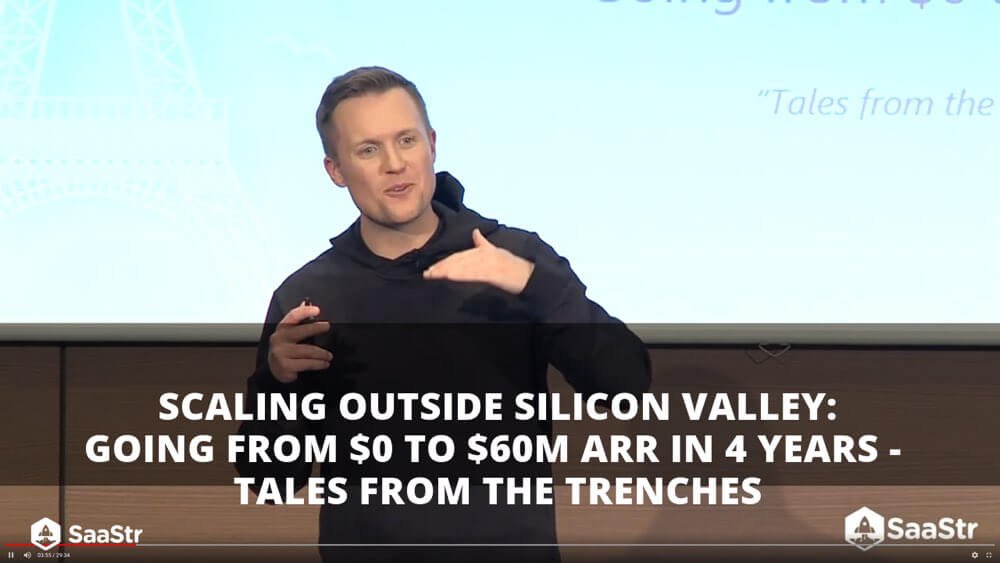
The company moved quickly. Rea told a Paris audience that Podium went from zero to $60 million in annual recurring revenue in four years. The product widened from reviews to a communications platform, then to payments. In 2019 he described 550 employees and $92 million raised. In November 2021, Podium announced a $201 million Series D led by YC Continuity. The financing valued the company above $3 billion and made the former attic seem like the opening joke in a very expensive comedy.
A company built in chapters
For Rea, Utah also meant a life that did not need to apologize for itself. He has praised the state's technology community, its five national parks within driving distance and the possibility of skiing double-digit days while running a company. The line is revealing. His case for a headquarters was not merely a spreadsheet. Work should be intense without making the rest of life geographically absurd.
There is a funny symmetry here. Podium helped small companies acquire the visible proof of legitimacy they lacked online. Y Combinator and later investors supplied a version of the same thing to Podium. Rea never pretended networks were useless. He simply refused to confuse the network with the work.
03 / The hard yearResponsibility before reinvention
Growth stories prefer a clean diagonal. Companies do not oblige. In December 2022, Podium reduced its workforce by 12 percent amid a punishing market for technology companies. Rea and Steele wrote that they accepted full responsibility for the decisions that led there and were sorry. The timing, shortly before the holidays, made an already painful decision harsher.
No metric repairs what a layoff does to the people leaving. It does, however, reveal something when founders put their names beneath responsibility instead of hiding the decision in passive voice. Podium cut back, worked toward profitability and faced the less cinematic task of deciding what kind of company should emerge.
The answer arrived through the same method that had produced RepDrive: identify the customer's binding constraint. By the end of 2023, Rea said more than 60,000 local businesses were using Podium to centralize leads and communications. Yet good software could not answer a phone after hours if nobody was there. Owners did not need another feature to click. They needed the work completed.
04 / The second betGiving the software a job
Podium began experimenting with GPT-3 in 2020, but Rea dates the practical breakthrough to late 2023, when capable models could support production conversations. The company built an agent called Jerry for car dealerships. It could respond to inbound leads, handle objections, follow up and schedule a test drive. One early customer canceled quickly. Others watched actual shoppers arrive for appointments arranged by the machine. The lesson was not that a clever demo could pass for a worker. Trust and customization would determine whether the agent survived contact with business.
Rea moved himself nearer the product. By 2026, he said every product leader had reported directly to him for two years and that he had effectively taken on product leadership alongside the CEO job. The arrangement gave him about 16 direct reports, an org chart with all the calming properties of a dropped cutlery drawer. He accepted the trade because artificial intelligence was changing too quickly for the company's bets to wait their turn in a conventional roadmap.
“For the first time, the software does the work instead of just holding the data.”
Eric Rea, August 2026
In January 2026, Rea said Podium's AI-agent line had crossed $100 million in annual recurring revenue in less than 24 months, with more than 10,000 agents in production and 300 percent year-over-year AI revenue growth. In an interview that month, he said about half of that revenue came from existing customers upgrading and half from new customers buying the agents first. These are company-reported numbers, but they clarify the bet: Podium was no longer only selling a tool to labor. It was selling a portion of the labor.
By August, the idea had expanded into an operating system for home-service contractors. Named agents could answer calls, manage memberships and work across schedules, jobs and invoices. Rea's ambition was no longer to make a review request feel personal. It was to let an owner describe a task in plain English and have the system pursue it across the business until it was done.
This future carries harder questions than review software did. An awkward review request may annoy a customer. An agent that speaks, schedules, prices or pursues payment can make a more expensive mistake. Rea's response has been to emphasize coaching, business-specific playbooks and escalation to people. The burden now is reliability, not novelty. Main Street has always been intolerant of software that needs the proprietor to become its unpaid technician.
05 / What stayed putThe boring business is the point
Across twelve years, the technology in Rea's pitch changed almost beyond recognition. The customer did not. It is still the owner whose phone rings during dinner, whose trusted employee may leave, whose reputation can turn on a handful of search results, and whose missed lead is not a line in a funnel but next month's payroll. The ordinary business was never a prelude to a more fashionable market. It was the market.
Rea's public persona carries an engineer's impatience with ceremony and a salesman's appetite for the room. He can reduce a strategy to an outcome a shop owner recognizes: get chosen, answer faster, book the work, collect the money. His advice to founders follows the same grain. Find the largest problem you can. Build something people want. Get it into their hands quickly. Hire people who can take the company somewhere the founders cannot reach alone.
He also remembers less dignified labor. His first job was washing dishes at a golf course, where somebody once sent him into a dumpster with a pressure washer. It is difficult to turn that memory into a grand theory of leadership, though it does establish a useful floor for bad office assignments. The bike-shop attic, at least, was above the refuse.
Podium's story is sometimes told through its valuations, funding rounds and revenue milestones. Those numbers explain the scale. They do not explain the persistence. For that, return to the tire shop. A decent local business was doing the work and receiving too little credit because the systems around it had not kept up. Rea noticed the gap. Then he kept noticing new versions of it.
The next version may work, stumble or invite a competitor with a better answer. Rea appears comfortable with that wager. He has already built through an investor's exit, a freezing attic, hypergrowth, a painful contraction and a technological reset. The scenery changes. His preferred test remains wonderfully unfashionable: does the owner get the result?