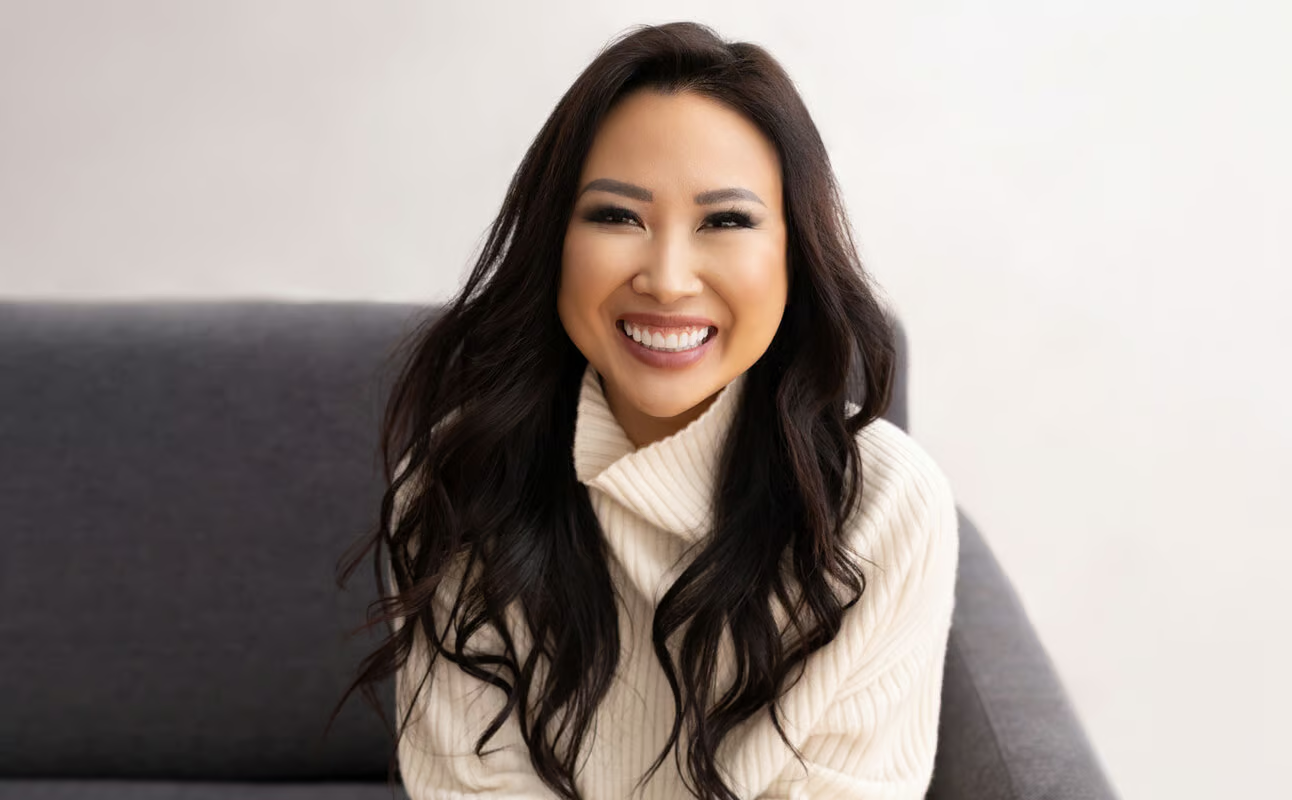
The CEO who packs your dinner in a jar she expects back
Julie Nguyen runs Methodology, a meal-delivery company whose most stubborn design choice is the container. Reusable glass jars. Returnable. The opposite of a microwave tray. Every box that arrives at a customer's door is also a quiet promise that she will accept it back, wash it, and use it again. That single decision tells you most of what you need to know about how she runs the company.
Methodology was started in 2015 out of the Bay Area. Today the headquarters sits in Concord, California, the staff is around 44 people, and the meals go out across the country every week, pre-cooked, chef-driven, and ingredient-strict. The founding partner in the kitchen is Stephen Liu. The founder at the wheel of the business is Nguyen. They have been at it for a decade without selling the company, without a unicorn fundraise, and without changing the answer to the question "why glass and not plastic?"
I wanted to bridge the gap between food as medicine and food as pleasure.- Julie Nguyen to Goop
An origin story that begins at a drive-thru in Santa Ana
Nguyen grew up in Santa Ana, California, raised by a single mother who emigrated from Vietnam. As she told Voyage LA, her mom did not feed the family fast food out of indifference. She fed them fast food because she believed it was healthy. Americans were taller. The country was wealthier. The food at the counter must therefore be the food that built that. It is the kind of family-table reasoning that no economics class at Stanford will ever quite undo, and Nguyen has never tried to scrub it out of the story. She tells it the same way every time, with the affection intact.
She went to Stanford from 2000 to 2004 and studied economics. She interned at UBS in 2003. She landed at J.P. Morgan Asset Management as an analyst in 2006. By 2008 she had jumped to Lumos Labs, the company behind Lumosity, where she climbed into VP of Lifecycle Marketing. By any normal reading of a resume, the next move was supposed to be a bigger marketing seat at a bigger tech company. Instead she went and started cooking.
Real food heals. I was sick for so long and it wasn't until I was in my 20s that I learned that.
Just eat real food. If you do that, you don't need to know anything else about food.
You need to understand the principles of what works for you as a leader.
The longer the shelf-life, the more likely hidden ingredients have been used to preserve flavor, look, smell, and texture.
How a finance brain becomes a food brain
Before Methodology existed there was a six-year personal research project. Nguyen worked through nutritionists, trainers, and the entire shelf of contradictory diet books. She kept what worked. She threw out what did not. It was less a wellness arc than a spreadsheet arc. When she eventually went looking for a meal service to outsource the result, every option on the market looked, in her words, like a TV dinner designed for a bodybuilder counting macros. None of them treated food as something a person might actually want to eat. None of them treated packaging as something a company might be embarrassed by. So she built one that did both.
The funding story is the part founders do not always like to repeat. Nguyen emptied her 401(k). She and Liu went without a salary in the early years. A seed round closed in 2019. There has been no chase up the venture ladder since. The eight-figure revenue line that Forbes reported in January 2025 was earned the slow way, customer by customer, repeat order by repeat order.
What is on the menu, and why it costs what it costs
Methodology meals start around fourteen dollars each. The exclusion list is the marketing. No refined sugar. No gluten. No dairy. No canola oil. No chemicals or preservatives that would let a meal pretend to be fresh after a month on a shelf. The inclusion list is shorter and more interesting: pastured proteins, avocado oil, plant-rich plates, the kind of produce a chef would point at in a market and call by its first name.
The weekly subscription is the trick that turns it from a meal kit into a habit. Customers set their restrictions and ratings, and the system assigns the next week's box accordingly. The meals arrive pre-cooked and reheat in under five minutes. The jars go back. It is logistics dressed up as luxury.
The four hours a week that explain the company
Every leadership profile of Nguyen circles back to one habit. She spends at least four hours every week answering customer service tickets herself. Not skim-reading them. Answering them. After ten years and an operations team that could absolutely cover it, she still does this. It is the cheapest qualitative research tool a CEO can buy and almost no CEO uses it. It is also why Methodology can pivot a menu item the week customers stop loving it instead of the quarter after.
Ask anyone who has interviewed her - Kara Goldin, the Dear FoundHer team, Forbes, Goop, The Chalkboard - and the same trait keeps surfacing. Patience. Operator patience. The willingness to do the unglamorous version of every job the company depends on, including reading the angry email that arrives at 11 p.m. on a Tuesday because a meal showed up two hours late.
We are seeing more people lean toward the Mediterranean diet as they've realized it's the most science-backed diet.- Julie Nguyen, The Chalkboard Mag
A founder who lives between two kitchens
Nguyen splits her time between San Francisco and Paris. Forbes calls her a nomadic CEO, which is generous wording for "answers Slack at strange hours from both sides of the Atlantic." Paris suits her. It is a city that takes food seriously without apologising for it, and that is roughly the posture Methodology takes with American customers who still think of healthy food as a punishment.
The Paris habit is not branding. It shows up in the way she talks about ingredients, in the Mediterranean lean of the menu, in the willingness to call something on the plate beautiful instead of macro-balanced. When she sits down with a journalist she will, more often than not, talk about cooking as pleasure first and as nutrition second. That order matters. Most founders in this category get it backwards.
The quirks worth knowing
Nguyen wanted to be a newscaster when she was a kid, inspired by Katie Couric and The Today Show. There is a version of this profile in which she ended up reading the morning news to America. Instead she ended up emailing morning customers about menu changes.
She has largely retired her high heels. She prefers shoes she can walk twenty thousand steps in. She tracks the steps on an Apple Watch that she has named, in interviews, as the single purchase that most changed how she moves through a day. She owns eight pill organisers so she only has to refill her supplements every two months, which is the kind of detail that tells you everything about her relationship with operational friction. She does not tolerate it. Not in her morning. Not in her warehouse.
She weighs her portions. She has said, with a straight face, that she used to eat healthy but eat too much and that the kitchen scale was a humbling teacher. It is the rare founder anecdote that doubles as a product principle. Methodology meals are portioned for a reason. Their CEO portions her own breakfast.
What she is building toward
The category Methodology sits in is loud. There are venture-backed competitors burning cash to win the homepage. There are grocery aisles full of plastic-tray meal kits promising the moon. Nguyen has chosen, by repeating the choice for a decade, to ignore the loud version of the game. Premium pricing. Reusable glass. Real cooks. A subscription that behaves like a habit rather than a stunt. The bet is that quietly defensible beats temporarily viral.
So far the bet is winning. Methodology has not been acquired. It has not pivoted into a ghost-kitchen marketplace. It has not bolted on hardware. It has not added a celebrity co-founder. It is the same company that started in 2015, only larger, calmer, and shipped to more zip codes. The CEO is the same too, only with more frequent flier miles and a slightly louder opinion about avocado oil.
If you want a working theory of where she goes next, listen to how she frames the product in public. It is rarely about weight loss and almost always about removing decisions. The Methodology customer is a person who has stopped wanting to think about what to cook on a Tuesday. Nguyen is selling that absence of decision. The end state of that thesis is not a bigger meal company. It is a default-option food brand that an entire generation of busy people decides to never have to think about again.
The glass jar comes back. The next box arrives. The CEO keeps reading the inbox.