Standing at the entrance to Bloch Heritage Hall, Julia Terenjuk found herself thinking about the people who had helped her get there. An alumni award was approaching. She had a company to her name, an MBA behind her and two decades of work with her business partner. Yet her account of the moment made room for a basketball coach, a scholarship, professors and a family away from home.
Entrepreneurship has a weakness for the solitary figure. The founder arrives, has an idea and proceeds to occupy the photograph. Terenjuk’s version comes with a longer cast list. In her telling, success involved other people making consequential decisions: offering a place, trusting an ambition, making education possible. Her career gives those decisions a visible afterlife.
She is the co-founder and CEO for the United States at Creative Capsule, the software consulting firm she started with Salil Talauliker in Kansas City in 2003. Her responsibilities include operations, project delivery and customer relationships. Based in Overland Park, Kansas, she now helps run a business with teams in the United States, India and Switzerland. The international geography came later. First came an opportunity to study.
A door opened by basketball
Terenjuk credits Tammie Romstad with offering her a scholarship to study in the United States. Another coach, Jeff Tadtman, gave her a graduate assistant role with the women’s basketball program at the University of Missouri-Kansas City. That appointment opened a route to advanced education. A September 1998 NCAA announcement records Julia Terenjuk among the women’s basketball assistants selected by Missouri-Kansas City.
The connection between a coaching job and a future software company is wonderfully indirect. Careers do occasionally decline to follow the diagram. Here, the concrete link is education: the basketball opportunity helped her pursue graduate study at UMKC, where she completed her MBA in 2000. A sporting institution and a business school occupy adjoining chapters of the same life.
For the person who later co-founded a software firm, that MBA belongs to the origin story as surely as the company’s launch. It places formal business education before the 2003 founding date, and makes the university a setting where several strands of her professional life meet. The campus connection would continue through her business partner and, eventually, a scholarship for other students.
“the culmination of investments by many people”
Julia Terenjuk, reflecting on her career in 2024
Kansas City, 2003
Terenjuk and Talauliker founded Creative Capsule in Kansas City, Missouri. Both were UMKC alumni: she had studied business, he had studied in the School of Science and Engineering. The partnership brought those educational backgrounds into a software consulting company. By the time she reflected on her alumni recognition in February 2024, she could thank him for 20 years as her business partner.
One early break came in 2004, when Creative Capsule developed automated financial reporting software for Hallmark Cards. It is a pleasingly practical detail. The first substantial chapter in the firm’s own history involves helping an established business handle financial information. There is no need to dress it in the costume of a revolution. A useful system for a real customer is a respectable beginning.
The company would go on to work with software businesses and startups, building applications and helping clients expand their technology capabilities. Its services grew to encompass interface design, enterprise and mobile applications, reporting, quality assurance and project management. For Terenjuk, the business provides a setting for an interest she identifies herself: solving problems and helping build and scale software-as-a-service products.
The work after the launch
A founding date fits neatly on a timeline. Operations do rather less posing. Terenjuk’s present remit covers the work that makes an ongoing relationship possible: how projects are delivered, how the business operates and how customers experience the company. These responsibilities put her close to the continuing life of the firm, long after a client’s first conversation or an application’s first release.
Creative Capsule organizes its work around dedicated teams. The intention is for those teams to become familiar with a customer’s operations and industry, building knowledge over time. Clients can see who is on their team and the qualifications those people bring. The arrangement gives continuity a practical purpose: the people doing the work have an opportunity to understand the business behind it.
That approach also explains why the company describes relationships as central to its model. It chooses engagements with an expectation of staying involved, and says most new client relationships begin with referrals from existing clients. A referral carries a small but meaningful burden. Someone has put their judgment into the introduction. Delivery then has to justify it.
There is an echo here of the way Terenjuk describes her own progress. In both accounts, trust has consequences beyond a single encounter. A coach’s offer can make graduate study possible; a customer’s confidence can give a young company a substantial assignment. The parallels are an observation about the shape of her story, rather than a claim that basketball supplies a secret formula for software management.
Her welcome to Haris Baig, the firm’s vice president of client and software services, offered another glimpse of what she values in a colleague. She highlighted his ability to understand client business needs, his approachable manner and his commitment to teamwork. These are specific qualities for a role that includes both existing relationships and new partnerships. They also sit close to the customer responsibilities in her own remit.
A company with more than one home
In 2009, Creative Capsule opened its development office in Goa, India. The business crossed the 100-person team mark in 2017 and moved into a new Goa office building in 2018. In 2019, it incorporated its European office in Switzerland. A company that started in Kansas City had acquired a working geography across three countries.
Its operating model distributes responsibilities across those places. Ideation, requirements and user experience design take place in the United States or Switzerland, while architecture, implementation and quality assurance take place in India. For customers, the arrangement combines local collaboration with a development team abroad. For the company’s leaders, it makes coordination part of the product they are effectively selling.
The founders remain involved in daily operations. Terenjuk leads as US CEO, while Talauliker is co-founder and CEO in Switzerland, with a focus on technical strategy and business development. Their distinct responsibilities sit within a wider leadership group covering engineering, client services, design, quality assurance and operations. Growth has given the partnership more colleagues and a considerably larger map.
Creative Capsule now reports more than 300 full-time employees. That number describes the company, rather than an individual accomplishment to be assigned to one founder. It nevertheless conveys the scale of the organization Terenjuk helps run. Her job has continued as the team has grown from its Kansas City beginnings into a business whose everyday work crosses borders.
She has also appeared on the student-facing side of the industry. At a 2018 technology and design institute event in Goa, Terenjuk joined a panel discussing career prospects and the relationship between academia and employers. The questions included how education and industry might work together on skills. It was another meeting point between professional experience and the next group preparing to enter working life.
An opportunity with someone else’s name on it
Terenjuk and Talauliker established the Richard Orr Entrepreneurship Scholarship for business students at UMKC’s Henry W. Bloch School of Management. It was first awarded in the 2022-23 academic year. The name matters. In her own account of the people who supported her journey, Terenjuk thanked Rich Orr for trusting the founders. The scholarship gives that acknowledgment a place in the university’s continuing life.
There is a satisfying change of position in this chapter. A person who credits a scholarship with helping her study in the United States has become someone who helps create an opportunity for another student. The support has changed hands. It has also acquired a specific form, a university home and a name that remembers someone else.
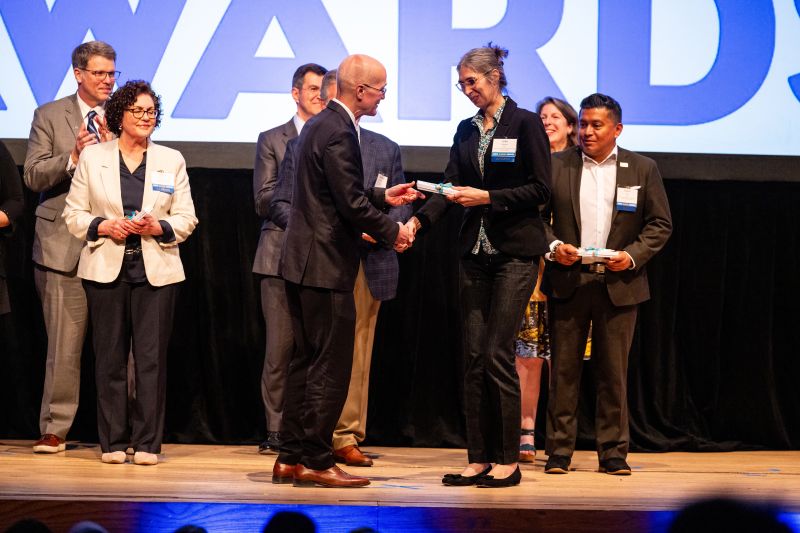
In 2024, Terenjuk received the Henry W. Bloch School of Management Alumni Award. The university celebrated that year’s recipients on April 5 at its performing arts center. Her MBA had been completed 24 years earlier. The elapsed time gives the occasion some perspective: enough years for an education to become a career, for a partnership to become a company and for the former student to become a supporter.
The award photograph shows the expected ceremonial exchange. Her reflection adds the people outside the frame. Together, they make a fuller portrait of a founder: the executive responsible for delivery, the former assistant coach, the business graduate and the scholarship supporter. At the entrance to Bloch Heritage Hall, Terenjuk had found a way to account for her progress. She remembered who had helped her through the door.