In April 2001, Joseph Ansanelli stood before roughly 30 students at Penn and discussed the sort of subject a successful alumnus might prefer to leave off the slides: failure. He had already started a company in college, worked at Apple and Macromedia, and founded Connectify. Yet the Apple Newton, an unsuccessful early digital assistant, belonged in the conversation too. “In failure, we reflect, whereas in success, we celebrate,” he said. A victory makes a pleasant dinner companion. A disappointment tends to ask more questions.
There is a useful place to begin his story. Ansanelli helped create the student lecture series that brought him back to campus. He had graduated from Wharton in 1992. Within a decade, he was returning to a room he had helped make possible, explaining why the route through technology was less orderly than a biography might suggest.
His later career would supply plenty of neat milestones: an acquisition by Symantec, a role at Greylock, another company called Gladly. But the more revealing thread is his willingness to return to familiar territory and reconsider it. He helped build an early generation of customer service software. Years afterward, he asked why customers still had to start their stories from the beginning.
A class project with a future
Trio Development began while Ansanelli was still a student. His collaborators were two engineering students, and the project concerned personal information management. They created software, found a market for it, and sold it into the Apple and Claris world. The product became Claris Organizer. A classroom assignment had acquired a life beyond the classroom.
Ansanelli earned a bachelor’s degree in applied economics at Wharton. His first venture put that education beside the practical work of building and selling a program. The collaboration matters: the origin story includes other people with different skills, rather than a solitary student having an idea and waiting for applause.
He went on to work at Apple and Macromedia, then co-founded Connectify. The company focused on electronic direct marketing software. It merged with Kana in 1999, and Ansanelli helped take Kana public. By then, customer relationships were already part of his professional life, expressed through the software companies used to communicate.
The information worth protecting
Vontu took him into a different problem: confidential information escaping the organizations entrusted with it. The company was founded in 2001. As its co-founder and CEO, Ansanelli worked on data loss prevention, a field concerned with identifying sensitive information and preventing it from leaving through the wrong route.
On June 24, 2003, he testified before a US House subcommittee considering identity theft and consumer credit. His argument paid particular attention to insiders. An organization could defend itself against outside intruders while employees still had access to customer information that could be exposed accidentally or stolen deliberately.
The concern was concrete. Who could reach the data? Where could it travel? What would stop a mistake before it became somebody else’s problem? These were enterprise purchasing questions with consequences for people who would never see the software. The customer behind the record had a stake in how the record was handled.
Symantec announced a $350 million agreement to acquire Vontu in November 2007. The companies had already partnered, and Symantec planned to integrate Vontu’s capabilities into its wider products. For Ansanelli, the sale became a defining career milestone. The figure describes the company transaction; it says nothing by itself about an individual founder’s proceeds.
A detour through the family album
Then came a problem of a rather different scale: sharing photographs. Ansanelli co-founded ZangZing, a service for group albums. His explanation began with trips, parties, weddings and everyday moments. Several people could photograph the same occasion, then struggle to collect the pictures in one place.
He wanted those images to have a lasting home. A snapshot moving down a social feed could be easy to publish and difficult to return to. An album could preserve the occasion, with a particular group able to contribute and view pictures, publicly or privately.
The team drew inspiration from the iPad’s straightforward interface. Ansanelli wanted a browser experience that felt similarly dedicated and approachable. This was consumer software, with different demands from security products sold to enterprises. The detour gives his career some texture: sometimes the information worth organizing is a corporate secret; sometimes it is everyone’s pictures from a wedding.
The colleagues who came back
Ansanelli joined Greylock in 2012. His investing work included relationships with companies such as Lookout, Smartling, Sumo Logic and Trifacta. Building a business and helping somebody else build one put him in different seats around the same table.
Gladly brought him back into operating a company, with Michael Wolfe and Dirk Kessler as co-founders. Wolfe and Ansanelli had met at Kana, where Wolfe ran engineering and Ansanelli ran marketing. They then co-founded Vontu. Kessler was the first person to join the Vontu team, and Ansanelli knew him from their Apple days.
That history gives Gladly’s founding a particular character. The team arrived with shared experience across more than one business. They had seen each other’s work before the new company required decisions about product, hiring and customers. A company acquisition changes the name on the door; it need not end the working relationship.
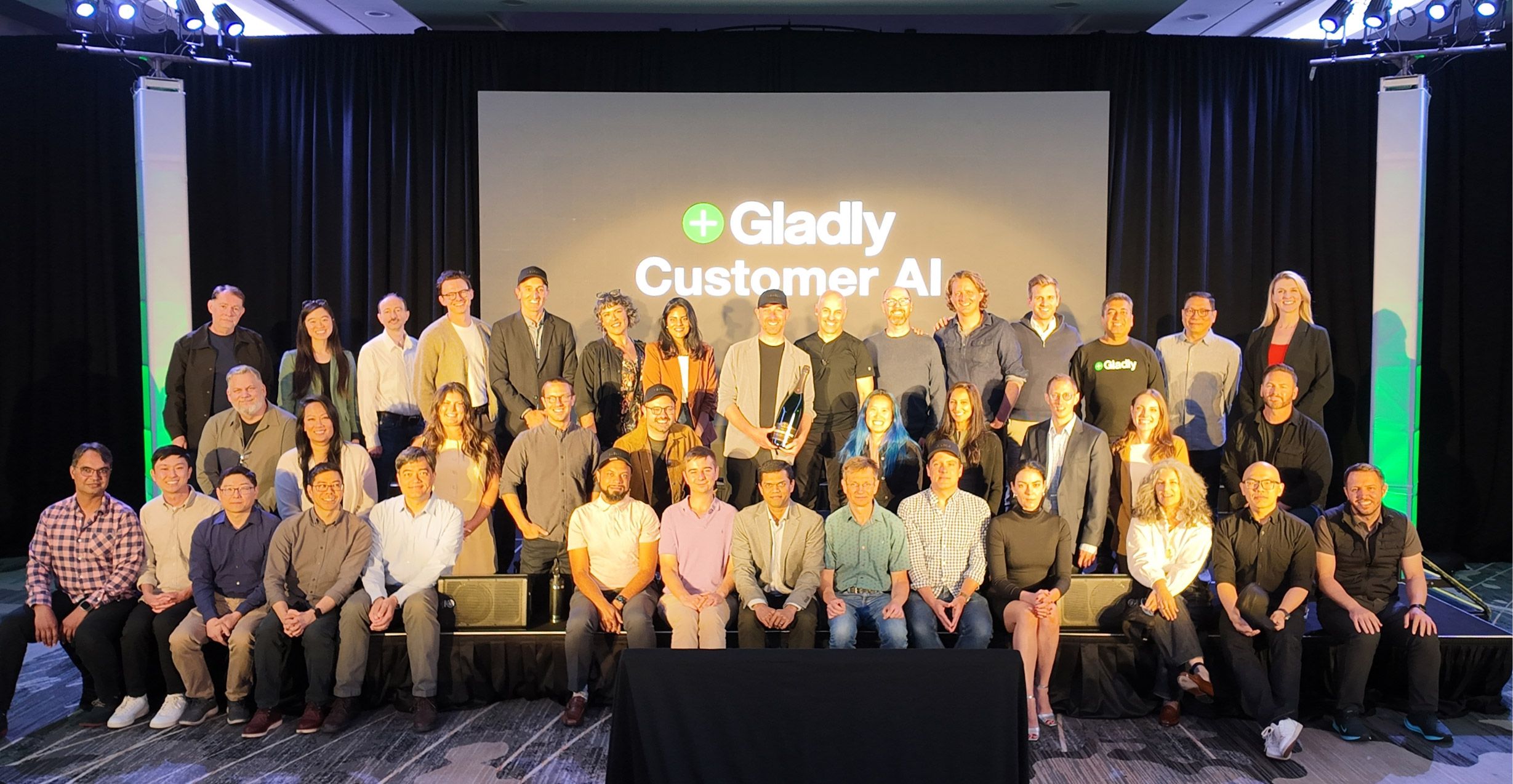
Gladly was incubated at Greylock. By its public introduction in 2016, it had backing from Greylock and NEA. Ansanelli had returned to customer service with partners who knew its earlier machinery. The question was what they would choose to build this time.
An agent should not need a detective’s hat
Consider the familiar sequence: a customer sends an email, waits, and calls the next day. To the customer, it is one unfinished conversation. If the company’s systems separate phone and email, the agent answering the call may begin with a blank page. The customer becomes the unpaid archivist of their own complaint.
Gladly’s founding proposal was to make the customer the enduring record. Interactions across channels would sit within a continuing conversation, giving the next agent the history needed to pick up where someone else left off. In his early explanation, Ansanelli compared the alternative to repeatedly asking a friend who they were and why they were calling.
Email02
Phone03
Chat
A conceptual illustration of Gladly’s customer-centered design, rather than a performance comparison.
There is humor in the comparison because the behavior sounds absurd outside a service queue. A friend who required a reference number before discussing dinner would receive fewer invitations. In a contact center, though, software can make that sort of forgetfulness routine.
Ansanelli’s emphasis also extended to the agent. The person taking the call needs usable tools and accessible information. A pleasant manner cannot produce an order history that is hidden in another system. Giving staff context is one practical way to make the desired customer experience possible.
His loyalty argument pushes further. Service can influence whether somebody buys again, recommends a brand or accepts advice about a product. In a 2020 conversation, he argued that teams should measure how well they helped customers and how much revenue they generated. Closing an interaction and earning the next purchase are different measures of success.
“Expertise plus experience plus empathy equals loyalty.”
Joseph Ansanelli
The customer on the other microphone
Ansanelli hosts Radically Personal, a podcast featuring customer service leaders from retail and consumer brands. He has said Reid Hoffman’s Masters of Scale inspired him to begin it. Hearing founders describe their decisions made him feel connected to a broader entrepreneurial community; he wanted a similar conversation about service.
The guest list has included leaders from businesses such as Crate & Barrel, Zenni Optical and Ulta Beauty. These conversations move his attention toward the people implementing customer experience inside organizations. A product vision has to meet a staffing decision, a training program and an actual customer question sooner or later.
The format is fitting for a founder interested in continuing conversations. He has a thesis, but a microphone also gives somebody else room to describe what happened. His public work includes explaining the product and listening to the operators whose decisions determine how that product is used.
Keeping the door open
His connection to Wharton continued beyond that 2001 lecture. In 2015, he helped shape an undergraduate visit to Silicon Valley, fund students’ travel and recruit Bay Area alumni to participate. The itinerary connected students with startups, established technology companies, investors and financial institutions.
He recalled that meeting alumni during his own undergraduate years had helped him see possible careers. Now he was helping other students have those encounters. It is a modest but revealing continuity: the former student who helped organize a lecture series kept finding ways to open rooms to the next group.
A different chair, the same question
In 2025, Ansanelli announced Charlie Besecker’s promotion to Gladly CEO. Besecker had joined as president the previous year. Ansanelli became executive chairman, explaining that he would focus on AI product strategy and work more closely with major customers on adoption.
His 2026 Gladly Connect Live keynote extended the company’s vision into conversational commerce. The presentation covered recommendations, co-browsing and checkout inside a conversation, along with changing ways for people and AI agents to work together. These were directions for the product, with customer experience still the organizing concern.
The change of role leaves a founder with a narrower stated responsibility and a familiar question. What should the software remember, and what should it allow a person to do next? Across his career, the answers have taken the form of organizers, security tools, albums and customer conversations.
Gladly’s next chapter puts that question inside AI-assisted service and shopping. The test remains wonderfully ordinary: someone has already explained what they need. When they come back, can the company carry on?