Jonathan Lewin had a perfectly reasonable answer to the prospect of another startup: no. He had done this before. He knew what the job consumed. He had a young child. Advising a friend sounded manageable; joining the company sounded like volunteering to have his calendar eaten. Then Tomas Vykruta and Mike Saltzman kept calling. Lewin eventually joined EvolutionIQ full-time in 2020. Some companies begin with a dramatic leap. His involvement acquired momentum one conversation at a time.
That distinction matters in a business culture fond of the instant conversion. Lewin brought an earlier career into the room. He had already worked through a previous technology shift, when publishers were figuring out how to charge for information delivered through a browser. By the time artificial intelligence became the subject of so many investment pitches, he had spent years around the more stubborn question: what makes software worth paying for?
The subscription years
In 2003, Lewin was president and chief technology officer of eMeta, a company he had co-founded. The business supplied access and commerce software to publishers. Its customers included the New York Times, Pearson and McGraw-Hill. Behind a reader’s apparently simple decision to buy something sat an assortment of permissions, subscriptions and billing arrangements. eMeta sold the machinery that made those decisions work.
There was room for considerable variation. A publisher might sell an entire publication, a particular piece of information, or access for a limited period. A customer might need a trial before committing. A university, an individual reader and a business subscriber could want different arrangements. Digital distribution made all sorts of combinations possible. Someone still had to make the till ring correctly.
The commercial model had its own variations. eMeta offered software for publishers to host themselves and a hosted service with a smaller initial payment and a share of transaction revenue. The choice reflected different customer resources and appetites. A sophisticated product could have a sophisticated price; a publisher with fewer resources needed another way in. These are the small distinctions on which enterprise businesses often depend.
“We join with the publisher in sharing the costs and risks.”
Jonathan Lewin, discussing eMeta in 2003
In February 2006, Macrovision announced its acquisition of eMeta. Lewin was then its chief executive. The plan included retaining eMeta’s employees and bringing them into Macrovision’s Corporate Strategy Group. The buyer wanted to broaden its digital distribution offerings. For Lewin, the transaction placed a company built around publishers’ online businesses inside a larger software organization.
A friend, an adviser, a founder
EvolutionIQ, founded in 2019, addressed insurance claims guidance. Its founders came to the opportunity with different backgrounds: Vykruta had worked on machine learning at Google, Saltzman had worked at Bridgewater, and Lewin knew enterprise software. It was a combination of technical, commercial and operating experience. The company would need all three to sell a new approach into an established industry.
Lewin’s connection to Vykruta preceded the company. Friendship and advice gave him a way to contribute before he committed to a full-time role. That sequence offers a less theatrical account of how founding teams come together. A useful conversation creates another useful conversation. Eventually, the person outside the organization is spending enough time on its problems to reconsider where he belongs.
There is a practical difference between giving advice and having to live with the result. An adviser can suggest a direction and return to other obligations. An operator inherits the consequences: the hiring, the budget, the customer conversation after something goes sideways. Lewin’s move brought his previous experience into that second category. He would help carry the business rather than visit its problems.
Two names on the door
Lewin and Saltzman came to share the CEO role. Vykruta became president. The arrangement is central to understanding Lewin’s place in EvolutionIQ because the title alone can obscure the work beneath it. A company with several founders still has to decide how responsibility travels between them. Shared leadership puts that question in plain sight.
EvolutionIQ’s answer gave Lewin and Saltzman the top job together. That choice deserves a little more attention than the conventional reaction that two people must inevitably trip over one another. An organization chart can indicate who has authority. It cannot, by itself, supply trust, judgment or the ability to speak candidly before a decision hardens.
“Having two people share that role gave us incredible leverage.”
Jonathan Lewin on EvolutionIQ’s co-CEO arrangement
The case is interesting precisely because it is particular. These were colleagues with different professional histories, building one business together. Their arrangement does not prescribe a structure for every startup. It does invite a more useful question than whether two CEOs look untidy on a slide: did the division help these people do the work the company required?
The customer gets a vote
The bridge between eMeta and EvolutionIQ is easiest to see from the customer’s side of the table. Publishers and insurers operate in different markets. Both have existing systems, established responsibilities and people who will have to use whatever gets bought. Selling software into that setting requires an understanding of the organization around the product. A demonstration is only the beginning of the conversation.
At eMeta, the details included which content a subscriber could access and how a publisher collected payment. At EvolutionIQ, the company describes its product as guidance for claims professionals. In each case, the software sits inside work someone already has to do. The value depends partly on whether the new tool makes sense within that work.
That is a useful way to read Lewin’s career without making every decision a prophecy about AI. The publishing business belongs to its own period, with its own customers and economics. His later company uses different technology. The continuity is the experience of building for organizations, where a purchasing decision usually begins a relationship that has to keep working after the contract is signed.
EvolutionIQ also invested in recruiting unusually early. The founding team brought in a full-time recruiter during its first year and added recruiting capacity while the company was still small. It is a revealing organizational choice. Recruiting can look like an overhead line when the immediate pressure is to sell and ship. It also determines who will be available to do either next year.
There is little glamour in a carefully filled role. The announcement is brief; the search can be tedious. Yet people are where an operating plan becomes real. A company may have customers ready to buy and investors ready to fund it, while still needing the colleagues who can turn those opportunities into a working organization. That tension is familiar terrain for a repeat founder.
A larger company, the same work
On December 20, 2024, CCC Intelligent Solutions announced an agreement to acquire EvolutionIQ for $730 million. The announced consideration combined cash and CCC stock. It was a corporate transaction with a public price attached, and it gave EvolutionIQ access to a business already serving a substantial insurance network.
Agreement announced December 20, 2024
Acquisition completed January 6, 2025
The founders’ letter described a company with more than 190 team members and set out their intention to keep building with CCC. That gives the transaction a human scale. An acquisition changes reporting relationships and ownership, but it also affects a group of colleagues who still have products to develop and customers to serve when the announcement has passed.
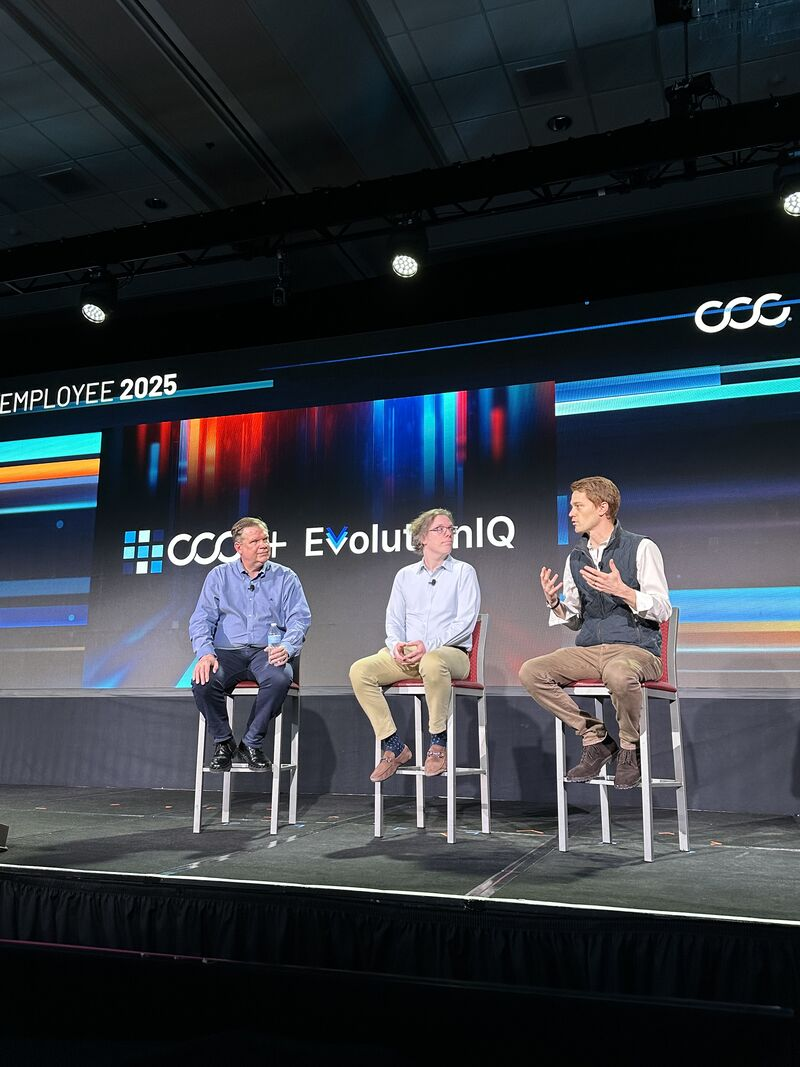
CCC completed the acquisition on January 6, 2025. The date draws a clear line between the agreement and the completed transaction. Lewin remained part of EvolutionIQ’s leadership, and the company’s current team page continues to list him alongside Saltzman and Vykruta. The work now takes place inside a different ownership structure.
For a founder, that is a distinctive transition. Building an independent company rewards the ability to assemble resources around an uncertain opportunity. Working within a larger organization adds another task: connecting what the team has built to the capabilities and relationships around it. The acquisition supplies a new setting. It leaves plenty of ordinary operating questions on the desk.
Room for a longer view
Lewin studied history at Harvard, earning an A.B. His public life also includes service on the Hamptons Observatory board, which he joined in 2018. The observatory supports astronomy education and public programs. It is a useful detail in a profile otherwise occupied by software, customers and company structures: another institution, another timescale, another reason to look beyond the office.
A history degree and an observatory board seat need no elaborate theory to justify their place here. They belong to the person. Founder biographies can become cramped when every detail must explain a commercial outcome. Some interests deserve to remain interests. The sky is under no obligation to improve a quarterly forecast.
Across his working life, Lewin has moved from helping publishers sell digital access to helping build an AI software company for insurers. Along the way came two acquisitions, different collaborators and a shared chief executive role. The career is long enough to resist being reduced to one announcement. Its recurring subject is the patient work of making a company function, with other people close enough to share the responsibility.