Before Jeremy Rassen co-founded Aetion, before the executive appointments and the acquisition announcement, there was a database problem. His name appears on late-1990s patent applications concerned with datamarts: how to assemble information, prepare it for questions, and give someone a way to ask those questions. It is an agreeably unromantic beginning for a founder story. The machinery comes before the microphone.
Datamart is a word unlikely to improve a dinner party. It does, however, point toward work that runs through Rassen’s career. Information has to be arranged before it becomes useful. A clever method needs a workable implementation. Someone has to care about the distance between an idea and the person expected to use it.
Rassen’s professional route has crossed enterprise software, academic research, and company leadership. There have been several titles along the way. Look beneath them and the engineering question keeps reappearing: how do you make an exacting process easier to carry out, without losing the details that make it worth doing?
The database before the company
Rassen’s early technology experience included Hewlett-Packard and E.piphany in Silicon Valley. His work involved high-performance software for creating and analyzing large databases. At E.piphany, he was an early employee working on data-intensive applications for customer relationship management. The business brought software into contact with the decidedly practical expectations of large corporate customers.
That background matters because a database is already a collection of choices. What gets stored? How is it organized? What can a user retrieve? Which operations happen in advance, and which happen when a question arrives? The answers shape the tool long before anyone has an opportunity to admire its interface.
Two E.piphany inventions provide a concrete trace. Applications filed on May 6, 1998 named Rassen among the inventors. One concerned creating aggregates for a datamart; another concerned creating the datamart and its query structure. The grants followed in December 2000 and February 2001. These were collaborative inventions, with several names on the documents, rather than a solitary programmer’s calling card.
Two database applications filed in May 1998. Grants issued in December 2000 and February 2001. Jeremy A. Rassen is a named co-inventor.
The subjects sound small beside the sweeping vocabulary often attached to technology companies. Yet the underlying work is substantial: designing a system that can turn a user’s request into an operation on organized information. A result on a screen has a considerable backstage staff. Rassen had experience with that backstage work before he began the company for which he would become better known.
A second education, and a software gap
His undergraduate degree was in computer science at Harvard College. He later earned master’s and doctoral degrees at Harvard and became an assistant professor at Harvard Medical School. His self-reported professional record places his employment at Brigham and Women’s Hospital from September 2008 to May 2014. The route brought a software background into an environment organized around research methods and the validity of results.
A second discipline can make familiar tools look different. Programming asks whether a procedure has been implemented correctly. Research also asks whether the procedure answers the intended question. For someone working across both settings, the space between those questions becomes a useful place to look. It contains plenty of work that a faster computer cannot settle by itself.
Rassen co-founded Aetion in 2013. His account of the beginning centered on a mismatch he and Sebastian Schneeweiss had encountered as faculty colleagues: established scientific methods lacked a suitable technology platform for applying them at the required speed and scale. Their response was to build a company around the missing software.
That is a specific kind of founding opportunity. It begins with people who already know how a difficult task should be performed, and who can see the friction in performing it repeatedly. The product has to carry knowledge into everyday use. Its design has to respect both the method and the person doing the work.
The practical business followed. In 2017, Aetion raised an $11.2 million Series A led by Flare Capital Partners, with Lakestar participating. Rassen described plans to extend the platform, expand its commercial use, and recruit an experienced CEO. Even at that stage, building the company included deciding what leadership it would need next.
The platform was offered as a service with cloud, on-premises, and hybrid deployment options. That detail in his 2017 description helps explain the enterprise software side of the venture. A customer’s existing systems were part of the problem to solve. Software had to find a place in the organization that would actually use it.
The founder returns to the chair
Rassen’s positions at Aetion have included president, chief science officer, chief technology officer, and chief executive. The sequence is more revealing than a single title. It places him in several kinds of responsibility inside the same organization, from the substance of the analytical work to the technology and the business around it.
Company leadership also involved returning. Aetion’s September 2024 announcement recorded an earlier Rassen term as CEO in 2016-2017. He assumed the interim CEO role in June 2024, while Carolyn Magill subsequently moved into a senior advisory position. Kevin Riley joined as president that September. The changes distributed responsibilities across people whose experience would shape the company’s next period.
On January 9, 2025, Aetion confirmed Rassen as CEO. Christophe Berthoux joined as executive chair. For Rassen, the appointment came with the history of having co-founded the business and served on its board. A returning founder brings that accumulated familiarity into a role whose demands have changed with the organization.
- 2016-17An earlier term as Aetion CEO
- JUNE 2024Returns as interim chief executive
- JANUARY 2025Appointment confirmed
There is an appealingly untidy quality to this career when set beside the usual founder diagram. The route includes established technology companies, graduate study, faculty work, a startup, and repeated changes of responsibility within it. A company does not hold still while its founder acquires a neater biography. Sometimes the biography has to accommodate the company.
The work beneath the interface
A useful statement of Rassen’s product thinking arrived in August 2025, with the announcement of Aetion Activate. The application combined low-code tools with a hosted coding environment. Its features addressed data preparation, reusable definitions, versioning, and the ability to follow transformations through an audit trail. These are the parts of analytical work that can disappear behind the finished presentation.
“Our goal is to simplify the complex so teams can focus on the analysis that matters.”
Jeremy Rassen · August 2025
The goal leaves an interesting design problem. Making an interface easier should still allow a user to understand what happened underneath it. Activate’s combination of guided tools and a coding environment addressed people with different ways of working. The product language brought ease of use and traceability into the same conversation.
That concern has a family resemblance to the early database work. Both involve arranging complex operations so someone else can perform a useful task. The resemblance is an interpretation of the career, rather than a claim that every product decision followed a single plan. Careers can develop a theme without having been written from an outline.
His comments on artificial intelligence in March 2025 made a related point about the limits of automation. He argued that AI needed a structured, scientifically validated framework and human oversight. The attraction of a quicker process did not remove the need to understand its reasoning. That position makes sense alongside a career spent on analytical systems: an interface can make a complicated operation feel simple while the responsibility for checking it remains. Rassen’s public emphasis was on trust, transparency, and rigor, qualities that require deliberate choices in the way a tool is designed and used.
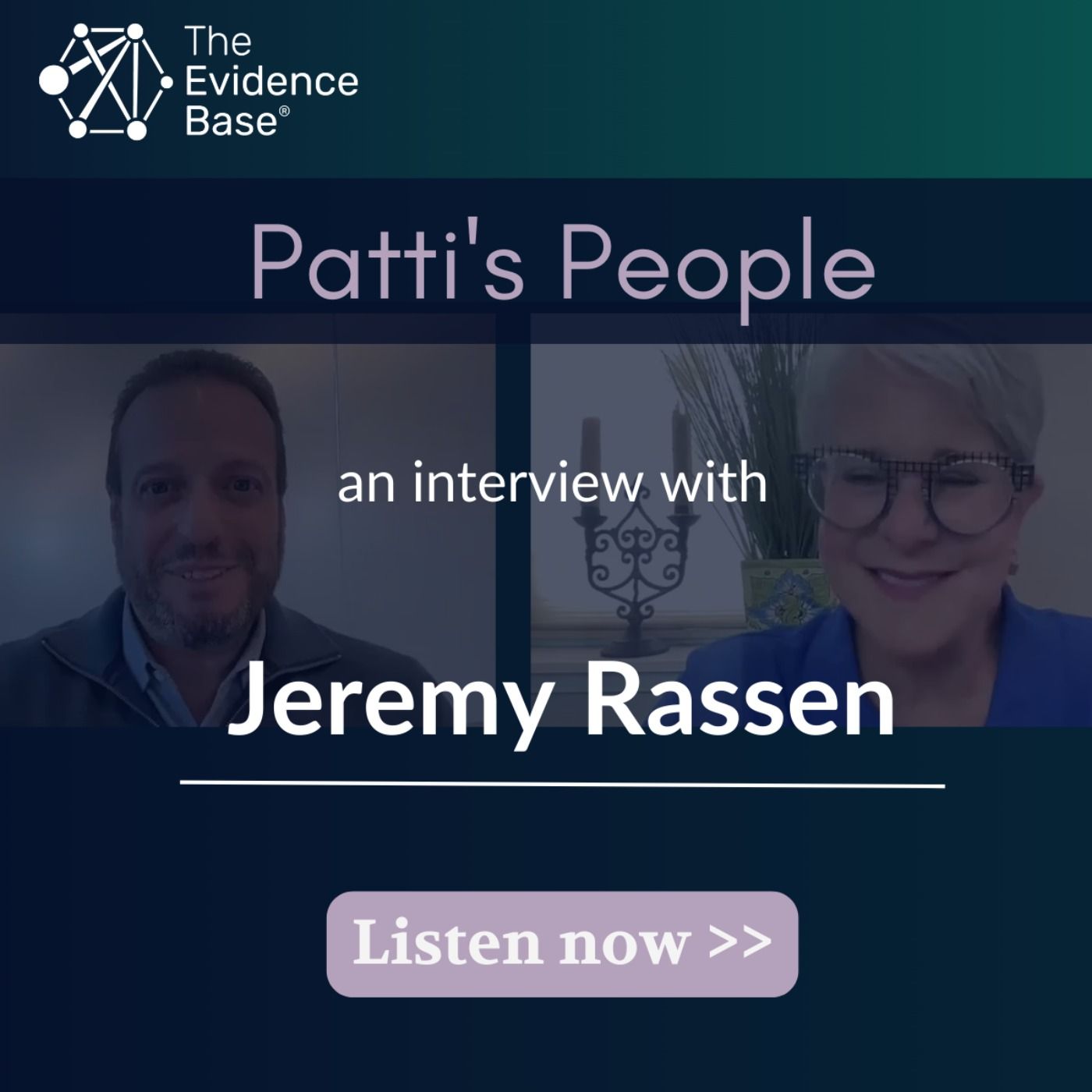
Rassen also continued to discuss questions of method and uncertainty in public. A July 2025 episode of Patti’s People paired a career conversation with questions about artificial intelligence, independent replication, open protocols, and the thinkers who influenced his approach. The interview was recorded before Aetion’s acquisition. Its range suggests how much sits behind the apparently simple act of asking software for an answer.
An exit measured in years
Datavant announced an agreement to acquire Aetion on May 15, 2025. Rassen was CEO at the time. The combination brought Aetion’s analytical capabilities together with Datavant’s data connectivity and privacy technology. Its stated scope included discovery, linkage, curation, and analysis: a longer stretch of the path that information travels before someone can put it to work.
The subsequent public farewell from Rassen used a different measure of time. He shared photographs of his children, one taken around Aetion’s founding and another years later. It was a personal way to make the duration of a company visible. Financial announcements have dates. Families make the years harder to overlook.
He thanked colleagues, customers, partners, investors, and the board, then pointed toward further adventures. By the time of this profile, his departure was public. A 2026 conference listing affiliates him with Arpeggio Solutions in New York. The next professional chapter has begun to acquire a name, while Aetion continues as a Datavant company.
There is another, smaller glimpse of Rassen in an earlier conversation. Asked to choose a favorite New York restaurant, he found the decision difficult and offered several possibilities, including places near his Queens home. After the platform, the investors, and the growth plans, dinner resisted a tidy answer.
It is a pleasant final complication. A career can involve years of making information easier to organize and still leave a person reluctant to compress a city into one restaurant. Rassen’s professional story allows a similar breadth. The databases, the research, the company, and the changing roles belong together. The useful answer takes the long way round.
Keep following the thread
- Aetion website
- 2017 founder conversation
- 2025 interview
- Listen: Patti’s People
- Database invention record
- Leadership appointment
- Activate announcement
Interview artwork: Patti’s People / The Evidence Base.