In the summer of 2024, Dashlane pointed a new security tool at its own employees. They already used the company’s password manager. Their vault health score stayed above 95 percent. Then the tool looked beyond the vault and found compromised logins that employees had never saved there. The reassuring score had been answering a smaller question than anyone wanted it to answer.
- Dashlane stores passwords and passkeys, then helps people use them safely.
- Its Omnix business platform detects risky logins outside the vault on managed browsers.
- It sells paid subscriptions. The permanent Free plan ended in September 2025.
That discovery supplies a useful way to understand Dashlane. A password manager can be good at protecting its contents while missing what happens outside. A drawer full of neatly labelled keys tells you very little about the spare key someone left under a flowerpot.
First, make logging in less annoying.
Founded in France in 2009, Dashlane grew from a familiar irritation: online life required too much repetitive typing. Its founders included Bernard Liautaud, Alexis Fogel, Jean Guillou, and Guillaume Maron; the company’s current founder list also includes former chief executive Emmanuel Schalit. The early proposition joined password management with a digital wallet. Remember fewer things. Fill fewer forms. Stop negotiating with the “forgot password” link.
Today, the basic bargain remains appealing. Generate a different password for each account, save it in an encrypted vault, and let the browser extension or mobile app fill it in. Store payment details and private notes. Share credentials without scattering them through messages. Save and use passkeys where websites support them.
Encryption makes this possible without giving Dashlane a readable copy of your vault. Its zero-knowledge design means the company cannot simply retrieve your secrets for you. Recovery therefore deserves attention during setup, while you still have access. Convenience at login does not remove the responsibility to plan for a lost device or forgotten master password.
The password that missed the meeting.
In April 2025, Dashlane made Omnix generally available, combining password management with credential protection. The distinction matters to an employer. Staff use applications that sit outside centrally managed single sign-on. They also type passwords manually. Waiting for everybody to save every credential leaves a gap between a purchased security tool and the workday it supposedly covers.
Credential Risk Detection addresses that gap through a deployed browser extension and management policies. It checks for weak or compromised passwords on company-managed desktop browsers, including when employees are logged out of Dashlane or have never activated an account. Supported deployment guides cover Chrome and Edge, using Windows or macOS management tools. Coverage depends on that deployment.
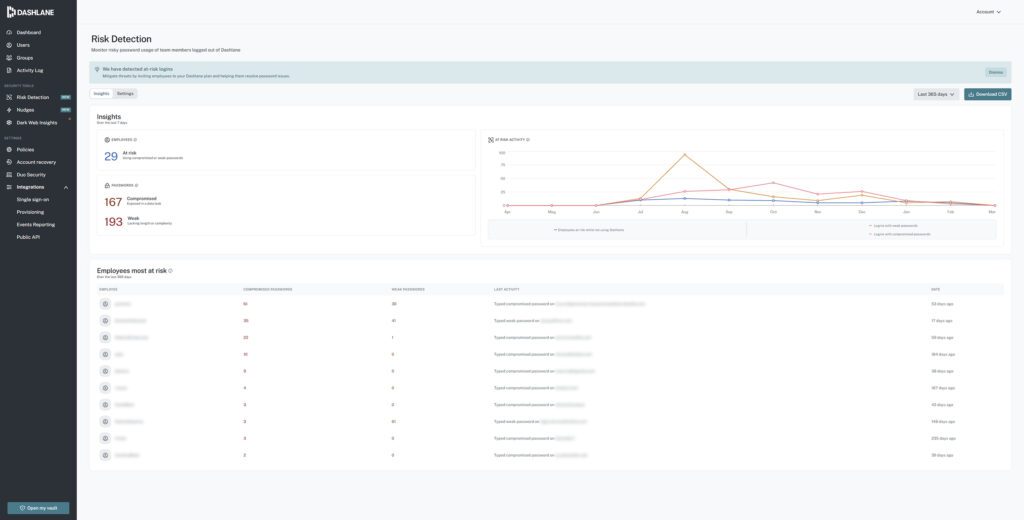
Privacy is a concrete design question here. Dashlane says the password check occurs locally. Administrators receive the website domain, the employee’s work-device profile identity, and the risk classification, rather than the password itself. On a shared device, that identity cannot reliably identify which person typed it. A useful dashboard still needs someone who understands what its labels mean.
“Give credit, not blame”One of Dashlane’s published company values
The company’s internal account credits contextual alerts and manual follow-up with reducing compromised credentials in use by 75 percent in the first month. That is a result from its own workforce, with its own security team involved. The practical lesson is copyable: observe actual use, prompt a specific repair, and check whether the repair happened.
the login
the risk
the repair
the result
There is a bill for the convenience.
Dashlane reports more than 25,000 organizational customers, including Michelin, Air France, and Forrester, alongside millions of consumers. It competes in password management with services such as 1Password, Bitwarden, and Keeper. Its enterprise pitch emphasizes detecting and responding to browser credential risk beyond stored entries, alongside the familiar encrypted vault.
The subscription menu makes that distinction literal. July 2026 support documentation lists Omnix Password Management at $8 per user per month and Credential Protection at $4; the website specifies annual billing. Enterprise combines the modules with custom pricing. At those listed rates, 100 password-management seats imply $9,600 a year before taxes or discounts. Protection is a separate module, not a feature to assume every vault subscription includes.
Consumers choose Premium or Friends & Family, which accommodates ten members. Dashlane ended its Free plan on September 16, 2025, saying it wanted to concentrate on advanced protection. It had attracted substantial backing much earlier: Sequoia led a $110 million Series D announced in May 2019. That financing figure describes investor support, not current revenue.
The browser becomes the intervention point.
The 2026 additions follow the same logic. Consumer Scam Protection evaluates suspicious pages on the user’s device, including places with no saved login to compare. KnowBe4 integration connects credential-risk events to relevant training. Microsoft Sentinel integration puts browser risk signals beside other security telemetry. Each moves a warning closer to a person or team able to do something with it.
There have been abandoned ideas, too. Dashlane’s September 2022 release notes retired its experimental Password Changer after evaluating the beta. Current credential protection is a different proposition: spot risk and help people respond, with administrators still responsible for deployment and follow-through.
The company has also faced supplier risk. In August 2025, it disclosed that attackers accessed a small subset of business information in its Salesforce system through compromised third-party software, Drift. Its investigation found vault data remained secure. The episode is a reminder to distinguish the encrypted product from the surrounding business systems: protecting one does not automatically protect every supplier connection.

A password company prepares for fewer passwords.
The Yubico partnership adds hardware-backed passwordless vault access. Dashlane’s October 2026 research also describes an awkward transition: 57 percent of its users stored at least one passkey, yet passkeys represented only 28 percent of measured Google logins. Those are observations from Dashlane-managed authentications, not the whole internet. Availability and habit remain different things.
That is where Dashlane fits: between the safer authentication methods people could use and the messy collection they actually use. Its most useful idea is to measure that collection honestly. Before celebrating a tidy vault, find out what never made it inside.