A calendar knows when thirty days have passed. It has no idea whether a medical report that arrived yesterday changes everything. In an insurance claims department, that is an awkward division of intelligence. The reminder appears on schedule; the useful fact may be waiting quietly in a document nobody has had time to read.
EvolutionIQ built its business around that mismatch. Its AI studies claim information and helps professionals decide where to put their attention next. The company’s name sounds like a laboratory experiment. Its daily task is closer to an unusually well-informed colleague arriving with a short list: look here, check this, consider involving that specialist.
- The buyer: insurers and third-party administrators handling complex injury and disability claims.
- The work: prioritize claims, synthesize medical records, and suggest next actions.
- The evidence: New York Life reports roughly 60% less investigation preparation time with Medhub.
- The deal: CCC completed its acquisition in January 2025 after announcing a $730 million transaction.
The interesting business question is how much money can hide inside a better allocation of attention. The equally interesting human question is what happens to an injured person while their file waits its turn.
01 / The appointment the calendar cannot make
EvolutionIQ’s Claims Guidance product addresses a familiar administrative arrangement: large caseloads, growing complexity, and recurring reviews. A date-based queue is orderly. It can also give a routine file the same invitation to a professional’s desk as a file whose circumstances have just changed.
The software takes structured information and the less cooperative material in notes and documents, assesses which claims merit attention, and helps teams intervene. Its workers’ compensation offering describes overnight scoring of open claims and next-action guidance each morning. Actions taken by adjusters feed back into the system. The ambition is to make the work queue respond to the claim’s condition.
- 01ReadRecords + notes
- 02PrioritizeWhich file needs you?
- 03ValidateCheck the evidence
- 04ActProfessional judgment
A schematic of the workflow, not a claim of automatic adjudication.
Customers buy this as enterprise software. The users include examiners, adjusters, clinicians, specialists, and managers. The injured worker is usually several steps away from the purchasing conversation, yet receives its practical consequences: the timing of a call, the involvement of a specialist, the quality of a review.
Public customer material names Prudential, Reliance Matrix, Principal Financial Group, Sun Life, and New York Life Group Benefit Solutions. EvolutionIQ began with disability and workers’ compensation expertise and now markets across income protection and auto casualty too. It inhabits the working space between a carrier’s accumulated data and the person expected to make sense of it.
02 / Give the finding a return address
On April 23, 2024, EvolutionIQ introduced Medhub, bringing medical synthesis into its claims workspace. Medical records are an excellent way of preserving information and a less obliging way of finding it again. Different providers document different moments. A change in restrictions, a medication adjustment, or conflicting notes may matter more than the sheer number of pages.
Medhub supplies claim summaries, document summaries, searchable medical history, and a timeline of key events. Its distinguishing design choice is the connection between an insight and its supporting record. Findings are cited and hyperlinked, so the professional can return to the original evidence. Users review what enters the living claim summary as fresh information arrives.
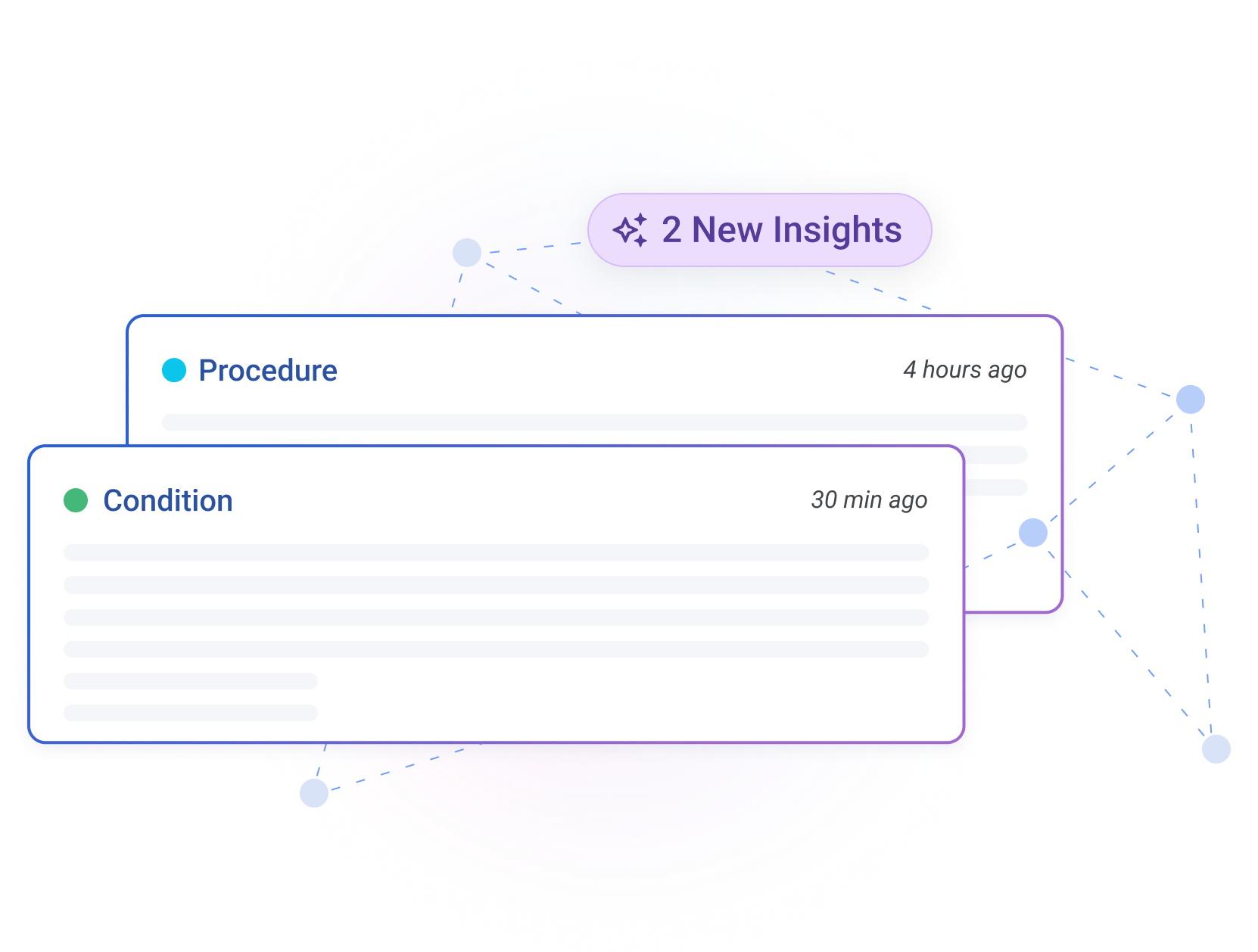
The case for this approach is straightforward. Compressing a record saves reading time. Connecting a finding to a claim’s context helps someone decide whether the saved time produced a useful understanding. An elegant paragraph is a poor consolation if the important physical restriction disappeared during condensation.
That also explains the company’s particular expertise. It combines machine learning and language processing with insurance operations and clinical knowledge. A claims product has to know what its users mean by a useful answer, which can differ across lines of business and across roles reviewing the same file.
03 / The customer helped write the instructions
The most revealing account of Medhub is its work with New York Life Group Benefit Solutions. The carrier’s long-term disability teams faced complex clinical histories distributed across large medical files. It chose to develop the capability through its existing EvolutionIQ partnership, involving claims leaders, frontline staff, and medical leadership.
Users tested the product in live workflows. Their feedback led to chronological views of medical events, clearer presentation of physical examination findings, and output configured around the carrier’s Medical Director Review standards. Confidence in the synthesis was an early priority. The product had to fit the review that people already understood and were accountable for completing.
“They didn't just build a tool for us; they built a tool with us.”
Orla Nixon · Head of Claim Operations, New York Life Group Benefit Solutions
The May 2026 case study reports approximately 60% less average time preparing for claim investigations and up to 80% faster review of medical records exceeding 300 pages. These are reported internal results, with gains varying by file complexity. They describe preparation and review efficiency, rather than an 80% improvement in every claim outcome.
preparation time
300+ page records
Case-specific efficiency measures. Human verification and source traceability remain part of the workflow.
The lesson a software buyer can borrow is refreshingly unromantic. Start with a task and a baseline. Let the people doing the task define the acceptable output. Check its evidence. Watch whether anyone actually uses it. The case study suggests that adoption was designed into the workflow through repeated feedback.
04 / An acquisition with a second destination
The founders came from different working worlds: Tomas Vykruta from Google’s AI work, Michael Saltzman from Bridgewater Associates, and Jonathan Lewin from startup operations. They established EvolutionIQ in 2019 around a hypothesis that claim data could help augment human decisions. By April 2022, a $21 million Series A had brought venture firms and insurance-sector investors into the same round.
A $7 million Series B followed, announced in February 2023. The company said its contracted recurring revenue had tripled in 2022 and every pilot that year had become a production customer. Those are company-reported growth measures. They help explain why an enterprise product could expand through an existing customer once it earned a place in the working day.

In a January 2026 founder interview, Saltzman described close design-partner work and an approach that copied carrier data into a separate model rather than forcing an early replacement of core systems. The accompanying interview write-up puts first-year revenue at roughly $50,000 with one design partner. The useful point is the patience: substantial enterprise work can precede substantial enterprise revenue.
CCC announced the acquisition on December 20, 2024, at $730 million, with roughly 60% cash and 40% stock. It closed on January 6, 2025. Later SEC filings report $674.3 million of acquisition consideration under the transaction’s accounting. The announced headline price and that later accounting figure describe different measurements of the deal.
CCC already served the auto insurance economy. EvolutionIQ added disability and workers’ compensation markets and injury-related capabilities that could travel into auto casualty. In April 2025, CCC announced Medhub for Casualty, then expected in the third quarter. The current EvolutionIQ portfolio also includes Demandhub, which structures medical, legal, and liability facts from demand packages for evaluation.
05 / A queue still needs someone to act
EvolutionIQ sells SaaS through an enterprise sales process, with implementation and client support. Its business can grow as carriers add capabilities across their claims operations. For a buyer, the relevant cost calculation includes integration, training, review effort, and the value of whatever changes after a file receives attention.
There are alternatives. Gradient AI offers adjacent claims prediction and triage capabilities. A carrier can also build analytics internally, buy a general medical summarization tool, or continue manual reviews in its existing systems. EvolutionIQ’s pitch rests on the combination of claims-specific guidance, medical synthesis, and workflows shaped with insurance professionals.
The operational implication is that useful guidance needs dependable records, someone willing to verify the findings, and capacity to follow through. A newly prioritized file cannot benefit from a specialist who is unavailable. A shorter review does not by itself establish that the claimant received better support. Buyers should measure both efficiency and the quality of what happens next.
EvolutionIQ’s story is appealing because its central insight is modest enough to understand: a person cannot act on a detail they have not seen. Insurance contains plenty of arithmetic. It also contains this quieter calculation - what a busy professional will notice before the opportunity to help has passed.