The interesting moment in a workplace injury is often the one before the paperwork. Someone is hurt. A supervisor has to respond. The worker wants to know whether this is serious, whether help is available, and what happens to tomorrow’s shift. Axiom Medical has built its business around that uncertain interval. Its proposition is simple: get a nurse into the conversation early, then keep the case from becoming a succession of disconnected handoffs.
- A nurse at the first decision: injury assessment and follow-up, available around the clock.
- Two questions, together: assess the physical injury and screen for mental distress.
- Built for employers: reporting tools connect the initial incident with the return to work.
The decision before the paperwork
Axiom’s nurse triage service starts with an employee reporting an incident. A licensed professional reviews the injury and medical history, assesses what level of help is appropriate, and recommends next steps. Those steps might involve first aid. They might involve referral to a medical facility. The useful feature is that the supervisor does not have to improvise a medical judgment.
The relationship continues after that initial assessment. Axiom describes coordinating with facilities when outside care is needed, updating designated employer representatives, and following the worker’s recovery. Its case-management process runs until recovery or a claims administrator assumes responsibility. For a distributed employer, that continuity is the product: somebody knows what happened yesterday and what needs to happen next.
- 01ReportPhone, app or portal
- 02AssessPhysical + mental
- 03RouteFirst aid or referral
- 04Follow upRecovery + reporting
The injury has a second story
The distinctive detail is what Axiom asks alongside the injury questions. Its behavioral health assessment uses the K6 psychological distress scale. Nurses consider the employee’s experience, provide mental health first aid, and refer to behavioral health services when appropriate. A damaged shoulder and a distressed person can arrive in the same call. The workflow makes room for both.
This is screening and support, with boundaries. In its March 2026 privacy policy, Axiom describes itself as a telephonic first-aid and injury assessment service and says it does not diagnose or treat. The distinction matters when evaluating the offer. An assessment can help organize a response; a worker needing examination, treatment, or emergency help still needs the appropriate clinical service.
The company also took this idea beyond individual calls. In February 2023, it announced a partnership with the National Council for Mental Wellbeing to expand access to Mental Health First Aid at Work training. The logic is consistent: the person receiving the first signal should have some preparation for responding to it.
The app is the front door
Employees enter the Axiom Medical app using a company-assigned ID. They can access screening and reporting functions; employers receive reporting and integration tools. The client portal supplies case visibility and analytics. This is software attached to a service relationship, with people responsible for the next action. A completed form is the beginning of the work.
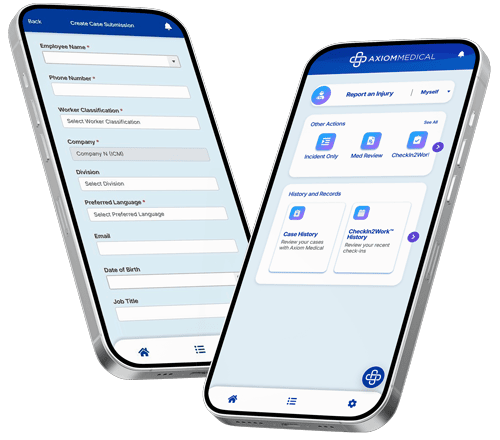
The app’s earlier name explains its evolution. CheckIn2Work began as a pre-work health attestation tool. By December 2022, added functions included vaccination and testing records and Tempo Live. Axiom announced a broader app identity as those functions accumulated. A tool built around one recurring workplace question had become a doorway into several health workflows.
Absence management extends the service beyond workplace incidents. For employees away with personal illness or injury, Axiom describes help with documentation, medication reviews, recovery progress, and return-to-work coordination. That gives an employer a way to manage the interval between a health problem being reported and an employee being ready to resume duties.
The part they handed over
One of Axiom’s more revealing public statements concerns something it decided to do differently. Announcing a January 2023 partnership with Mobile Health, CEO Mark H. Robinson acknowledged that medical exams and testing had not reached the standard clients expected from Axiom’s main services.
“It was not our core capability”
Mark H. Robinson, on medical exams and testing, January 2023
Mobile Health brought employee screening, pre-employment examinations, and compliance services to the arrangement. Axiom brought case management, behavioral health, infectious disease, and absence support. The useful business lesson is the decision itself: a comprehensive offering can depend on specialists working together. The customer’s problem is broader than any one company’s strongest capability.

Selling the first decision
Axiom occupies the employer-facing side of occupational health. Its buyers include businesses with physically demanding operations, where an injury affects an employee, a shift, and a claims budget. NMS Capital reported more than 1,500 employer customers when it announced its December 2025 investment and recapitalization. Its investment thesis emphasized self-insured employers and healthcare cost containment. Serent Capital had announced a growth investment in 2018.
There are alternatives. Medcor also offers round-the-clock workplace injury teletriage. Clinics and internal occupational health teams handle other parts of the problem. Axiom’s case rests on its combination of assessment, psychological screening, continuing management, and employer visibility. A buyer can compare those responsibilities with its existing arrangements, then weigh the proposed service cost against clinic spending, claims costs, and time away from work.
of cases managed at the first-aid level, according to the company. A reported operating result, not a promise for every workforce.
For a purchaser, the revealing questions concern the handoffs: who follows up after an outside visit, who sees a change in case status, and who helps plan the return? Axiom packages those functions with the initial assessment. Its absence service adds another route into the same practical problem of keeping employees and employers informed while a health issue interrupts work.
Make the first call easy
At its March 2026 Signal Summit, Axiom recognized Ajinomoto Foods for a reported 93% first-aid rate and F-E-T for reporting 72% of cases within the critical hour. These are selected client results. They illustrate the company’s emphasis on early action; they do not establish what another employer will achieve.
The practical lesson is available even to someone buying nothing. Give employees a clear route to report a concern. Put assessment with a qualified person. Assign responsibility for checking back. Those steps depend on workers trusting the process enough to use it. If a report stays unspoken, the service cannot assess it. Axiom’s technology can connect the stages. The first connection still requires someone to speak.