The first picture in Jomaro Kindred's career was not his. He was seven, at a laundromat with his mother, when he saw an older boy drawing Conan the Barbarian in combat with a monster. It was a wonderfully unsuitable laundromat scene: soap turning, clothes tumbling, and on a piece of paper a large barbarian settling matters with a beast. Kindred looked at the battle and thought it was cool. That moment stayed.
He learned to draw, ink and paint with help from friends and mentors, but without a formal route that has entered his public biography. The road announced itself through work. Long before art direction and Marvel licensing, there was fan art, independent hustle and an artist learning how to make an image speak quickly. In 2005, a Jomaro Kindred drawing appeared in a City of Heroes fan-art feature. He later ran MMOART.com, then joined Nerve Software in Dallas, where the studio worked on other companies' large games. The credits from that stretch include Call of Duty: Black Ops and the Xbox version of Doom II. Glamour, in game production, often arrives wearing a subcontractor badge.
The useful thing about working behind the curtain is that one learns how many curtains there are. At Nerve, Kindred saw the machinery of production. On his own time, he kept making the work he wanted to see. He created fan-made Horde and Alliance card backs for Hearthstone. Those designs found their way to Blizzard's team and helped him get noticed. In June 2014, he joined the game as a concept artist.
The tusks at right angles
Hearthstone gave Kindred a larger definition of concept art than the job title usually suggests. The artists did early visualization, but they also worked on card backs, boards, interface, key art and finished illustration. They did not merely hand a blueprint to someone downstream. They could watch an idea travel all the way into the game, occasionally with fingerprints still visible.
That breadth trained a particular kind of attention. A game board had to accommodate cards, effects and the irresistible little objects players could click while waiting for an opponent. A card back had to express an entire theme at the size of a biscuit. An expansion character had to feel native to Warcraft but fresh enough to carry a campaign. Kindred liked the variation. One week might begin with the visual premise of an expansion and end inside the interface. The work resisted the romantic fantasy of an artist polishing one perfect canvas in a quiet room. It was closer to repertory theatre: new roles, tight stages and a company constantly handing props across the wings.
Kazakus is a good example. Warcraft already had plenty of trolls, so the task was not to draw a competent troll. It was to invent one that could be recognized across a tavern. Kindred began with silhouette and gave the character tusks bent at ninety degrees. A tiny piece of geometry made an old species look particular. He later described the process as a conversation among concept artist, game designer and art director: Is it whimsical? Is it fun? Is it unique? Does it belong here?
That last question did not crush the first three. Kindred's Hearthstone work cheerfully contains a dinosaur made more menacing by enlarging it, planting volcanoes on its back and giving it molten drool. He helped paint the Goblins vs Gnomes board. He made the Cupcake card back for the game's first anniversary and, when asked to name his favorite card back, chose his own with a sheepish “You got me.” Good taste is admirable. Good taste with frosting is better.
By BlizzCon 2016, he was onstage with designer Matt Place explaining how Mean Streets of Gadgetzan had taken visual form. The move from drawing to presenting matters. Concept artists are translators even when they never touch a microphone: mechanics become silhouettes, tone becomes color, a designer's sentence becomes the first believable version of a character. Onstage, the translation simply became audible. Kindred was learning to articulate why a visual decision worked, a skill that would become as important as making the mark himself.
“Sometimes I actually jump into WoW and fly around on my mount, looking for inspiration.”Jomaro Kindred on finding visual ideas
He also understood the social pleasure of drawing. At a Hearthstone championship in the Bahamas in 2017, people queued for sketches while Kindred took requests, including a bread-headed agent for the streamer Disguised Toast. That same year, an interviewer asked him to identify the worst Overwatch player among his colleagues. He laughed and declined to throw anyone under the bus. The answer says little about digital marksmanship and quite a lot about a future art director.
A studio before a game
Kindred left Blizzard in August 2018 and joined four fellow Hearthstone veterans at Second Dinner: Ben Brode, Hamilton Chu, Yong Woo and Michael Schweitzer. Early footage showed the founders squeezed into a small working space, all confidence and insufficient square footage. They had a company before they had the game that would define it.
Marvel SNAP arrived publicly in October 2022. Its basic stage is almost comically small: twelve cards in a deck, six turns in a match, three locations on a screen. Its visual appetite is enormous. Cards split, flare, shake and push outside their borders. Illustrators with markedly different styles sit beside one another. The art director's problem is not simply consistency. It is controlled abundance - thousands of small canvases that need to read under a thumb while preserving the character of the artist and the hero.
This is where Kindred's old lesson about silhouettes meets a new lesson about stewardship. Marvel arrives with decades of costumes, faces and fan expectations. SNAP also invites artists to bend those identities through variants, each one a fresh argument for how a familiar hero might look. Too much control would bleach out the guest artist. Too little would turn the collection into a jumble. Art direction lives in the narrow, busy space between those failures. The achievement is visible when a card feels unmistakably like its illustrator and unmistakably at home in the same game.
The game won Best Mobile Game at The Game Awards in 2022 and Apple's Design Award for Innovation in 2023. Awards are blunt instruments, useful for shelves and press releases. Kindred's sharper contribution appears in the decisions most players will never see debated.
Who gets to hold the pencil
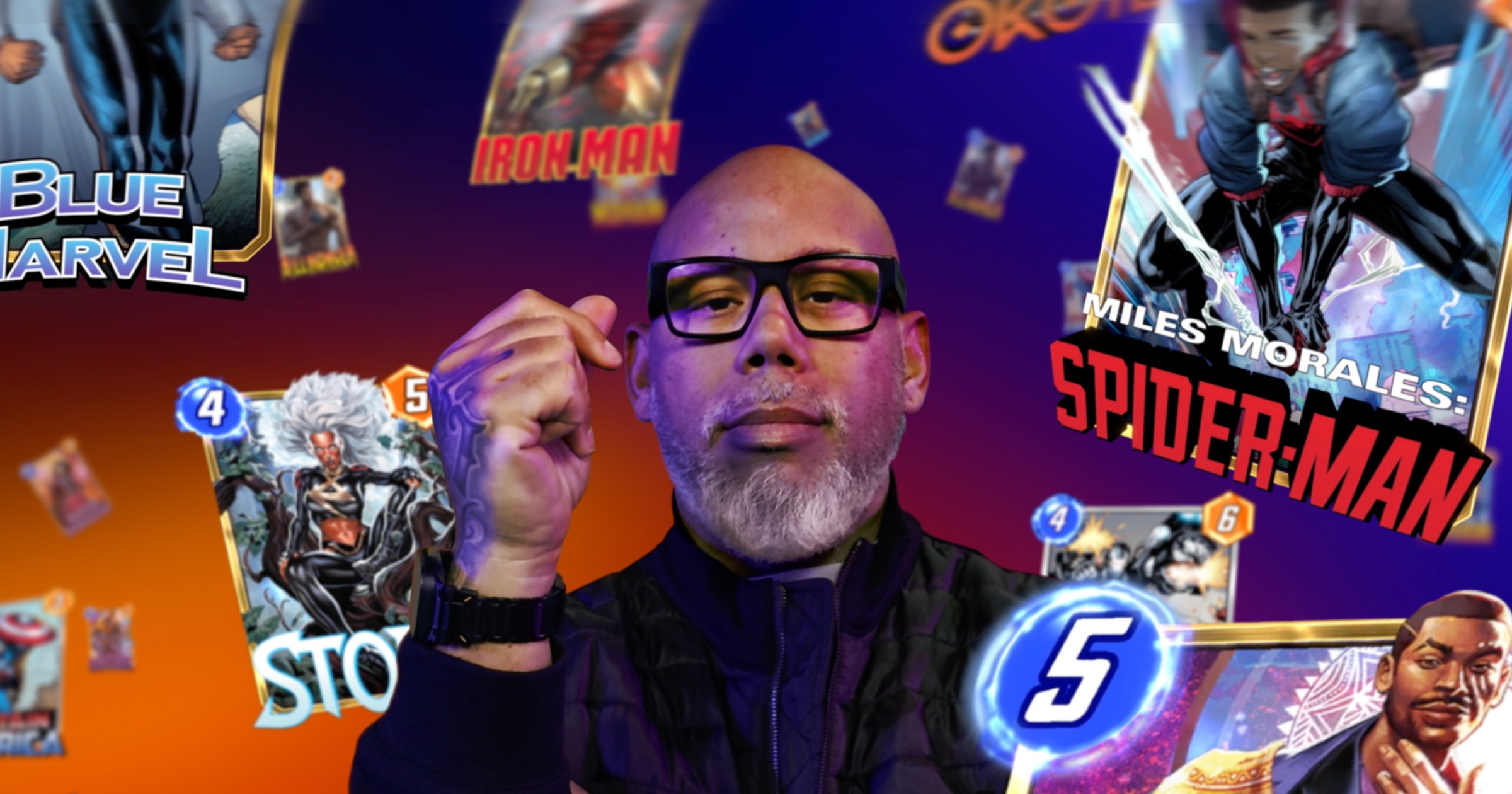
When Marvel SNAP depicts Black characters such as Storm, Luke Cage, Falcon, Misty Knight and Blue Marvel, Kindred pays attention to details that an unspecific brief can flatten. He has spoken plainly about art returning with skin made too light or noses drawn without the breadth of the people being represented. His response is practical. He tries to hire Black artists to make art that understands Black appearance from the inside.
For Blue Marvel, power was not enough. The character needed force and dynamism, certainly, but also majesty. Kindred enlisted veteran comics artist Ryan Benjamin, whose long career includes Iron Man, Captain America and the X-Men. Benjamin could handle the superhero scale. Equally important to Kindred, he understood face and bone structure and the texture of Black hair.
The team worked through rough poses, then pencil, ink and color. Expression carried its own brief. They wanted to avoid making Blue Marvel look reflexively angry or aggressive, so the gaze came directly toward the viewer, the eyebrow furrowed only slightly, the mouth left calm. None of these marks is spectacular alone. Together, they allow authority without stereotype. Representation here is not a commemorative skin placed on a finished system. It is production: whom you commission, what you notice, what you send back, what you refuse to let become shorthand.
“Players see themselves in these worlds. We're here. We're part of these worlds. We're these superheroes too.”Jomaro Kindred
There is a satisfying loop in this. At seven, Kindred saw a drawing and discovered that pictures could open a world. As an adult, he works on who is visible inside those worlds and how they are allowed to stand. The work is larger now, negotiated among licensors, studio teams, outside artists, schedules and screens. The essential transaction remains intimate: someone looks at an image and understands that a door is there.
The unproven road
Kindred's public motto is “Art is Life.” It could float away as branding if his career did not keep giving it weight. He made fan art before a job existed. He moved from a support studio to one of the world's largest game companies. Then he left that security to found a studio with no settled game idea. At each stage, art was not a decorative department waiting for instructions. It was a method of finding the instructions.
He has said that finding his own path never frightened him and that he does not want to travel an already-proven road. This does not read as the lone-genius pose. His descriptions of good work are full of other people: friends, mentors, designers, fellow artists, specialists and players. Independence, in Kindred's version, means having enough conviction to begin and enough judgment to invite the right collaborators.
At Comic-Con, he has helped take audiences behind the making of Marvel SNAP's card art, from early concepts to final illustration. The scale can sound industrial: thousands of cards, a global license, a live game. Yet his best explanations return to the particular. A tusk angle. A relaxed mouth. The right texture of hair. A monster drawn in a laundromat. Large worlds, it turns out, depend on small lines being drawn with care.