There is an old assumption in games: first you make the entertainment, then you advertise it. ENVER found a stranger arrangement. In its best-known worlds, advertising is what the players accidentally manufacture while they are having fun. Someone misses a landing in MotoX. Someone else shrieks as a monster lumbers around a laboratory in Scary Baboon. A third person records the calamity, trims it for YouTube, and gives the game its next customer. The studio does not merely tolerate this behavior. It designs for it.
That distinction explains how a company that began under the broader Enver Experience and Enver Ventures identity became a New York game developer and publisher. The earlier business advertised a familiar agency toolkit: coding, design, marketing, business development. The current ENVER still uses every piece of that toolkit, but now points it at one problem - how to make online games that move through culture without buying every new player.
The first bike took the lonely road
MotoX supplies the uncomfortable opening. The PC VR game arrived on Steam in November 2022 at $7.99. It offered seven worlds, time trials, bikes, coins, obstacles, and a solitary promise of speed. The reception was rough. When this profile was researched, only 17 percent of its 34 Steam reviews were positive. It was not merely a small launch. It was a compact demonstration that building a plausible motorcycle experience was different from building a place people would repeatedly inhabit.
The Quest version moved in another direction. Multiplayer became central. Voice chat lived inside the race. Players organized tournaments, compared tricks, customized riders, and wandered through more than 20 tracks. The motorcycle remained, but the product had changed from a ride into a gathering. By March 2026, ENVER said MotoX had accumulated more than 23,000 Meta ratings at 4.9 stars. The present store page is less pristine - 4.7 stars across about 11,000 displayed ratings - and its reviews include buyers unhappy with the later changes. That messiness is part of the lesson, too.
“Our audience would rather play with their friends than against them.”Kyle Joyce, co-founder and CEO
ENVER removed MotoX's upfront price in March 2026. The free core kept base tracks, online multiplayer, and leaderboards; extra tracks, content packs, cosmetics, and in-game currency became the things for sale. Earlier buyers were promised an “OG” tag, a golden bike, and 6,000 coins. The bet was blunt: a fuller starting line would be more valuable than a paid doorway. Some old customers objected when favorite single-player options or expectations shifted. Free access enlarges the crowd, but it does not erase the receipt in a previous customer's drawer.
A monster is better when friends can blame one another
Scary Baboon made the formula easier to see. The free Meta Quest game is a social horror sandbox set around a failed experiment. Its ingredients are almost suspiciously legible: locomotion with your arms, friends in the same space, a pursuing creature, and enough unpredictability to turn panic into comedy. By mid-2026, Joyce said seven million unique people had installed it. ENVER reported millions of monthly YouTube views and a Discord above 200,000 members.
The growth did not come from preserving an original design in amber. Joyce said the studio's audience preferred cooperation to fighting one another. ENVER leaned away from frustrating player-versus-player encounters and toward co-op survival. The Fight Back update let players attack monsters, but not carelessly: hit one too often and it could become enraged and temporarily invincible. Dreamcore sent groups into a surreal environment. Toxic returned to popular maps, improved settings and accessibility, and added more horror machinery. When the pet Lil Babs caught on, the September Pet Powers update gave pets combinations of abilities, personalities, cosmetics, and ultimate moves.
The game that carries itself
This is ENVER's difference from a conventional development shop and from many premium VR studios. It treats game design, community management, creator media, and user acquisition as one system. The Discord is not simply customer support. It is a noisy research department. A popular mechanic earns a sequel. A complaint reveals friction. A creator discovers which scene can be understood before a viewer has time to swipe away.
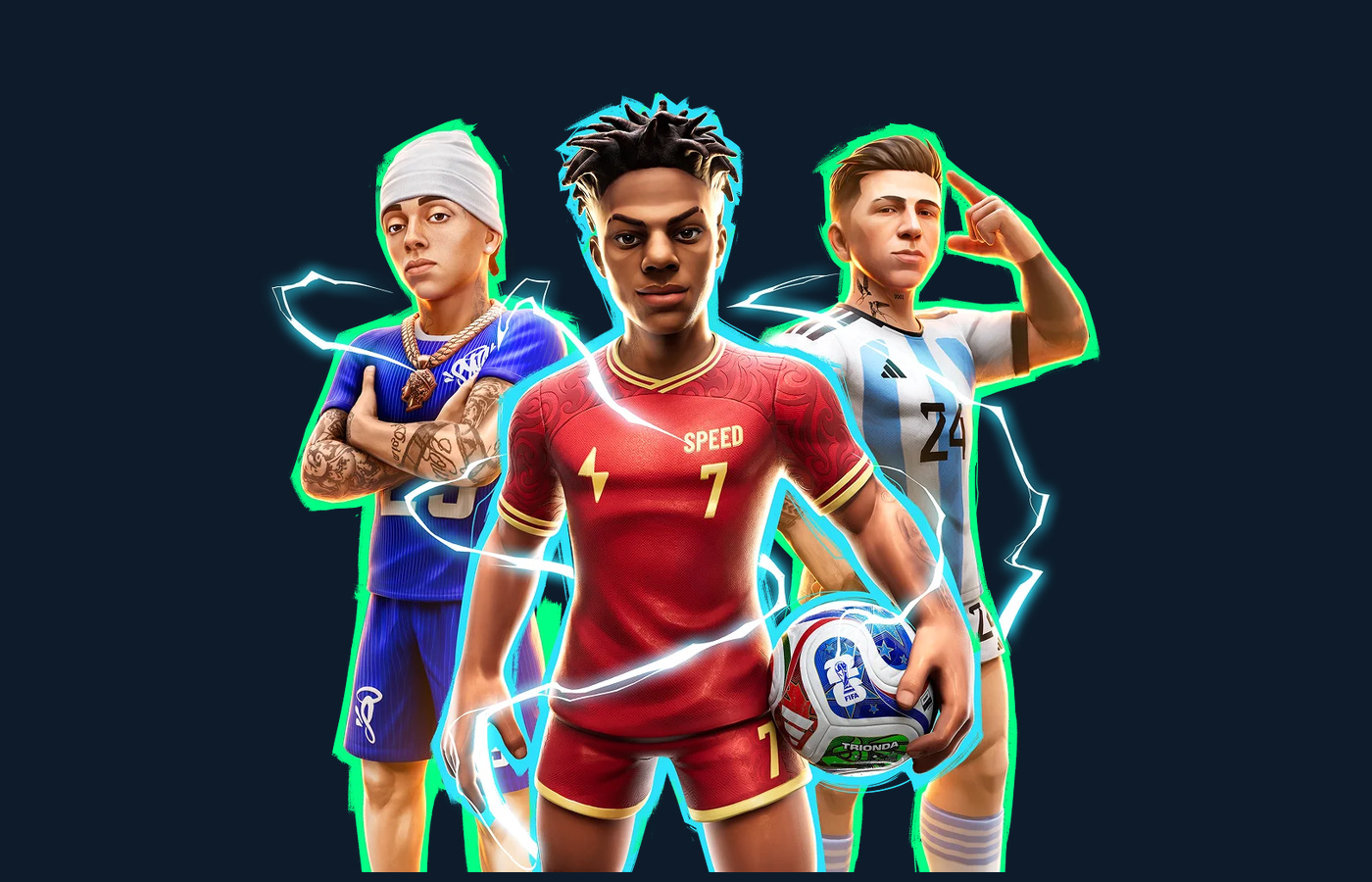
FIFA, folded into the same small moment
FIFA Heroes looks like a departure only if you focus on the ball. Developed by ENVER with publisher Solace, the mobile-first game stages short five-a-side matches with real players, FIFA World Cup mascots, celebrities, and fantasy characters. Teleport dribbles and magnetic tackles replace solemn simulation. Matches last roughly two minutes. Google Play showed more than one million downloads after its 2026 launch, with PC and console editions announced.
The same design preference survives the jump from Quest to phone: fast comprehension, social competition, improbable collisions, and a moment worth replaying. Its distribution strategy became more literal through Motorola. Select new phones offer instant access to the game, exclusive content, and an interface adapted for the large unfolded screen of a new Razr. ENVER says the arrangement can put FIFA Heroes within reach of more than 100 million devices. That is not an audience number, but it is an unusually wide doorway.
The company also began turning its experience into a service for other studios. After helping fund and market ContinuumXR's creature-raising social game UG with Trass Games, the partners announced up to $2 million for emerging VR developers. Their offer combines capital with publishing, marketing, and distribution advice. The alternative for a small developer is familiar: build a clever world, launch it into a crowded store, and hope strangers notice. ENVER is selling a map out of that forest.
What another studio can actually borrow
- Test with five to ten committed players before mistaking a large, indifferent sample for insight.
- Measure what people repeat: session length, return behavior, purchases, and the mechanics that become stories.
- Make the premise readable in seconds. The best clip should not require a paragraph of lore.
- Let community response alter the roadmap, then deepen the mechanics players adopt on their own.
- Lower the price barrier only when the team can moderate, update, and monetize a much larger room.
Free games are expensive rooms to keep interesting
ENVER is private and does not publish revenue or valuation. It said in August 2026 that it had grown revenue more than 2,500 percent over three years, remained profitable, employed more than 200 people across the United States, Europe, and Brazil, and reached the Inc. 5000 without outside capital. LinkedIn presented a more conservative snapshot, placing it in the 51-to-200 band with 79 visible employee profiles. Both can be true when contractors, global teams, and profile counts enter the arithmetic, but the useful fact is the shape of the machine: development, publishing, animation, live operations, and media sit close together.
Its customers are not only the people inside headsets. They are mobile football fans, creators searching for the next watchable accident, licensed brands looking for participation rather than a static placement, and smaller studios that need distribution expertise. Competitors therefore change by angle: Gorilla Tag, Animal Company, Yeeps, UG, VRChat, and Rec Room compete for social time; racing titles compete with MotoX; arcade football games compete with FIFA Heroes; publishers compete for the developer who has a good prototype and no audience.
The limits are practical. Social-first growth needs enough simultaneous players to make a room feel alive. It needs moderation, voice safety, fresh updates, community staff, and mechanics that remain funny after the hundredth clip. A finite narrative, a deliberately solitary game, or a tiny specialist audience may gain nothing from this machinery. And a free-to-play conversion can sour the people who already paid if old access feels diminished.
ENVER's most interesting achievement is not a particular rating or chart position. It is the recovery from a conventional mistake. The company once built the motorcycle as the product. It later understood that the product was the thing that happened when three riders, an open microphone, and a badly judged jump occupied the same ten seconds. Scary Baboon refined the discovery. FIFA Heroes is testing whether it travels. The loop begins with software, but it ends with a person saying, “You have to see this.”