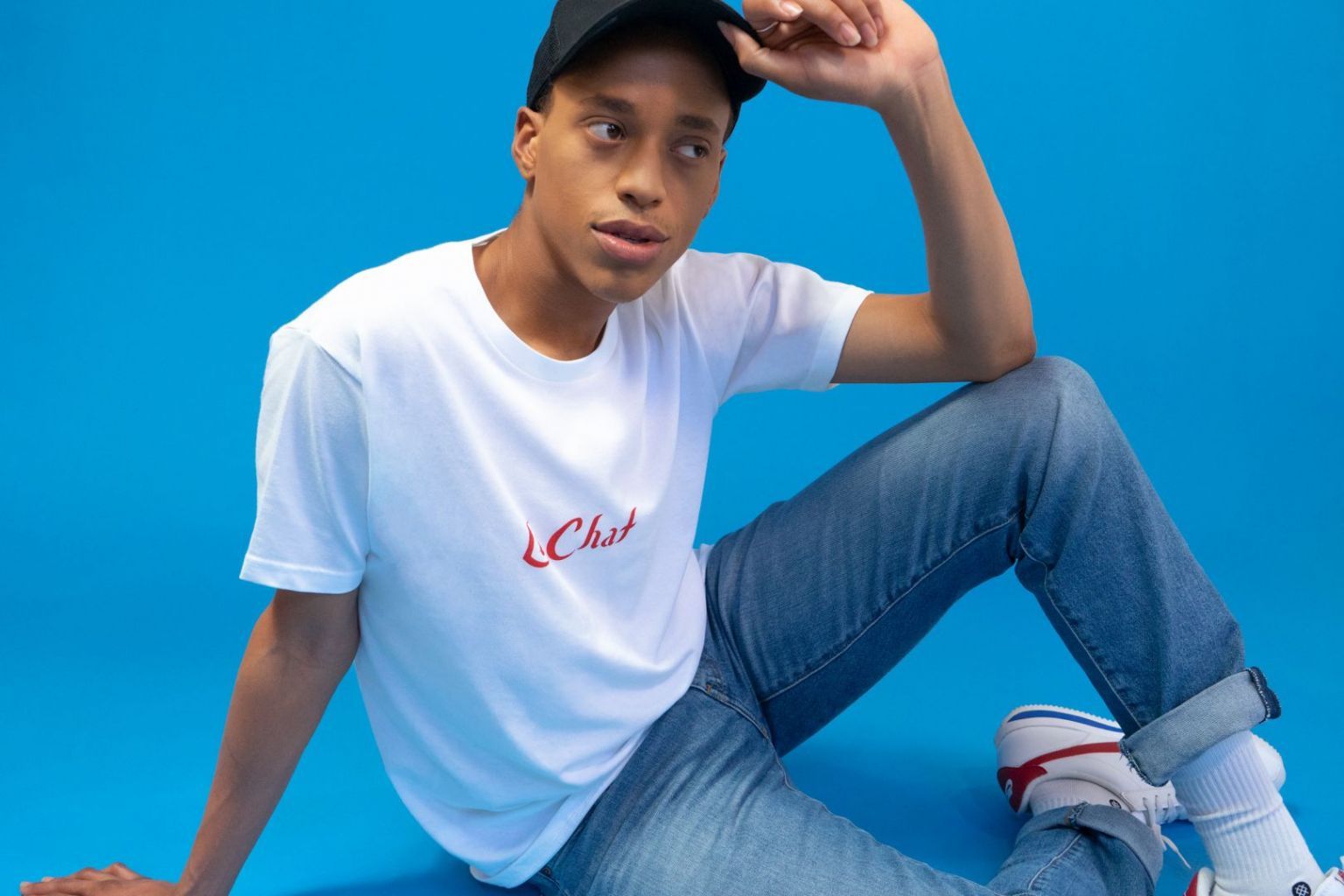
Patrick Collins is sitting against a blue field in a white T-shirt, one hand on the floor, the other touching the brim of a black cap. The shirt carries two red words: Le Chat. It is a founder's portrait without the standard founder furniture. No glass conference room. No heroic stack of boxes. No laptop opened to a graph that goes encouragingly up and to the right. Just the designer wearing his own idea.
The picture catches the central fact of Collins's working life. He is both inside the machine of fashion and busy assembling one of his own. In Los Angeles, his career has moved through graphic design, campaign work and art direction. At Fabletics, he has worked with the men's creative team on campaigns and promotions, and later contributed art direction and design to the launch of Fabletics Scrubs. With Le Chat Couture, the independent label he founded, the assignment is wider. The product, the materials, the packaging, the purpose and the business model all land on the same desk.
Those jobs share a vocabulary - silhouette, audience, color, desire - but they keep different time. A retail campaign is attached to a calendar. It has assets, approvals and a moment when the work must meet the public. An independent brand grows at the speed of decisions that can actually be defended. Collins has called that part of his career a “slow and steady process.” In an industry fond of overnight discovery, the phrase has the clean ring of an honest production note.
The useful education
Learning to see the whole table
Collins's education reads like an early attempt to solve the same puzzle. At Arizona State University, he studied Design Studies with a focus on design management. Later, from 2018 to 2020, he pursued a Master of Science in Integrated Design, Business and Technology at the University of Southern California. The name of the USC program is almost comically complete. It sounds less like a department than a meeting in which nobody was allowed to leave anything out.
For Collins, the breadth was practical. Graduate school gave him frameworks for entrepreneurship, purpose and business models. Fashion work supplied the friction of real schedules and real audiences. One route taught him how to put structure around an idea. The other showed him how an image travels through a company, a campaign and a customer's attention. Together, they made founding a label feel less like a leap into fog and more like another design problem, although with unusually expensive swatches.
Before Fabletics, Collins worked at Jaanuu, the medical-apparel company, from 2018 to 2020. He also took on design work connected with the Strausberg Group, where the canvas included marketing and advertising for hospitality and real estate. The settings changed; the task remained recognizably his. A designer has to understand what an organization means, then give that meaning a shape people can grasp in a second.
At Fabletics, that ability met a brand operating across online retail, membership and physical stores. Collins's documented work on Fabletics Men placed him in the business of making a newer category feel native to an established brand. The Scrubs launch carried a related challenge. Medical apparel has firm functional expectations; activewear brings its own language of movement, performance and personality. The art direction had to introduce the category while making the family resemblance clear.
“Consistency, persistence and a growth mindset” are not decorative words in Collins's story. They are the production schedule.Patrick Collins
A label with consequences
Purpose has to survive the packaging room
Le Chat Couture gave Collins a place to connect the lessons. He has described the label in terms of eco-conscious clothing and accessories, organic fabrics and compostable shipping materials. The ambition is a fully sustainable business model, not merely a collection with the correct shade of green in the campaign. That distinction matters. Fashion can make virtue look marvelous in a photograph. The harder work happens after the shoot, among suppliers, fibers, mailers and margins.
Collins links those choices to water conservation, pollution and waste, with particular concern for communities affected by drought and water pollution. His stated hope reaches beyond his own label: to make an example that can influence other brands. It is a large aim for a small venture. It is also appropriately designed. Influence rarely begins with commanding the room. Sometimes it begins with choosing a different envelope and being willing to explain why.
The campaign clock
Seasonal deadlines, coordinated assets and a clear launch moment. The work must be legible at retail speed.
The founder clock
Materials, suppliers, packaging and purpose are tested together. Progress is measured by what the model can sustain.
This is where Collins's two professional speeds become mutually useful. Large-brand work teaches the discipline of consistency. Independent work keeps the underlying questions alive. Who is the product for? What does it cost beyond the price tag? Which compromises are temporary, and which become the company? One side sharpens execution. The other refuses to let execution become automatic.
His public portfolio also names work with Frame Denim, Global Brands Group and Barneys New York, alongside Fabletics and Jaanuu. The list sketches an education in multiple fashion dialects: denim, activewear, medical apparel, department-store polish. Collins's interest is not confined to the garment. He is drawn to the identity around it - the visual system that tells a shopper what kind of life the product expects to enter.
The people in the frame
No creative career is a solo credit
When invited to name the people behind his progress, Collins started broadly. He credited creative friends and colleagues who pushed him to make and helped him develop as a designer. Then he named Tina Fine, a former colleague, creative director and founder of the eco-friendly candle business Everything's Fine. Fine served as a mentor, teaching him the creative process behind a fashion brand and giving him room to gain experience.
That answer is revealing because it resists the easiest founder myth. A label may have one name on its biography, but ability accumulates socially. Someone explains a process. Someone offers the first consequential assignment. Someone looks at an early version and tells the truth. Collins's own account leaves those fingerprints visible. Even the portrait that introduces him and Le Chat together carries a family credit: Myles Collins made the photograph.
- 2018-2020Graphic design at Jaanuu, where fashion and medical apparel share the brief.
- 2020Completes USC's integrated design, business and technology master's program.
- 2020 onwardMoves through graphic design, senior design and art-direction work at Fabletics.
- 2021Sets out Le Chat Couture's organic-material and compostable-packaging ambitions in public.
- 2023Contributes art direction and design to the Fabletics Scrubs launch.
- 2025Appears on a creative roster as a Fabletics art director working across fashion, lifestyle and sports.
Los Angeles suits this arrangement. Collins's version of the city is social and a little improvisational. For a visiting friend, he once imagined a base near Wilshire or Sunset, dinner at Sugarfish, Ocean Prime or Jon & Vinny's, drinks on a Westside rooftop, then a live show or a DJ set found through the artists promoting it. It is less an itinerary than a sequence of moods. The designer in him leaves room for art direction; the Angeleno leaves room for traffic.
The anecdote also clarifies his relationship to creative community. Music, restaurants, rooftops and colleagues are not scenery around the work. They are part of the visual and social information a designer absorbs. Fashion borrows from the room it enters. A good art director notices the room before asking it to pose.
What the two clocks make
A career shaped like a studio, not a ladder
Collins's path does not arrange itself into the tidy upward line that professional biographies prefer. It spreads sideways. Design management sits beside graphic design. Art direction sits beside entrepreneurship. Fabletics campaigns sit beside a Le Chat shirt. The range is coherent because each role asks him to convert values into visible choices.
There is a useful restraint in the way he describes progress. Practice and exploration, he has said, were only beginning to prove their value. The sentence makes room for unfinished work without dressing it as destiny. Le Chat's sustainability goal remains an ambition that must be earned through operations. A campaign remains a collaboration, not the private expression of its art director. The career is interesting precisely because Collins treats both facts as prompts to keep working.
Back in the blue portrait, the composition looks simple. Blue, white, red, denim, skin. Yet the T-shirt is carrying a considerable argument. It proposes that clothes can hold a personal mark, a commercial idea and an environmental intention at once. Collins is not standing behind it. He is wearing the proposition, patiently, while the faster clock keeps ticking.