Before there was a label, there was a girl rearranging rooms. Pamela Vega made jewelry, played dress-up, played music and danced. The activities looked different, but the impulse was the same: take the given world and adjust its composition. Move this there. Pair that with something unexpected. Change the story until it feels right.
That instinct survived adulthood, fashion work and all the tidy labels a résumé tries to impose. Vega became a stylist, a creative director, a jewelry designer and, eventually, a wine professional. Her working life is less a ladder than a well-set table: distinct objects, arranged with intent. The common skill is not decoration. It is discernment.
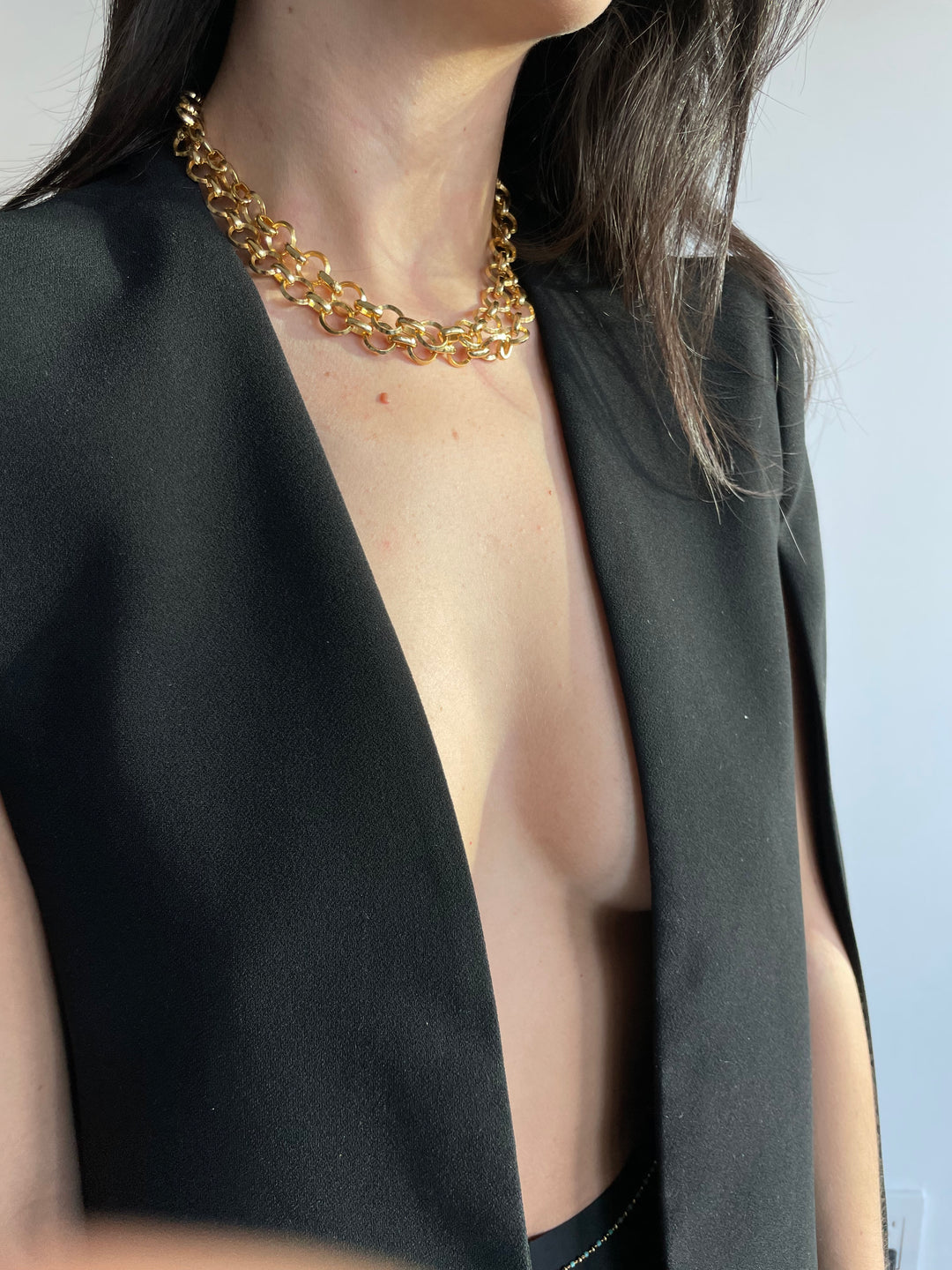
Vega describes herself as someone with an ever-curious, imaginative mind. Her phrase for the operating system is even better: a “discerning eye to curate at any landscape.” It explains why her two businesses share a sensibility without sharing a format. Curated is a multidisciplinary creative agency. Eleva the Label makes demi-fine jewelry and accessories. One shapes how clients speak; the other gives metal and form a voice of their own.
The old skill waiting in the drawer
Eleva arrived in 2020, when quarantine turned time strange and made hobbies feel newly consequential. Vega began making jewelry again. “Again” matters. She had spent two summers taking formal jewelry craft courses as a teenager, storing a tactile education she could not yet know she would need. Years later, with ordinary schedules suspended, the dormant skill returned with a business attached.
The initial brief was precise: special jewelry at an attainable price, without sacrificing quality, aesthetics or style. Within three years, Vega said, Eleva had reached a national customer base. The chronology is compact, but it refuses the usual overnight-success fable. Childhood experiments came first. Then teenage coursework. Then fashion and visual merchandising. The hobby could move quickly because it had been quietly rehearsed.
The brand’s scale is visible in its constraints. Vega said many pieces were made to order and no more than 20 of a design were produced. Plated materials came from a manufacturer in Istanbul with fewer than 50 employees and a fair-trade practice, while the jewelry was handcrafted and assembled in a Puerto Rico home studio. Eleva’s current statement of principles adds waste reduction, supply-chain monitoring and one tree planted for each purchase.
It is a charming sentence, but also a demanding one. If a customer is buying a relationship, the maker cannot disappear behind the checkout button. If a customer is buying a story, the production choices become part of the plot. The limit of 20 is no longer merely inventory math. The home studio is not just an address. Both tell the buyer what sort of object this is and what sort of attention made it.

A small-batch object’s route
A club before a customer list
Eleva did not begin with a grand acquisition machine. It traveled through friends and family, then through their friends. Vega calls the wider circle the Eleva Club. In corporate language, this might be filed under retention. In her account, it sounds more like hospitality. She said the team dances when a new order drops. Some supporters have accumulated four or five pieces. Others have requested custom jewelry and given her full creative liberty.
That last detail is a useful measure of trust. Buying a finished piece says, I like what you made. Commissioning a piece without dictating the result says, I trust how you see. For someone whose career rests on curation, that is the more meaningful transaction.
Vega’s language around community can be exuberant, but her production model is controlled. That tension gives Eleva its character. The brand invites people into a club, then resists flooding the clubhouse with product. Its website describes a visual language where minimalism meets surrealism. It has also moved beyond jewelry into functional objects that double as sculptures. Expansion, here, means widening the idea rather than simply multiplying units.
The gender-neutral approach is another kind of edit. Instead of beginning with the familiar division of jewelry into his and hers, Eleva begins with the piece: its line, weight, surface and relation to a body. That leaves the wearer more room and the sales taxonomy less authority. It also fits Vega’s larger preference for reshaping a narrative when the inherited version does not quite work.
Her childhood forms of play now read like early departments in the same company. Rearranging a room became visual direction. Dressing up became styling. Making jewelry became Eleva. Music and dancing supplied rhythm, which any good composition needs. None of this means the ending was predetermined. It means creative lives often reveal their logic backward. The clues were present long before there was a company name to gather them.
The agency and the appetite
Curated takes the same way of seeing into a broader arena. Vega describes the Puerto Rico-based agency as a strategic partner that helps clients talk to, and with, their audiences. Its client work reaches music, hospitality, fashion and real estate. Its creative direction crosses art, culture, lifestyle, design and events. Where Eleva makes an object, Curated makes a conversation.
The distinction between talking “to” and talking “with” an audience is small enough to miss and large enough to build an agency around. The first assumes a recipient. The second expects an answer. Vega’s account of Curated emphasizes listening to the marketplace and discovering a client’s unique voice, not merely polishing a broadcast. That makes the agency’s role closer to an editor at the table than a megaphone in the corner.
The range has roots. Her public career record includes fashion-week volunteering that began in 2014, where she helped set up venues, style and dress models, and organize show lineups. At Gabriella Arango Couture, she created visual merchandising displays, one of which placed second in Coral Gables’ annual holiday storefront contest in 2015. In 2018, she added a Fashion Styling and Image Making certificate from The Business of Fashion.
Begins hands-on fashion-week volunteering, from venue setup to styling.
A Gabriella Arango Couture window earns second place in a Coral Gables contest.
Completes Fashion Styling and Image Making studies.
A quarantine jewelry practice develops into Eleva the Label.
Adds the WSET Level 2 Award in Wines to a deliberately varied toolkit.
Then there is the wine qualification. In January 2023, Vega earned the WSET Level 2 Award in Wines. On paper, it might look like a side road. In practice, wine asks for the same muscles as styling and jewelry: attention to material, origin, balance, memory and language. Taste must be felt, but it also has to be articulated. For a creative director, that is familiar work in a glass.
Vega calls herself a lifelong learner. The phrase is often reduced to professional wallpaper, but her sequence of practices gives it teeth. A stylist studies proportion. A merchandiser studies movement through space. A jewelry designer studies the body at intimate scale. A wine student studies distinctions that vanish when rushed. Together, they form a curriculum in noticing.
Eleva’s environmental commitments belong to that curriculum too. The label asks customers to choose well, buy less and make pieces last. Its public principles include made-to-order production, fewer manufacturing processes, inventory control and waste reduction. These are plain operational choices rather than ornamental language. They turn responsibility into a series of decisions that can be repeated at the sourcing table and the workbench.
There is also a useful modesty in the way the brand states its ambition. Eleva calls itself small but wants its impact to be significant. Smallness, in that sentence, is a condition rather than an apology. A small operation can know the limit of a run. It can finish an order at home. It can notice when one person has returned for a fifth piece. Those details become harder to see as an organization grows, unless someone decides they are worth protecting.
Stillness is not standing still
Vega names two pillars for her work: “stillness amongst the chaos” and “finding pleasure in the details.” The first can sound paradoxical for a founder wearing several hats. Yet stillness, in her formulation, is not idleness. It is the refusal to react before observing. It creates the small interval in which a better choice can appear.
That pause links her agency and her label. Curated listens for the voice that can start the right conversation. Eleva chooses a chain, an edition size, a supplier and a silhouette. Both depend on editing. The work is as much about what does not enter the frame as what does.
Her stated aspiration for Eleva is to grow it into a lifestyle brand with a solid identity, one able to develop alongside both its founder and its market. The wording leaves room for movement without discarding the original character. Growth is welcome. Amnesia is not.
Vega’s story offers no neat choice between commerce and craft, scale and intimacy, or breadth and focus. It offers a working arrangement. Make a limited number. Invite the customer closer. Learn another vocabulary. Keep the thread visible. Above all, look long enough for the detail to disclose what it wants to become.
A childhood room gets rearranged. A teenage skill waits. A quarantine hobby becomes a label. An order arrives and somebody dances. The plot sounds accidental only from a distance. Up close, it is the consequence of attention.