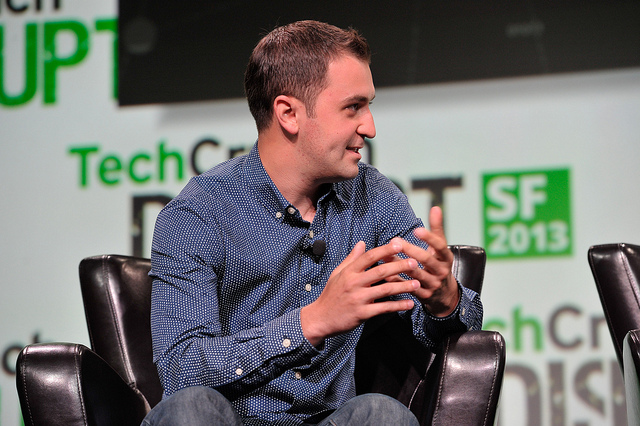
John Zimmer, co-founder of Lyft and CEO of Yes&
TechCrunch Disrupt, SF
Founder / Operator / Builder

John
Zimmer

"The man who put a pink mustache on a car and dared a nation to change seats."

Cornell hotel grad. Lehman escapee. Pink mustache inventor. Lyft co-founder. Now building Yes& for the next act.

Co-Founder, Lyft CEO, Yes& Forbes 30 Under 30 Fortune 40 Under 40
$24B
Lyft IPO Valuation
16
Years at Lyft
11
NYE Drives as Pres.
125+
Zimride Universities
2006
Cornell
Valedictorian
2012
Lyft
Launched
$0
Salary, First
3 Years at Lyft
30%
Lyft Drivers
Who Are Women
2025
Yes& Inc. 5000
Honoree

The Hotel Kid Who Rebuilt How America Moves

John Zimmer

Greenwich, CT to Silicon Valley. Long way to go.

Before the billion-dollar valuations, before the IPO, before Lyft became the ride that America took when it didn't want to get in an Uber - there was a 22-year-old in Greenwich, Connecticut, keeping a private journal of carpooling ideas from his desk at Lehman Brothers. Not a pitch deck. A journal. Pages of handwritten notes about human mobility, filled between spreadsheet sessions at a firm that had less than two years left to live.

John Zimmer studied hospitality at Cornell. He graduated valedictorian. His first job was answering phones at a Hyatt, where he once dispatched milk and cookies to a frustrated family's room at 10 p.m. because the shower was broken and the kids were crying. That instinct - fix the experience, not just the problem - would become the entire operating philosophy of a company he hadn't yet imagined.

In 2007, a mutual friend on Facebook introduced him to Logan Green, a UC Santa Barbara grad who'd built a campus car-sharing system partly inspired by hitchhiking networks he'd seen in Zimbabwe. Green flew to New York within a week of connecting online. Within months, Zimmer had handed in his notice at Lehman. Three months later, Lehman Brothers filed for the largest bankruptcy in US history. Zimmer was in a Silicon Valley apartment that doubled as an office, co-founding a carpooling startup called Zimride.

The first launch was at Cornell. Within six months, 20% of the student body had signed up. By 2012, Zimride was running at 125 universities. But universities were small. Cities were where the opportunity was. And so they built Lyft - a peer-to-peer rideshare service in San Francisco with a distinctive marker: a giant pink fuzzy mustache mounted on the front grille of regular people's cars.

People smiled when they saw it. That was the point. Not just a product feature - a signal that this wasn't a taxi, wasn't a limo, wasn't a transaction. It was a ride with a person. Zimmer had learned at Cornell that the feeling a guest has when they walk through a door determines everything that follows. He was trying to make the door feel different.

"Cities of the future must be built around people, not vehicles. They should be defined by communities and connections, not pavement and parking spots."

- John Zimmer, "The Third Transportation Revolution," Medium, 2016

What followed was a decade of controlled chaos. Lyft grew fast, then faster. Uber grew faster still, with a war chest and a willingness to operate at a loss that would test any competitor's resolve. In 2018, Zimmer admitted in a CNN interview that the pressure had broken through: "I was in a funk for several months. I was depressed. I didn't know what to do." It was a rare admission from a Silicon Valley executive - not processed through a PR firm, not framed as a lesson learned in retrospect. Just a direct account of what it felt like to be outgunned and scared.

Logan Green's response, as Zimmer recalled it, was simple: enjoy the journey. Focus on what you can control. Keep building. They did. In 2017, Uber's internal culture crisis became public. The contrast with Lyft's values-first operation suddenly mattered in the market in a way it hadn't before. Drivers and riders who cared about how a company treated people had a clear choice. Lyft's community of drivers reached 30% women, in an industry where the figure was typically 1%.

March 2019: Lyft went public at $72 per share, a $24 billion valuation, becoming the first major US ride-hailing company to hold an IPO. There are photos from the floor of the Nasdaq that day. Zimmer looks, for a moment, like someone who just carpooled across the country and actually arrived.

He literally had. Before Lyft launched, Zimmer and Green needed a way to move from the East Coast to San Francisco to work together. They used Zimride to do it - carpooled their way across America in the product they'd built. The full-circle logic that defines everything Zimmer has ever built.

On leaving Lyft in 2025: "The trust, the support and the pushes were everything I needed. When I was down, you rose up." - to Logan Green, in his farewell letter

In March 2023, Zimmer and Green simultaneously announced their departure from Lyft's executive roles. David Risher, a former Amazon executive, stepped in as CEO. Zimmer became Vice Chair of the Board. In August 2025, both co-founders formally stepped off the board entirely, converting their Class B supervoting shares to Class A - relinquishing formal control of the company they'd built from a Cornell carpool into a global ride network. It was, by any measure, a graceful exit. No drama, no shareholder revolt, no hostile board maneuver. Just a two-year handoff, done.

On the day he left the board, Zimmer announced his next move with a Willy Wonka quote: "The suspense is terrible, I hope it will last." The new venture is called Yes&. A consumer company-builder focused on health, connection, and joy. Co-founded with Ben Wolan, with Jesse McMillin and Mason Rothschild as founding partners. Zimmer's stated goal is to prove - not just claim - that business can make positive impact at scale. Yes& was named a 2025 Inc. 5000 honoree in its debut year.

The through-line is obvious once you see it. Hotel school, frog costumes on a Cornell campus, milk and cookies at the Hyatt, a pink mustache on a car grille, 11 consecutive New Year's Eve drives with passengers in the back seat. Every career move Zimmer has made has been a version of the same question: how do you design an experience that makes a stranger feel, for a moment, that they matter?

He hasn't stopped asking.

From Hyatt Phones to a $24B IPO

2002-2006
Cornell University, School of Hotel Administration - graduated valedictorian. Member of Quill and Dagger honor society and Sigma Pi Fraternity.
2006
Joined Lehman Brothers as a real estate finance analyst in NYC. Quietly kept a personal journal of carpooling ideas the whole time.
2007
Connected with Logan Green on Facebook via a mutual friend. Green flew to New York within a week. Co-founded Zimride, a college carpooling platform. First launch at Cornell: 20% of students signed up in six months.
2008
Resigned from Lehman Brothers to pursue Zimride full-time. Three months later, Lehman filed for bankruptcy. He and Green moved into a shared Silicon Valley apartment-office.
2012
Launched Lyft in San Francisco. The pink fuzzy mustache on car grilles debuted as the signal that this was something different: a ride with a human being, not a transaction.
2013
Sold Zimride to Enterprise Holdings. Shifted all focus to Lyft's rapid national expansion.
2014-2017
Forbes 30 Under 30, Inc. 35 Under 35, Fortune 40 Under 40 (twice). Cornell Hospitality Innovator Award. Meanwhile, quietly driving Lyft on New Year's Eve every single year.
2019
Lyft IPO at $72/share - $24 billion valuation. First major US ride-hailing company to go public. The idea that started in a carpooling journal at Lehman Brothers was now on the Nasdaq.
2023
Announced departure from President role alongside Logan Green. David Risher (former Amazon exec) named CEO. Zimmer became Vice Chair of the Board.
2025
Stepped down from Lyft's Board of Directors. Launched Yes&, a consumer company-builder. Inc. 5000 honoree in year one. The next chapter, already running.

Outgunned, Underpaid, and Still There

There's a version of the Lyft story that skips the part where Zimmer admitted he was depressed. It's a tidier story - scrappy underdog outsmarts Silicon Valley giant, all confidence and vision. That version exists. It is not the interesting one.

The interesting version includes 2016 and 2017: Uber had ten times Lyft's capital, a global presence, and a playbook that included tactics Zimmer described carefully as being "willing to go to whatever means" to win. Lyft was fighting for market share on one continent while Uber was operating on six. In private, Zimmer stopped making good decisions. He describes it as fog - the inability to act because the things you can't control overwhelm the things you can.

What broke the pattern, according to Zimmer, was Logan Green. Not a strategy session. Not a consultant. His co-founder saying: let's enjoy this journey. Let's fight for the values we believe in. Then Uber's 2017 scandals became public - the internal culture, the leadership failures - and suddenly Lyft's entire positioning as the "nicer" company wasn't just a brand line. It was the differentiator. Drivers preferred it. Riders chose it when they had the option. The values Zimmer had been defending through the fog turned out to be the moat.

"It was foggy and I didn't necessarily take action and focus on what I could control. I got overwhelmed with the things I couldn't control."

- John Zimmer, CNN "The Human Code," December 2018

The Lines Worth Keeping

  • "America is running a failing transportation business."
  • "You should never veer off the path of your own values."
  • "Every time we have a team meeting, we share a driver or passenger story to remind ourselves that as we grow the business, behind each ride there are two people that are interacting."
  • "By rebuilding transportation so that you're not owning this thing that just sits there all the time, you get to rebuild cities in the process."
  • "Optimism means focusing on the fact that things can always be better. People want to do the right thing, so leaders need to provide ways for people to do that."
  • "The passenger is the ultimate customer, but if we don't take care of our drivers, they're going to get a bad experience."
  • "15 years ago, I carpooled across America so Logan Green and I could build Lyft together. We started with a crazy idea that we would put pink mustaches on regular people's cars and create a community movement. And it worked!"

What He Built and What He Won

  • Co-founded Lyft, which grew from a campus carpooling experiment to a $24 billion public company
  • Led Lyft as President for over a decade - the first major US ride-hailing company to go public (2019)
  • Grew Lyft's driver community to 30% women in an industry where the norm is 1%
  • Built Zimride from zero to 125+ university campuses before pivoting to Lyft
  • Named Forbes 30 Under 30 (2014) and Inc. 35 Under 35 (2014)
  • Named Fortune 40 Under 40 twice - 2015 and 2017
  • Cornell University class valedictorian (2006)
  • Received the Cornell Hospitality Innovator Award (2017)
  • Took no salary for the first three years at Lyft while building the company
  • Yes& named an Inc. 5000 honoree in its debut year (2025)
  • Successfully exited Lehman Brothers 3 months before its historic 2008 bankruptcy

The Stories Behind the Story

01

The Frog Suit Incident. While employed at Lehman Brothers, Zimmer moonlit as a mascot: he and Green wore frog costumes on Cornell's campus to hand out Zimride flyers. At a Lehman recruiting event, a candidate recognized him. "I swear I recognize you - were you in a frog suit on Saturday on campus?"

02

The Childhood Dream. When he was a kid, Zimmer's stated career goal was to become a doughnut baker at Dunkin' Donuts. He was not joking. He eventually settled for co-founding a $24 billion transportation company instead.

03

The Nicaraguan Pineapple Failure. During a college trip to Nicaragua, Zimmer discovered a rare white pineapple native to the region. He tried to import it and sell it as dried fruit in the US. The venture failed. It sparked his interest in community-driven enterprise. Not every product can be Lyft.

04

11 New Year's Eves. For eleven consecutive years - even as President of Lyft - Zimmer drove as a Lyft driver on New Year's Eve in San Francisco. Not a photo op. He wanted to hear what passengers actually said when they thought they were just talking to a driver.

05

The Carpooling Journal. Long before Lyft existed, Zimmer kept a personal journal of carpooling ideas at his Lehman Brothers desk. When he found Logan Green on Facebook - a stranger who was already trying to build what he'd been thinking about - he recognized it immediately. Within a week, Green was on a plane to New York.

06

He Met His Wife Through Zimride. In 2008, Cristina Garcia Rivas carpooled with Zimmer through the Zimride platform. They started dating. They eventually married. He had been arguing for years that carpooling creates genuine human connection. He now has permanent empirical evidence.

07

Milk and Cookies at the Hyatt. As a teenage phone operator at a Hyatt in Greenwich, CT, Zimmer handled a complaint from an unhappy family whose room had a maintenance issue. He sent milk and cookies to their room. This single anecdote explains roughly 80% of how Lyft was run for a decade.

08

The Willy Wonka Exit. When Zimmer announced Yes& on departing Lyft's board in 2025, he quoted Willy Wonka: "The suspense is terrible, I hope it will last." It is, possibly, the most accurate description of what it feels like to start a company that has ever been borrowed from a children's film.

Yes&: The Next Bet

The name "Yes&" comes from improv comedy - the principle that you build scenes by accepting what your partner offers and adding to it. Not "yes, but." Not a negotiation. Just forward motion. It is a deliberate name for a company-builder whose founder spent 16 years at Lyft proving that the answer to almost every hard business problem is more commitment, not less.

The stated focus - health, connection, joy - sounds like a wellness brand pitch. In Zimmer's framing, it's actually a thesis about business as proof-of-concept. The best companies don't declare their values in a mission statement. They demonstrate them at scale. Lyft's 30% female driver community wasn't an ESG talking point. It was a structural outcome of building a platform that made driving feel safer and more dignified for everyone. Yes& is trying to replicate that logic across consumer categories Zimmer believes are currently being done wrong.

Zimmer works alongside co-founder Ben Wolan and founding partners Jesse McMillin and Mason Rothschild. Yes& was named a 2025 Inc. 5000 honoree in its debut year - which is either a sign the company is growing fast or a sign that someone on the team knows how to submit nominations. Given Zimmer's history, probably both.

🟡
Lyft (2012-2025)

From pink mustaches in San Francisco to a $24B public company. President for 16 years. First major US ride-hailing IPO in 2019.

Yes& (2025-present)

Consumer company-builder focused on health, connection, and joy. Inc. 5000 honoree in year one. Zimmer's next proof-of-concept.

Things You Might Not Know

01
His childhood dream was to be a doughnut baker at Dunkin' Donuts.
02
He quit Lehman Brothers exactly 3 months before it filed the largest bankruptcy in US history.
03
He drove as a Lyft driver every New Year's Eve for 11 consecutive years - including years when he was company President.
04
He met his wife through his own Zimride carpooling platform in 2008.
05
The pink fuzzy mustache on early Lyft cars was partly chosen because it made people smile - a hospitality principle from his Cornell hotel training.
06
He kept a personal journal of carpooling ideas at his desk at Lehman Brothers, years before Lyft existed.
07
He and Logan Green shared a one-bedroom Silicon Valley apartment that was also their company office.
08
He tried to import rare Nicaraguan white pineapples to the US as a college side project. It failed.
09
He wore a frog costume on Cornell's campus to hand out flyers while still employed full-time at Lehman Brothers.
10
He took no salary for the first three years at Lyft while building the company.

Know someone who'd find this interesting?

The hotel kid who rebuilt how America gets around.