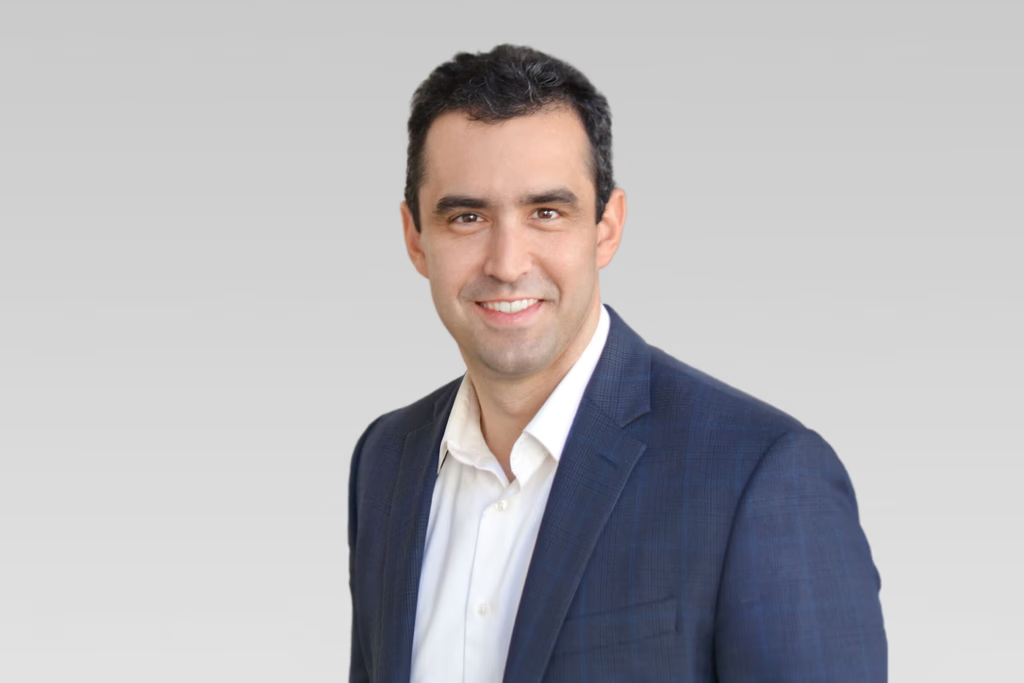
Profile
The Man Who Listens to What the Earth is Not Saying
Before John Mern ever thought about mining, he was building drones and satellites at a secretive Boeing division called Phantom Works. Not the kind of drones that get delivered to your door - the kind that move through classified airspace with no pilot on board. He spent years there as a structural design engineer, then a systems architect, designing requirements for machines that most people would never know existed. It was precise, demanding work. And eventually, it wasn't enough.
The question that pulled him away from aerospace was deceptively simple: how do you make good decisions when you can't see everything you need to see? At Stanford's Intelligent Systems Laboratory, he spent five years turning that question into a dissertation. The answer involved Monte Carlo tree search, deep reinforcement learning, and a willingness to sit with uncertainty long enough to extract something useful from it. His thesis - "Monte Carlo Planning and Reinforcement Learning for Large Scale Sequential Decision Problems" - has since accumulated 234 academic citations. Not bad for an aerospace PhD.
Despite decades of investment in sensors and data, we're doing worse every year.
- John Mern, Co-Founder & CEO, Terra AIBetween Boeing and Stanford, and then Stanford and Terra AI, Mern stopped at two places that would shape everything he built next. At Prime Movers Lab, he was an AI Fellow - a role that put him in close proximity to founders trying to solve the hardest physical problems in energy and industry. Then at KoBold Metals, the Bill Gates-backed mineral exploration startup, he became a Senior Decision Scientist, leading the development of AI systems to help figure out where to dig for the copper and cobalt the world's battery supply chains depend on.
KoBold gave him the problem in its full scale. Mineral exploration is a mess. The false positive rate - sites that get explored but yield nothing commercial - exceeds 90%. The time from a promising discovery to an operating mine averages nearly two decades. The global mining industry spends roughly $12 billion per year on exploration, while the value of new discoveries created each year is closer to $900 billion. That's not a gap. That's a chasm.
Two Stanford Labs. One Unusual Partnership.
Terra AI didn't emerge from a single insight - it emerged from a collision between two research communities that had never properly talked to each other. Mern's Stanford Intelligent Systems Lab had spent years building algorithms for sequential decision-making: how do you choose the next action when outcomes are uncertain and each choice changes what you know? The Stanford School of Sustainability had spent years building models of the Earth's subsurface: what does the rock look like down there, and how confident should we be in any given estimate?
Neither group alone had what mining needed. Combined, they had exactly it. Mern and his co-founder Anthony Corso - also a Stanford AI PhD - saw the bridge that needed building.
The Exploration Gap Terra AI is Closing
What "125,000x Faster" Actually Means
Terra AI's platform does something that sounds simple and is technically ferocious: it generates thousands of probabilistic models of what might be underground, then recommends what to do next based on those models. Geophysics, geochemistry, and drilling data get fused into a picture of the subsurface - not a single picture, but a distribution of possible pictures, ranked by likelihood and decision value.
The key claim is that Terra AI's patent-pending geophysical simulations run 125,000 times faster than traditional physics-based methods. That's not a rounding error. Traditional subsurface simulation requires large compute clusters running for hours or days per model. Terra's approach uses generative AI - similar to the diffusion models behind image generation - to shortcut the physics while preserving enough accuracy to make real exploration decisions. The result: instead of running one model and hoping, exploration teams can run thousands and choose.
We are entering a new era of global demand for subsurface resources - facing an exploration gap that will define whether we meet our climate, energy, and AI ambitions.
- John MernThe early numbers are doing the talking. Terra AI reports 40% reductions in drilling meters for pilot clients - the equivalent of cutting the most expensive line item in mineral exploration nearly in half. Targeting accuracy under cover (finding resources that are hidden beneath rock layers that make conventional geophysics unreliable) improves by 90%. And for clients who have piloted the platform, Terra AI claims to have helped them secure over $100 million in downstream investments - the kind of funding that flows when a project's risk profile shifts from "maybe" to "probably."
Who's Already Digging In
Rio Tinto didn't just become a client. The mining giant became an investor, joining through Founders Factory - Rio Tinto's accelerator program - in 2025. That's a meaningful signal. Rio Tinto operates on geological timescales; they aren't given to trend-chasing. When they put capital into a 21-person Palo Alto startup, they've seen something that moves the needle.
Ero Copper and Ramaco Resources are also on the client list. The platform has been piloted on rare earth projects in the United States and tested by mining companies across the Americas, Africa, and Europe. For a company that only emerged from stealth in 2026, the geographic spread is notable.
The AI Needs Mining Problem Nobody Talks About
Here's the loop Mern likes to point to. AI systems run on data centers. Data centers require enormous quantities of copper - for wiring, for cooling infrastructure, for power distribution. The global AI buildout is accelerating demand for copper at exactly the moment when new copper mine development has slowed to a crawl. The major mines producing today were discovered decades ago. The pipeline of new mines is thin. And copper takes 17 years, on average, to move from discovery to production.
The AI sector's supply chain problem is, in a meaningful sense, a mining problem. And mining's productivity problem is, in an equally meaningful sense, an AI problem. Mern is working both sides of that equation.
The Tech Stack
Generative AI + surrogate simulation + decision-making agents. The system models the Earth probabilistically and recommends next actions - drill placement, survey strategy, capital allocation - based on expected value.
The Background
BS in Mechanical Engineering and Finance (Washington University). PhD in Aerospace Engineering, Stanford SISL (2021). Boeing Phantom Works. Prime Movers Lab. KoBold Metals. Then Terra AI.
The Research Base
234 academic citations, h-index of 9. Collaborators include Stanford's Mykel Kochenderfer (AI safety) and Tapan Mukerji (subsurface geoscience). The science behind Terra AI has peer review behind it.
PDAC, Patents, and What's Coming
In March 2025, Mern spoke at PDAC - the Prospectors and Developers Association of Canada's annual convention in Toronto, the mining industry's version of Davos. Standing in front of an audience of geologists, mine operators, and capital allocators, he made the case that the existing exploration playbook is broken. That the industry's false positive rate isn't a bad luck problem - it's a data integration problem, and AI is the answer.
The platform's underlying modeling methods are patent-pending. The team behind them includes AI researchers and PhDs from Stanford SISL, geophysics and Earth Sciences PhDs, reservoir engineers, data scientists, mine developers, and tech founders. For a 21-person company, it's an unusually dense research bench.
Mern's stated aspiration is to build the backend intelligence engine for the world's mineral and energy exploration decisions. The implication: that every major mining company, every energy explorer, every critical mineral project eventually runs its risk assessments and drill planning through Terra AI's platform. A bold claim from a $3.4 million seed round. But then, the best founders always know exactly how large their problem is.
The reality is, the majority of our supply chain is going to come from beyond our borders.
- John MernSelected Publications
Bayesian Optimized Monte Carlo Planning
A Sequential Decision-Making Framework with Uncertainty Quantification for Groundwater Management
Autonomous Attack Mitigation for Industrial Control Systems
The Intelligent Prospector v1.0: Geoscientific Model Development and Prediction
Obstacle Avoidance Using a Monocular Camera