Stand outside a downtown conference hall and a bus becomes a very different object. It is no longer a colored line on a map. It is a moving deadline, a municipal expense, a driver's shift, a rider's connection and a public promise arriving at the same curb. John McLeod likes to begin there, where technology has to answer to the street.
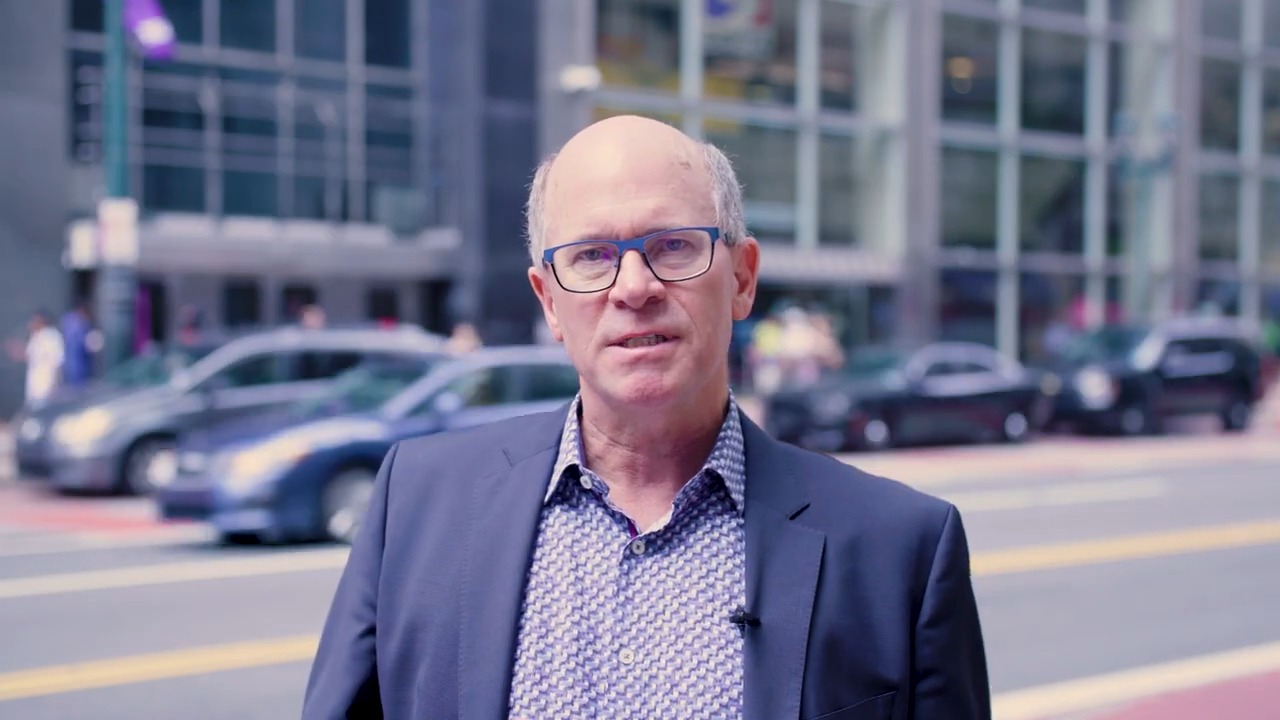
In a 2024 video from APTAtech in Philadelphia, McLeod stood with traffic passing behind him and SEPTA's headquarters across the way. The setting did part of the work. RideCo, where he is Head of Marketing, had helped the transit agency modernize its paratransit operation. McLeod's assignment was to explain what the software meant after it left the product demo: a more effective operation, a more efficient one and a better experience for riders.
This is the quiet consistency in a career that otherwise hops categories. McLeod has marketed learning-management software, accounts-receivable automation, event technology and now the routing machinery behind on-demand public transit. These are products that can disappear under their own terminology. He has spent roughly two decades pulling the consequence back into view.
The accountant who chose the sentence
McLeod's résumé contains a combination that looks unusual until the work begins: he is both a marketing executive and a Chartered Professional Accountant. He earned a BBA from Wilfrid Laurier University and an MBA from Ivey Business School at Western University, concentrating in marketing and international business. The accounting designation supplies one vocabulary; brand and growth supply another.
In infrastructure software, those languages need each other. A transit pitch can carry the warmth of mobility and still collapse if the cost per trip does not reconcile. A fintech message can sound liberating and still fail if the workflow does not save time or get an invoice paid. McLeod's public explanations tend to move between both registers: what an experience feels like, then how an operation changes to produce it.
He joined Desire2Learn, now D2L, in 2006 and spent eight years there, ultimately as Vice President of Marketing. A speaker biography credits him with playing an instrumental role as the company grew from 35 employees to nearly 900, serving 13 million learners. In 2012, when D2L raised an $80 million Series A after years of self-funding, McLeod described an aggressive international strategy and a fast hiring plan. Growth, in this version, was not a mood. It was offices, teams and customers in more countries.
He arrived at VersaPay in 2014 as Vice President of Marketing and later became CMO. Accounts receivable is another field where the daily benefit can vanish behind process language. McLeod was responsible for building and delivering the brand and marketing strategy while the company pushed cloud software into a function still shaped by spreadsheets, paper and disconnected systems. He remained the company's marketing chief through the period of its 2020 acquisition by an affiliate of Great Hill Partners.
Consulting and an interim CMO role at EventMobi followed. Then the same translation problem appeared on city streets.
“We are striving to have more and more shared rides. We try to combine riders who are going in a similar direction.”John McLeod on RideCo's operating idea
An app is only the visible edge
RideCo sells cloud software to transit agencies and fleet operators. A rider sees options for pickup, drop-off, timing and price. Behind that small interaction sits a larger problem: match vehicles with requests continuously, pool trips that make sense together, honor service rules and adjust when demand refuses to behave like yesterday's timetable.
McLeod's useful distinction is between a ride-hailing interface and a public-transit operating model. In 2023, when RideCo announced a technology integration with Uber, he described Uber vehicles as an additional layer beyond an agency's core fleet. The point was not to replace the public system. It was to give that system another way to cover late hours, thinly populated areas or sudden peaks without keeping every possible vehicle in motion all day.
by hour and place
and flexes fleets
with less empty travel
The operating phrase he returns to is continuous optimization. Empty miles are not an abstract inefficiency. They consume a budget without carrying a rider. A vehicle that can be added when the system is crowded, or left out when demand is light, turns software into capacity. “Transit agencies can now expand or contract their service offerings at different points in the day,” he said while discussing the partnership.
The timing matters. Commuter behavior stopped clustering as neatly around familiar rush hours. Workplaces changed, trips became less predictable, and agencies still had to serve communities with a finite supply of drivers and vehicles. McLeod's pitch meets that uncertainty directly: if demand varies, the service model needs room to vary with it.
The management style behind the message
A marketer can become skilled at framing other people's work while leaving little public trace of how his own team experiences him. McLeod has a few unusually specific receipts. Former VersaPay colleagues describe a leader who pushed them toward difficult work while providing the resources, support and air cover to attempt it. One recommendation emphasizes his ability to operate at the strategic level and still attend to detailed tasks. Another notes that he made sure people received visibility and opportunity.
The same pattern appears years earlier. In 2025, Barry Dahl looked back on 13 years at D2L and named McLeod among the three bosses who stood out. Dahl's explanation was refreshingly plain: support people in their work, value their input and be a decent person. He remembered feeling comfortable calling McLeod simply “Boss.”
There is a connection between that style and the way McLeod explains software. Both begin by listening for the practical constraint. A strategy needs enough clarity to coordinate people, but enough openness for the people closest to the work to correct it. A product message needs a strong promise, but it also needs the operational detail that keeps the promise honest.
The app is the visible edge. The operating model is the product.
A public brief gets larger
RideCo's projects have grown in scale. The company has worked with transit systems in Philadelphia, Houston and San Antonio, and it has been selected to help New York City Transit modernize Access-A-Ride. McLeod greeted the New York work by focusing on tens of thousands of people rather than the contract's size. That choice fits the through-line: the machinery matters because of the ordinary outcome it can support.
Paratransit gives that outcome extra weight. These services involve reservations, eligibility, scheduling, dispatch and communication across riders, caregivers, agencies and operators. Old workflows can be manual and expensive. RideCo has moved deeper into that administrative layer, including AI-assisted processing intended to turn handwritten eligibility forms into standardized digital records. McLeod recently shared the company's update about the tool as part of a broader push toward equitable mobility.
His stated aspiration is concrete: reduce system inefficiency and make paratransit more affordable. Affordability sounds modest beside the language of disruption, but public infrastructure is a discipline of repeated, funded promises. A cheaper trip can preserve coverage. A more dependable booking can preserve trust. A clearer explanation can help an agency understand why changing a familiar system is worth the risk.
Three moves from the McLeod playbook
The first move is to translate the noun into a verb. “Optimization” sits still. Combining riders headed in a similar direction shows the system doing something. “Fleet flexibility” is a label. Expanding service at a busy hour and contracting it later is a picture. McLeod's most effective public comments make that switch quickly. A buyer can carry an action into a budget meeting more easily than a category term.
The second is to keep the economic buyer and the person using the service in the same paragraph. Enterprise marketing often separates them: efficiency for the organization over here, experience for the customer over there. Transit refuses the split. A vehicle traveling empty wastes agency money, but that same waste also limits where and when a rider can be served. Pooling can lower cost and make more rides possible. The operating case and the human case strengthen each other when they share the frame.
The third is to let scale arrive through specifics. McLeod's career markers are concrete enough to visualize: D2L moving from 35 employees toward 900; 13 million learners; RideCo traveling to more than 50 conferences and trade shows in 2022; SEPTA's headquarters standing across the street as he explains the agency's work. None of those details needs an adjective to feel consequential. They give the audience something countable, locatable or repeatable.
Together, the moves form a useful test for any difficult product story. Can the core value be written as an action? Can the customer's customer see a benefit? Can the scale be demonstrated without leaning on praise? If the answer is yes three times, the copy has probably escaped the product sheet. It can travel into a council chamber, a sales call or a conversation at a transit conference. McLeod's work keeps showing why that portability matters: complex systems are adopted by groups, and groups need language they can share without a translator in the room.
The career has moved from online classrooms to finance departments to moving vehicles, but McLeod's real product has remained consistent. He translates a system until its value can be observed in someone's Tuesday afternoon. The learner gets access. The finance team sees the invoice. The rider sees the vehicle.
That is less glamorous than selling the future. It is also harder. The future can remain vague; a curb has an address and a clock. McLeod keeps bringing software back to both.