Consider the bus ride that ends at a ferry terminal, five minutes after the ferry leaves. The vehicle has done its job. The timetable has done its job. The passenger has acquired a splendid view of departing transport. For The Routing Company, this gap between a successful ride and a useful journey is where the interesting work begins.
- The job: coordinate on-demand, fixed, flexible and paratransit services.
- The buyer: transit agencies, fleet operators and campuses.
- The receipts: a documented $733,106 Kitsap contract; five million cumulative trips reported by TRC in April 2026.
TRC’s Pingo platform connects a rider requesting a trip, a driver following a changing route and a dispatcher managing the fleet. The bus can respond to demand while remaining part of a larger network. The promise is appealingly practical: make the vehicles you already have more useful to the people who need them.
01 / The ferry stays on the timetable
In July 2021, Kitsap Transit added Ride Pingo to BI Ride on Bainbridge Island. This was an existing public service, with scheduled departures from the ferry terminal. People could book, track and pay through the app, while telephone booking remained available. At launch, the regular fare was $2. Technology arrived without requiring every passenger to become a smartphone enthusiast.
The distinction matters. A transport app can produce a pickup time; an agency must produce a service. TRC’s Transit Connect feature is designed to coordinate on-demand rides with fixed-route connections. Its routing engine, the company says, reoptimizes every 15 seconds under rules set by the operator. Those rules give the calculation its purpose: a connection, a service boundary, a workable journey.
This puts TRC in the market for transit operations software, alongside Via and RideCo. Both rivals also serve microtransit and paratransit. TRC’s case rests on its routing technology and the coordination of service modes. The sensible buyer would test that case against local demand, rather than award points for an attractive vocabulary.
02 / The researchers needed a customer
Alex Wallar and Menno van der Zee founded the company in 2018. Wallar was working on transportation research at MIT when van der Zee emailed him about another approach to the same problems. Wallar flew to meet him a week later. Academic competition became a business partnership; Wallar left his PhD in May 2019.

The first difficulty was deciding how to turn the research into a product and whom to sell it to. In a 2022 interview, Wallar said the founders had hesitated to commit to governments as customers. Public-sector sales felt risky for an inexperienced startup. Looking back, he regarded that hesitation as a mistake: public transportation was the problem they had wanted to solve.
Van der Zee described a related lesson: spreading a small company across too many products weakened its chances. They recruited experienced people, including CEO James Cox, formerly Uber’s global head of product operations. The culture described in these interviews makes room for founders who would rather build the technology than insist on running every part of the business.
“It’s better to select one thing, do it well, and then slowly expand.”Menno van der Zee / 2022
03 / Three screens, one operation
Ride Pingo lets passengers request trips immediately or in advance and track services. Drive Pingo supplies navigation and pickup instructions. Pingo Dashboard gives operators fleet visibility, service settings, call-center booking and reporting. The customer gets tools for the whole operation; the passenger sees the small part that gets them somewhere.
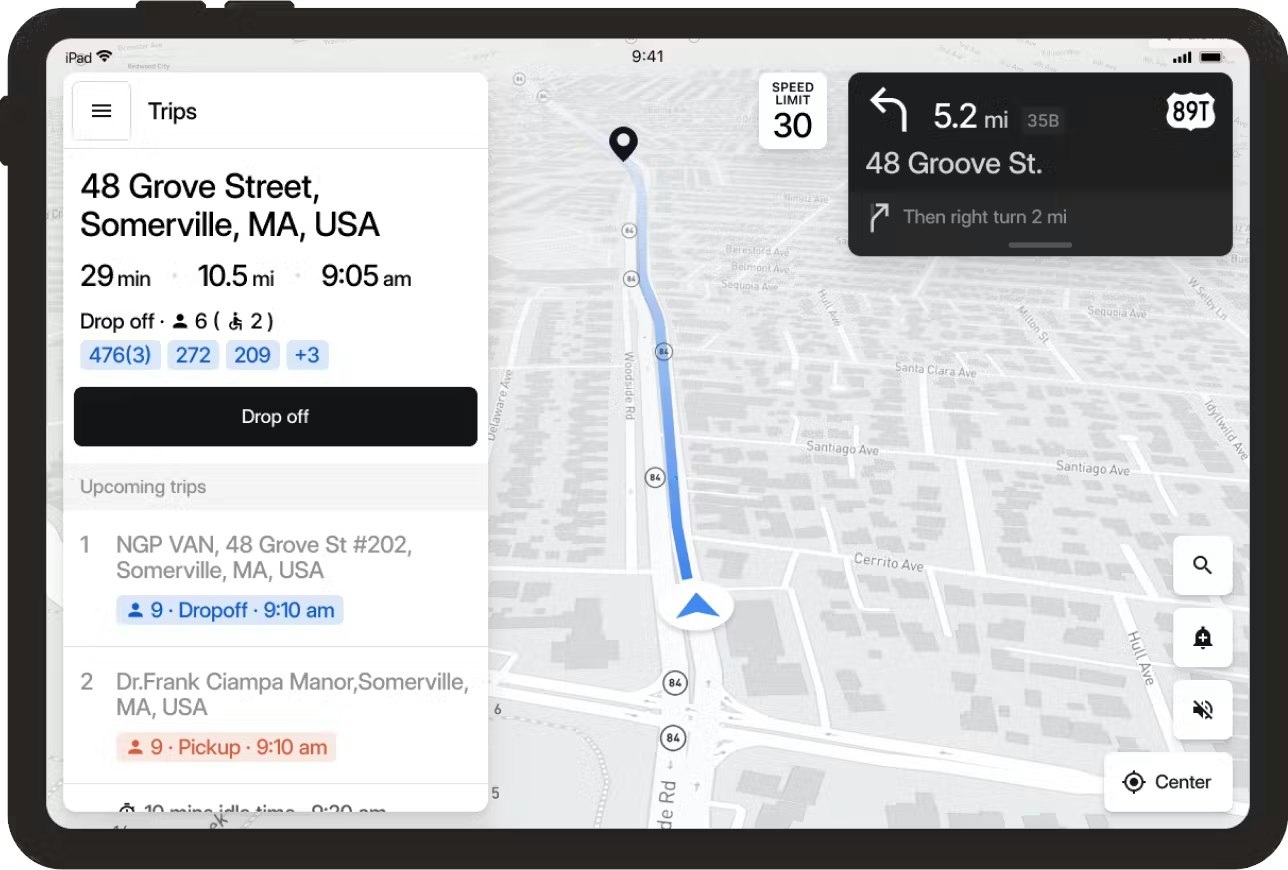
In March 2024, TRC introduced The Hub inside its dashboard. Shifts, drivers, vehicles and trips appear together, with shared trips stacked on a timeline and unassigned trips visible as overflow. That design addresses a mundane but consequential problem: dispatchers lose context when the pieces of an operation live on different pages.
Pingo Access supports paratransit, including commingled operations that use a fleet for different service types. Pingo Rural packages tools for rural deployments. These products serve agencies and institutions with distinct obligations, rather than assuming everyone needs the same ride. In August 2026, VCU added RamsLink for registered riders with temporary or long-term mobility needs, alongside its Pingo-powered campus services.
04 / The price of the software
TRC’s business is selling software and services to operators, plus licensing its technology. Its published terms put rider fares with the transit operator. Agencies buy through contracts; passengers encounter the service those agencies choose to run.
Five years of on-demand software and planning.
One agency’s contract, not a published price list.
Kitsap’s 2023 board record documents that five-year award. Two proposals were evaluated, and TRC scored as best value. The figure buys software and planning; it should not be mistaken for the cost of drivers, vehicles and the entire service. On the investment side, TRC announced a $5 million seed round in 2020 and a $15 million Series A led by Galvanize Climate Solutions in 2022.
Another customer arrived from a different corner of transportation. In 2025, Zoox obtained a nonexclusive license to TRC’s matching technology, and five TRC engineers joined the robotaxi company. The confirmed arrangement was a license and talent move. Routing expertise had found another application.
05 / More trips, with conditions attached
TRC reported five million passenger trips in April 2026. In September, it announced a Transit Orange partnership covering fixed routes, dial-a-ride and ADA paratransit, with launch planned later in the year. Expansion increasingly means coordinating an agency’s mix of services.
The lesson others can copy is to start with the journeys and operating constraints, then choose the tools. Keep a booking route for people who cannot use an app. Give dispatchers context. Test whether shared trips and connections actually work locally. This is an inference from TRC’s deployments, not a guarantee of savings.
The conditions matter. Software cannot supply missing drivers, fund operating hours or make every scattered trip easy to share. Van der Zee explicitly acknowledged that trains and fixed-route buses remain necessary. Pingo’s useful question is where flexibility can strengthen that network. A passenger watching the ferry pull away would probably appreciate the distinction.
Follow the route
TRC website · Pingo products · Newsroom · Founder interview
Watch: Meet Pingo · TRC on YouTube
LinkedIn · X · Instagram · Facebook · Blog archive