John Maraganore did not greet his move into business with the composed gratitude expected of a future chief executive. At Biogen in 1994, he worried that leaving his scientific work would damage his career. His boss, Jim Vincent, had other ideas. Over a series of conversations, Maraganore gradually understood that the proposed change was an instruction. He took the job reluctantly. The laboratory was losing a scientist who would rather have stayed.
That is an awkward beginning for a conventional business success story. Usually, the young executive is supposed to recognise his destiny before everyone else does. Maraganore needed somebody else to recognise it first. Vincent saw a person who could judge opportunities and grow into management. Maraganore saw a departure from the work that had made him useful. Both assessments could be reasonable at the same time.
Years later, he would become the founding CEO of Alnylam Pharmaceuticals, stay for nineteen years, and leave with a conviction that helping other leaders might be his most useful next job. Today he is co-founder and executive chair of City Therapeutics. Between those titles lies a recurring question: how much of a company can you build by making room for someone else?
“But I went into the role kicking and screaming.”
John Maraganore, on his move into business
Chicago, before the boardroom
Maraganore grew up in Chicago, the son of Greek immigrants. His interest in science arrived early: a microscope at six, work in his father’s laboratory during high school. He went to the University of Chicago and earned a bachelor’s degree in biological sciences, followed by a master’s and doctorate in biochemistry and molecular biology. The scientific training was substantial. A chief executive’s job was still some distance away.
His early professional stops included Upjohn and ZymoGenetics, followed by Biogen. The progression put him inside different kinds of organisations before he was responsible for shaping one himself. A large established company, a smaller biotechnology business, and a growing industry each offered a different answer to the question of how scientific work should be organised. His later interest in culture had practical material to draw on.
The business assignment at Biogen added another education. He worked under Ken Bate and came to value the managers and colleagues who had shaped his judgment. His account of that period gives other people considerable room. A career often gets reduced to a sequence of personal decisions. Here, a boss’s insistence belongs in the sequence too.
A telephone call becomes nineteen years
After Biogen came Millennium Pharmaceuticals, where Maraganore’s responsibilities included strategy, mergers and acquisitions, and leadership of its biotherapeutics business. By then, the scientist who had resisted a business role was evaluating transactions and managing across functions. Millennium gave him experience with the machinery surrounding research: deciding what to pursue, how to organise it, and when another company might be part of the answer.
Phillip Sharp, the MIT scientist and Nobel laureate, knew Maraganore from Biogen. In 2001, Sharp called him at Millennium to discuss RNA interference, or RNAi. A scientific presentation followed. The relationship eventually produced a different kind of invitation: would Maraganore lead Alnylam? He joined as founding chief executive in December 2002. An established working relationship had carried an unfamiliar opportunity across his desk.
The early Alnylam was a small venture-backed company with a great deal left to establish. In his later reflections, Maraganore described the demands of building scientific credibility while maintaining access to capital. Neither task could politely wait for the other to finish. A company had to exist long enough to do the work, and the work had to justify keeping the company alive.
This is where his earlier detour into business becomes consequential. Scientific judgment helped him assess the idea. Experience in partnerships, strategy, and management helped him assemble an organisation around it. The unwanted assignment at Biogen had expanded the range of problems he could take responsibility for. Alnylam would require that wider range for much longer than a promising first meeting.
- 1994Biogen
Into business - 2002Alnylam
Founding CEO - 2021The handover
Greenstreet succeeds - 2024City launches
Executive chair
The arithmetic, and the personality
By the end of his tenure, Alnylam employed more than 1,600 people in nearly twenty countries. Its growth had required a web of outside relationships: over twenty major pharmaceutical alliances, alongside the internal work of building the company. The figures describe an institution that had become geographically and organisationally larger than its founding circle. Nineteen years is long enough for the job itself to change repeatedly.
He also became a conspicuous public personality in an industry whose executives can sound as though a legal department has temporarily borrowed their voices. Colleagues described his candour. His glasses and clothes drew notice. He liked blackjack. A much smaller wager, recalled by his former Millennium boss Mark Levin, supplies a useful corrective to any excessively polished portrait.
At a meeting in 2000, Maraganore insisted that February had thirty days once every hundred years. Colleagues disagreed; money followed the disagreement. Levin remembered Maraganore losing $1,000. The calendar had declined to cooperate. It is a pleasingly unflattering detail: the same person can be willing to challenge consensus and occasionally discover that consensus has brought a calendar.
The anecdote is worth keeping separate from a theory of leadership. A bad bet does not explain a successful company. It does, however, leave room for the person behind the executive biography: competitive, capable of being wrong, and apparently memorable enough that former colleagues were still telling the story years later.
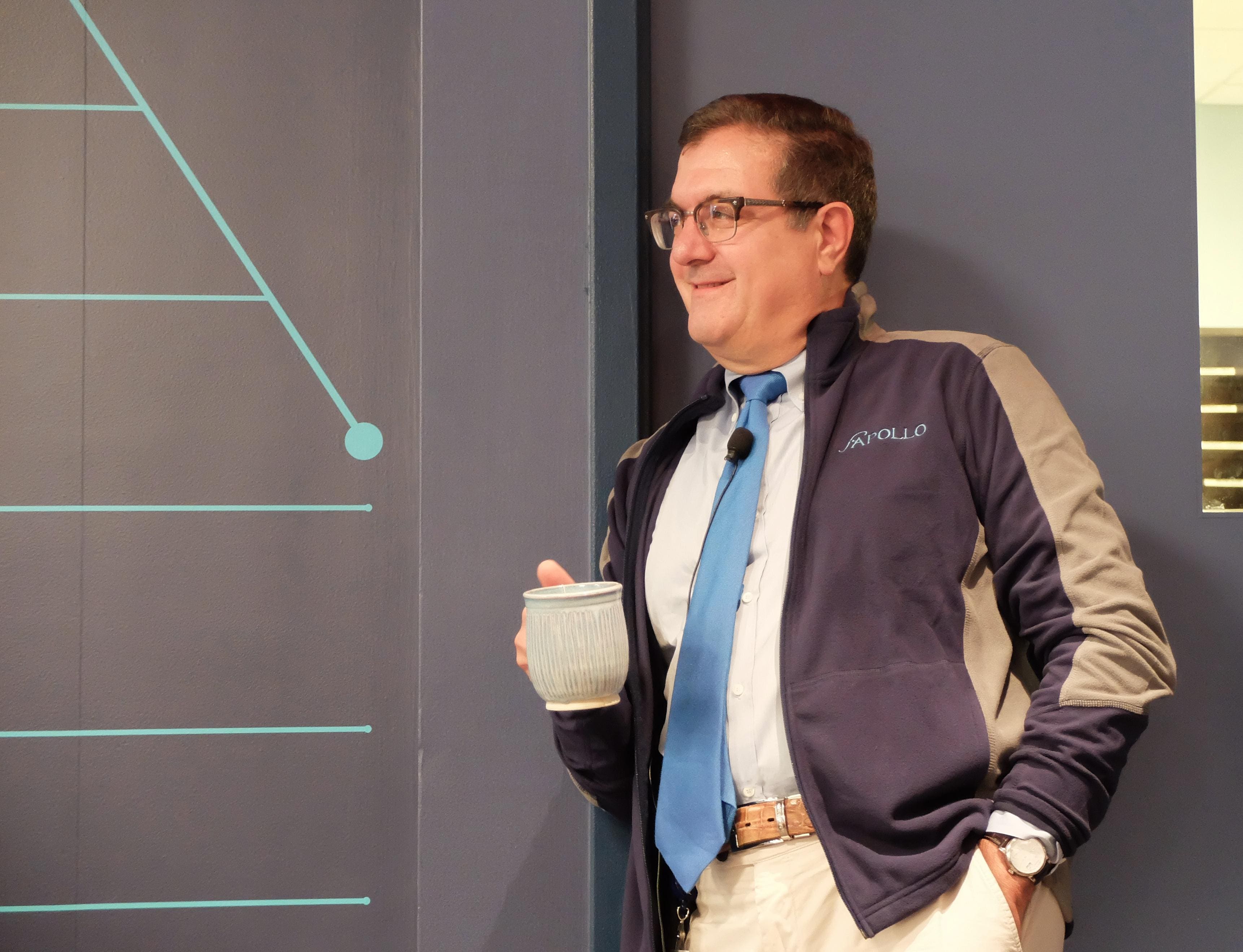
Leaving the keys with Yvonne
On December 31, 2021, Maraganore left the CEO role. Yvonne Greenstreet, Alnylam’s president and chief operating officer, succeeded him. The change put a different task in front of the founding chief executive: describing a useful future without putting himself back at the centre of the company he had just left. For someone whose public identity had been attached to Alnylam for nineteen years, that required a new vocabulary.
He chose the vocabulary of multiplication. He wanted to mentor emerging executives, work with investors, help form companies, and serve on boards. His explanation placed people between the industry’s scientific possibilities and its available money. There was plenty to work with; there also had to be leaders capable of bringing the pieces together. He explicitly wanted his mentoring to help develop a more diverse group of future leaders.
His account had a lighter domestic analogy too. Running Alnylam had been like parenting. The next phase could resemble being a grandparent: enjoy helping, then return responsibility to the parents. The joke recognised something any experienced adviser has to confront. Advice and authority are different arrangements. The person receiving the advice still has to make the decision and live with the consequences.
The appointments arrived quickly. RTW Investments brought him in as an executive partner. His work also extended to ARCH Venture Partners, Atlas Venture, and Blackstone Life Sciences. He became chair of Hemab Therapeutics, working again with Benny Sørensen, whom he had previously recruited at Alnylam. A professional relationship could continue across companies, with the former chief executive now sitting on the other side of the table.
Maraganore’s stated ambition: help emerging leaders build companies of their own.
A new City, some familiar faces
City Therapeutics launched publicly on October 8, 2024, with a $135 million Series A led by ARCH Venture Partners. Maraganore was a co-founder and executive chair. The organisation brought together people from his earlier professional world and scientific founders based at institutions including Ohio State, the University of Tokyo, and UMass. His next chapter had acquired its own company name and financing round.
The founding group included ARCH’s Robert Nelsen and Ari Nowacek, chief operating officer Sebastian Trousil, and scientists including Phillip Zamore, Mark Keating, Kotaro Nakanishi, and Yukihide Tomari. Chief scientific officer Tracy Zimmermann had previously worked at Alnylam. This was company formation through a combination of fresh research and established relationships. Familiarity offered a starting point; the new organisation still had its own work to do.
In January 2025, City appointed Andy Orth as chief executive. Orth had held leadership roles at Alnylam and later served as chief commercial officer at Krystal Biotech. Maraganore remained executive chair. Their earlier acquaintance mattered: Maraganore said he had known Orth for years and saw his experience as complementary to the team’s. The appointment made the division of leadership explicit.
That arrangement gives the mentoring ambition a concrete setting. An executive chair can stay closely involved while another executive runs the business. City’s structure puts an experienced founder beside a CEO with his own operating record. It also gives Maraganore a way to participate in building again without simply recreating the position he held for nineteen years.
The next chapter has a balance sheet
City completed a $99.5 million Series B in June 2026. New participants included Viking Global Investors and Sofinnova Investments, joining existing backers. Added to the announced Series A, the two rounds total $234.5 million. That is company financing. The money comes with work attached: building the organisation, allocating resources, and answering to investors as plans become operating decisions.
In August, City appointed Keith Regnante as chief financial officer and Mary Beth DeLena as chief legal officer. DeLena had spent more than fifteen years at Alnylam. The additions are less theatrical than a founding announcement, but they show the business acquiring the financial and governance capacity that growth demands. Company building eventually has to make room for the people who read every clause.
Maraganore’s public outlook remains competitive. In a February 2025 discussion, he welcomed innovation coming from China and argued that American companies should respond by improving their own competitiveness. The position fits a career spent moving among scientific work, corporate strategy, investing, and advice. Good ideas do not become less interesting because somebody else had them. They may become a reason to work harder.
The boy with the microscope has accumulated a considerable number of boardroom seats. He has also become the kind of person a younger executive might consult before taking an unfamiliar job. There is a particular usefulness in that: he can remember being offered a future he did not want, and needing someone else to see what he might do with it.