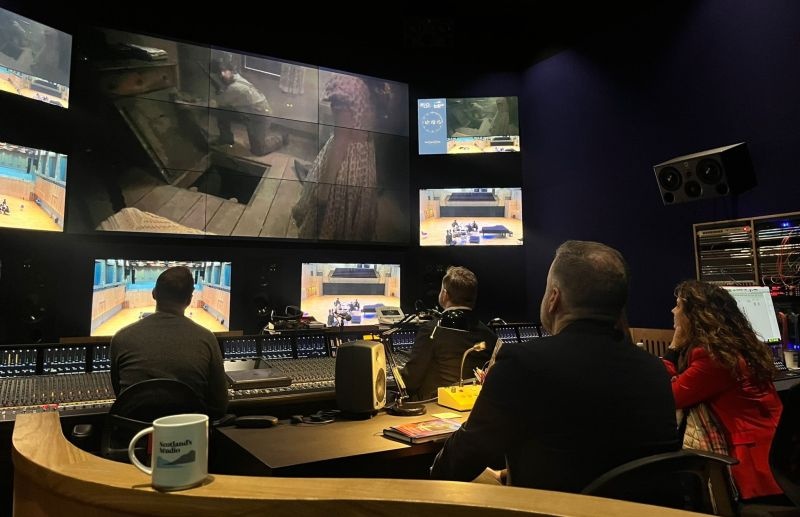
In October 2024, John Forsyth and a delegation from Austin visited a recording studio in Scotland. The Royal Scottish National Orchestra was showing its guests how Cirrus Logic technology helped carry its work into concert halls and cinemas. For a semiconductor chief executive, it was an unusually legible demonstration. The chips had acquired a soundtrack.
There is something pleasing about that encounter. Forsyth graduated from the University of Glasgow in 1995. Nearly three decades later, he was back in the city as the head of an Austin chip company, visiting an orchestra whose recording operation used its technology. A circuit diagram and an orchestral score have rather different audiences. Both become interesting when somebody makes them work.
His career has followed the less visible parts of the devices we carry: handheld development at Psion, mobile software at Symbian, audio products at Wolfson, then strategy and leadership at Cirrus Logic. Follow those jobs and a familiar object begins to look less familiar. A phone contains years of decisions about what to build, what to license, how to conserve power and which tiny inconvenience deserves an expensive engineering solution.
Before the chip, the handheld
Forsyth began his working life in handheld device development at Psion in London. His later roles included vice president of strategy at Symbian Software and chief technical officer of the Symbian Foundation. These were jobs concerned with the machinery beneath the interface, where technical choices and commercial arrangements had to coexist.
The distinction matters when looking at his eventual move into semiconductors. A device is experienced as one thing, although its software, components and business relationships arrive from many places. Forsyth’s early work put him among the people deciding how those pieces could fit together. By the time he joined Wolfson in 2012, portable computing was already the thread connecting his jobs.
His university qualification offers a small surprise. Cirrus Logic’s 2025 proxy describes it as an M.A. in Social Science. The chief executive’s route into a company of analog circuits and signal processing did not begin with the electrical engineering degree a reader might expect. The documented progression runs through product development, technical leadership and strategy. The diploma alone would make a rather poor career forecast.
One customer, one vote
At Symbian, Forsyth had to think about a problem that survives every change of technology: how do you build something with powerful partners without making everyone else feel like a guest?
Speaking at the O’Reilly Open Source Convention in 2008, he argued that the emerging Symbian Foundation needed its own working culture and technical experts who could think beyond the interests of their employers. Nokia’s substantial investment and influence created an obvious difficulty. An independent community needed to feel independent.
He supported a voting arrangement in which each company had one vote. It is an almost comically tidy sentence for a complicated negotiation. Size would not automatically determine formal influence. He was discussing software governance, but the subject underneath was trust: who would contribute if they believed the outcome had already been decided elsewhere?
In a 2009 interview, he described another tension. His former strategy job had involved making a licensing business effective while anticipating that operating-system fees would become harder to sustain. Customers were spending on services and experiences further up the software stack. A successful existing business could still need a different economic model.
“Value is moving up the stack.”
John Forsyth, discussing mobile software in 2009
He was also candid about Symbian’s application-development difficulties. A platform could offer handset makers considerable depth while asking too much of someone simply trying to build an application. That observation gives the early chapter some texture. Here was a strategy executive discussing both the power of a system and the trouble it caused the people expected to use it.
An acquisition becomes a career
Wolfson brought Forsyth closer to audio hardware. He served as its vice president of audio products, then entered Cirrus Logic when the acquisition was completed in August 2014. The transaction joined businesses with audio components, software and customer relationships. It also brought into Cirrus a future chief executive.
An acquisition announcement usually concentrates on portfolios and markets. The longer story can be found in the people who stay. Forsyth moved through product marketing and strategy before becoming president in January 2020. The acquiring company eventually placed a leader from the acquired business at its head.
The presidency widened his responsibility for daily operations while retaining his involvement in product development and strategy. Jason Rhode remained chief executive at that point. The arrangement gave Forsyth a broader operating brief before the final handover.
In January 2021, he became CEO. The succession was therefore an extension of work he was already doing, with additional responsibility for the whole enterprise. A strategy can look agreeable on a presentation slide. Running the business means living with the consequences when engineering schedules, customer needs and spending plans meet on Monday morning.
His responsibilities later extended beyond Cirrus. In November 2023, he joined the board of Lattice Semiconductor, whose business includes low-power programmable chips. It added a separate boardroom to a career already spanning software platforms and specialized silicon.
The other kind of pipeline
One useful detail about Forsyth’s leadership sits a long way from a quarterly revenue table. In 2020, while serving as president, he mentored Adriana Reyes, a high-school intern participating in Code2College. She had spent two consecutive summers interning at Cirrus Logic.
Reyes worked with the software team and discussed her career goals with Forsyth. Her experience contributed to her decision to study computer science at the University of Texas at Austin. It is a specific example of an executive spending time with someone near the beginning of a technical career, before titles and promotion ladders had acquired much relevance.
Mentorship is an easy word to put in a corporate paragraph. This episode supplies the useful particulars: a student, real software work, conversations about what she wanted to do next. The distance between a company president and a high-school intern can be considerable. A conversation is one practical way across it. The episode also changes the scale of this profile. Much of Forsyth’s working life is described in terms of markets and product categories. Here, the unit of attention was one person’s next step.
In his introduction to Cirrus Logic’s first annual ESG report in 2021, Forsyth emphasized establishing an accurate baseline, connecting the business’s prospects with its environmental and social responsibilities, and taking action in local communities. Those stated principles help explain why a story about the company’s future can reasonably include the people who have yet to enter its industry.
What fits inside a phone
As chief executive, Forsyth has described a growth strategy with three parts: maintain the smartphone audio business, increase the range and value of high-performance mixed-signal products in smartphones, and take the company’s existing expertise into other markets. Each part starts with capabilities Cirrus already has.
The vocabulary can make ordinary experiences sound forbiddingly remote. Audio circuits help a device capture or reproduce sound. Other products address functions including haptics, cameras and power. These are places where digital systems have to deal with physical behavior. A user encounters the result as a sound, a sensation or a device that uses its available energy more effectively.
In August 2026, Forsyth described Cirrus’s chosen territory in terms of precision, power efficiency, fast response and tight control. He also made clear that the company selects opportunities that fit those capabilities. Read alongside his earlier software work, the continuity is striking: the question keeps returning to the experience a technical system can actually deliver.
Revenue for the quarter ended June 27, 2026. Bars share a zero baseline; values rounded to the nearest $0.1 million.
The accounts show the scale of that work. Fiscal 2026 revenue was approximately $2 billion. In the following June quarter, audio revenue was $249 million and high-performance mixed-signal revenue was $210.7 million. Together, they produced $459.7 million in sales. The less familiar second category had become a substantial part of the business.
There are public ceremonial moments, too. Forsyth rang Nasdaq’s opening bell in November 2024, marking 35 years since Cirrus Logic’s stock-market listing. Employees and colleagues joined him. For a business whose products generally sit inside somebody else’s finished device, a bell in Times Square provides a rare opportunity to be conspicuous.
An Italian coda
On October 6, 2026, Cirrus Logic announced that it had acquired INVENTVM, a semiconductor company in Pavia, Italy, specializing in mixed-signal power management and audio integrated circuits. The financial terms were undisclosed. Cirrus said the transaction would have no material effect on its revenue.
Forsyth’s explanation concentrated on engineering capacity, intellectual property and talent. The companies had already worked together for several years. In that respect, the acquisition formalized a relationship rather than introducing a roomful of strangers.
There is a neat connection with his own arrival in 2014. The executive who entered Cirrus through Wolfson was now welcoming another acquired team. It would be premature to assign those engineers a future chapter. His own career does, however, show how much can happen after the transaction paperwork is filed.
The studio visit offers a useful place to leave him. A graduate of Glasgow, a veteran of London handhelds and mobile software, an Austin chief executive visiting an orchestra whose studio used technology his company supplied. The route is international; the encounter is wonderfully concrete. At the mixing desk, nobody needs a glossary to understand why the sound matters.