Five minutes into an interview for a strategic role, Samidha Garud found herself talking about something that did not fit neatly on a résumé. The candidate was describing a side project, a failed experiment, a problem they wanted to keep working on. Garud followed the conversation. A record of previous jobs was useful; here was a glimpse of what someone might do without being asked.
She later described that exchange as a turning point in how she hired. It also offers a useful way into her own career. Garud, the co-founder and CEO of Kanerika, has spent years making software delivery and company operations work. Now she is asking a rather awkward question for someone good at getting things done: how much of the company should still need her to do them?
Founders are rewarded for being available. They remember the client, know the exception, answer the question. Eventually, the whole office can become very skilled at finding the founder. Garud has begun to describe the cost of that convenience in unusually direct terms. A growing business needs more people who can decide, and a chief executive willing to let those decisions stand.
The long route through delivery
Her working life began well before Kanerika. After studying engineering at Jawaharlal Nehru Engineering College in Aurangabad from 1992 to 1996, she joined Tata Consultancy Services in 1997 as an assistant systems engineer. Software engineering at Arsin followed, then consulting at Polaris and another period at TCS. Between 2012 and 2014, she worked as a technical delivery manager at Data Science Labs.
Those titles describe a career close to the practical business of making enterprise systems function. Engineering, consulting, and delivery bring different obligations: understand the system, understand the customer, and get the work across the line. A person can be technically correct and still leave the other two unfinished. Garud's subsequent move into operations makes sense against that background.
She has said that her early Tata years continued to shape how she thinks about people and the long term. In 2026, watching Made in India: A Titan Story sent her back to those beginnings. What interested her was the uncomfortable middle of a company's story, when established habits have to change so a larger organization can emerge.
The person who kept things moving
Kanerika was established in 2015 to work on data integration, analytics, and automation. Garud co-founded the business with Bhupendra Chopra and served as its chief operating officer before becoming CEO. This placed her in the part of entrepreneurship that receives fewer photographs: coordinating people, keeping work moving, and turning a company's intentions into something a customer can use.
By early 2023, her responsibilities covered operations and operational efficiency, with particular attention to detail and several competing demands. The company was also developing its own products, including FLIP for data transformation and Phi for analytics and visualization. The business was acquiring two sets of obligations: delivering today's client work and making tools that could support tomorrow's.
Kanerika's learning practices give that period some texture. It ran an internal innovation tournament called Kaotech Day, supported learning through FLEX, and reimbursed employee certifications. Such arrangements matter because a stated enthusiasm for learning can otherwise disappear at the first crowded calendar. A competition, a learning system, and a reimbursement policy give curiosity somewhere to go.
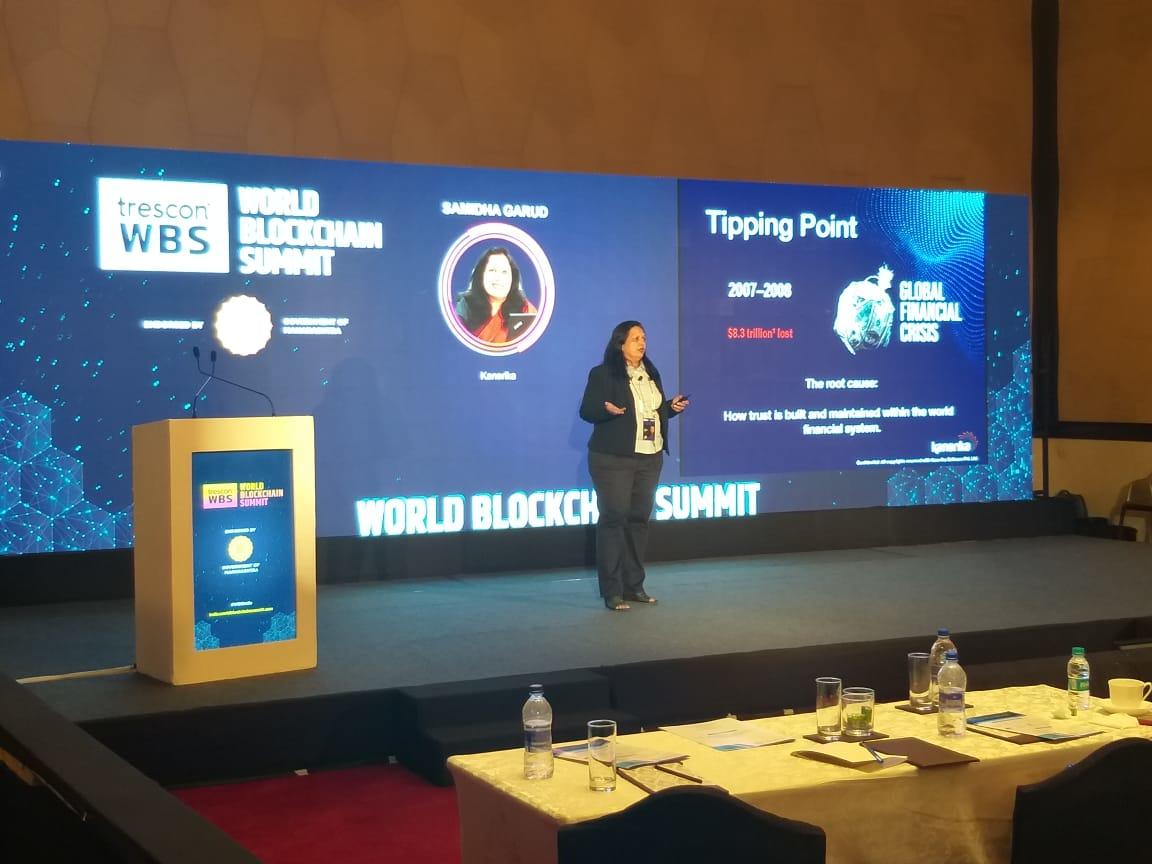
There was a public-facing side, too. In 2019, Garud spoke at the World Blockchain Summit in Mumbai. A photograph shows her onstage beside a presentation about trust in the financial system. Enterprise technology changes its vocabulary quickly. The question of why people should trust a system has rather more staying power.
Back to school, beyond the classroom
In 2022, Garud undertook Wharton's Advanced Management Program. Her account of it includes rowing, filmmaking, social enterprise projects, and personalized coaching. The cohort brought together people from 19 countries. She continued to draw on that network for advice, describing an education that extended beyond formal lessons.
The experience helped her refine an approach built around adapting to different people and giving them ownership. She wanted a clear direction, room for others to act, and a team that kept learning. These are easy ideas to endorse. They become more demanding when someone makes a decision differently from the person who founded the business.
Rowing makes an appealing detail in this particular education. It puts coordination somewhere more immediate than a slide deck. Filmmaking adds another kind of shared work. Neither activity needs to be turned into a grand explanation of her career; they simply make the portrait more interesting. A software operator went back to study management and came away remembering experiences as well as concepts.
A new title, a different set of questions
Kanerika announced Garud's appointment as CEO in April 2023. Chopra moved into the chief revenue officer role. The announcement emphasized her experience in finance, strategy, and operational effectiveness. The division of responsibilities gave the co-founders different jobs within the business they had built together.
The move from COO to CEO changes the horizon of a working day. Operations rewards knowing how things are going. Company leadership also requires deciding which things deserve attention at all, who should own them, and how the business will keep working as its demands multiply. Garud brought years of operational knowledge into that assignment, along with the habits those years had taught her.
In a June 2024 conversation with Selvi Cherian on the Scale Adventure Podcast, she discussed entrepreneurial pivots, client trust, and growth through marketing, sales, and people. The combination is revealing. Growth involves finding customers and earning confidence, while building a team capable of fulfilling what has been promised. Each depends on the others.
A sales conversation can introduce a company. Delivery supplies the evidence for the next one. Garud's career has largely occupied the space between those two moments, where a promise encounters a schedule, a team, and a real customer's expectations. That makes her attention to trust a practical concern rather than an ornamental value on an office wall.
The résumé leaves out the interesting part
Her hiring story returns to a similar problem: how to judge the work behind the presentation. The candidate who diverted that interview toward a side project also spoke about an unsuccessful experiment and a process they would redesign without owning it. Garud recognized an appetite for solving problems that a list of credentials could only partly describe.
She connected the experience with Geoff Smart and Randy Street's Who: The A Method for Hiring. Her questions expanded to include interests beyond work, problems a candidate would tackle without constraints, and failures they could discuss with pride. Experience still counted. So did the energy someone brought to an unfinished question.
A résumé is an unusually tidy document for something as untidy as a working life. Garud's account suggests she became more interested in how a candidate made sense of the untidy parts. It is a useful preference for a business whose customers bring problems that rarely arrive with every assumption agreed and every dependency conveniently labeled.
Past outcomes. Personal curiosity. Unfinished experiments.
Three threads in Garud's account of how her interviewing changed.Before the AI, agree on the data
By August 2026, Garud was writing about the foundations beneath enterprise AI projects. Her argument focused on fragmented data, modernization, and the work needed to make an experiment useful in production. It was a familiar operational concern wearing a newer technical vocabulary: a working demonstration still needs a dependable system underneath it.
That emphasis connects with Kanerika's origins in integration and analytics. An organization can buy sophisticated tools and still struggle to establish which information people should trust. Garud's writing directs attention toward that underlying work. There is less theater in it than in a demonstration, but a customer eventually has to live with the result after the demonstration ends.
For someone who came through engineering and delivery, the continuity is striking. The technology under discussion has changed. The obligation to make it useful remains. Her public position gives data preparation and execution a central place in the conversation about AI adoption, keeping the discussion close to what a business must actually organize.
Learning to leave room
The same practical scrutiny now reaches her own leadership. In 2026, Garud described deliberately withdrawing from decisions that no longer needed her involvement and recruiting leaders with experience of scaling businesses. She called the adjustment difficult. The founder's ability to answer quickly had become something the organization could lean on too heavily.
“When the CEO is the quickest path to a decision, the organisation learns to wait.”
Samidha Garud
In September, Kanerika announced Dheeraj Garg as chief delivery officer, effective from August and reporting to Garud. His remit included delivery governance, the FLIP product organization, the project management office, and the practice taking AI pilots into production. These are substantial responsibilities to place with another leader when delivery has been central to your own career.
The appointment gives a concrete shape to the change she has been describing. A larger business needs people with authority over important work. For Garud, that means making space in territory she knows well. The test will unfold through ordinary decisions, including the ones she no longer has to make.
There is a pleasing reversal in her story. In that hiring conversation, she wanted to discover what someone would do when no one was directing them. As CEO, she is working on an organization where more people can answer that question for themselves. After years of keeping things moving, Samidha Garud is learning when to get out of the way.