The useful thing about a hackathon is that the clock is rude. It does not care about your roadmap, your committee, or the tasteful deck explaining what may happen next quarter. In Raleigh, North Carolina, more than 120 Pendo employees broke into functional teams and were given five hours to make something with Lovable. The room held people from security, go-to-market, marketing, data and community. There was a fireside chat, a camera crew, a DJ, a country singer and, eventually, working software.
Joel Soo was there for the connective tissue. A colleague later credited him with orchestrating the build day across both companies. Soo described walking the floor with members of the Lovable team, trading notes with Pendo groups about what they had made. Other participants remembered apps aimed at real problems and manual processes. The day was festive, but the premise was plain: stop admiring the tool and use it.
This is a revealing place to find a go-to-market operator. The familiar picture of GTM is a funnel rendered in cheerful arrows. Soo's version has people at tables, laptops open, trying to get a stubborn workflow to behave before the afternoon runs out. His public title at Lovable is Founding GTM. The job, as his work presents it, is part translator, part producer and part host of a very compressed working day.
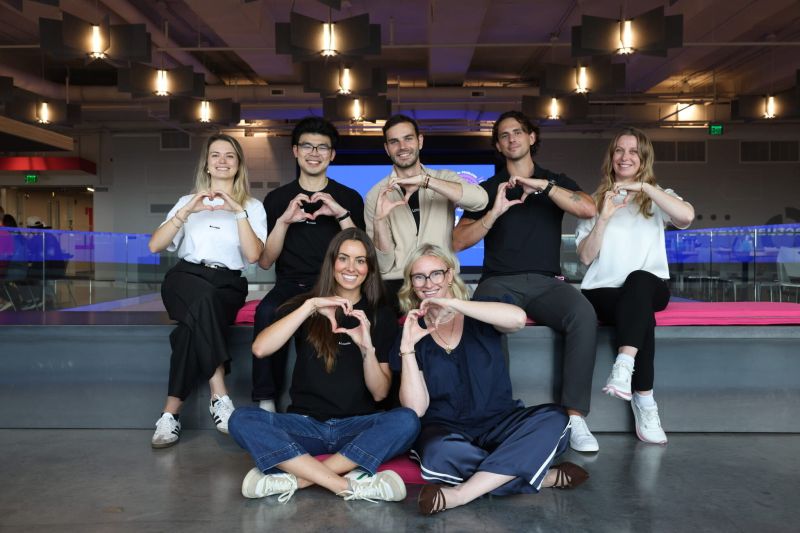
A demo ends with applause. A build day ends with evidence.
Enterprise software is often sold through a polished sequence: identify the pain, display the dashboard, promise the transformation. A buildathon rearranges the etiquette. The customer is no longer a spectator. Someone from operations can try to replace the spreadsheet that ate Tuesday. A marketer can make a small internal tool without first writing a solemn request for engineering. A security colleague can ask awkward questions while the thing is still young enough to answer them cheaply.
Soo's account of the Pendo event reads like an operator's notebook. He listed the agenda, the people, the teams and the hours of focus. He noticed how functions met one another. He gave credit freely. The emphasis was not on a dazzling prompt whispered into a machine. It was on the setting that let a large group concentrate at once.
“Sharp teams, bold ideas.”Joel Soo, after his first in-person Lovable hackathon
There is a modest but important idea hiding there. As code generation gets quicker, coordination does not vanish. It becomes more visible. Someone still has to choose the room, frame the problems, bring together the right functions, establish a deadline and make the experience useful enough that people return to work differently on Monday. Software may now appear from natural language. Organizational permission remains stubbornly human.
02 / Before the promptPartnership was the apprenticeship.
Before Lovable, Soo worked at EnergySage as a senior partner success manager focused on special projects. EnergySage is a marketplace where energy decisions meet a network of installers and commercial relationships. Partner success teaches a particular kind of attention. A product can work perfectly in isolation and fail in the seams between organizations. The job is to live in those seams without becoming gloomy about them.
His education includes Northeastern University, where his public profile lists service on the executive board of Alpha Kappa Psi. The two entries make a coherent prehistory without demanding mythology: a business fraternity, then partnership operations, then the adoption edge of an AI software company. The thread is not code. It is the practical question of how groups decide to work together.
Studied in Boston and served on Alpha Kappa Psi's executive board.
Worked in senior partner success and special projects.
Joined the founding go-to-market team as the company expanded its business and enterprise work.
Helped orchestrate a 120-plus-person build day across Lovable and Pendo.
Lovable was founded in Stockholm; Soo is based in Boston. That geography matters. He works on one of the bridges by which a Swedish product becomes an American company's afternoon, then perhaps part of its operating habits. Global expansion sounds grand in a board memo. In practice it can look like name tags, power strips and knowing whom to introduce to the security team.
03 / The permission statisticFour in five builders do not call themselves technical.
Lovable's own study of its user base reported that four in five builders identified with non-technical roles. The company also reported 50 million projects created and 720 million monthly visits to Lovable-built projects. Those figures describe scale, but the first number may be the one that changes an org chart. If software creation is no longer confined to software teams, every department gains a new capacity and a new set of questions.
A wider building floor
4 in 5 Lovable builders identify with non-technical roles.
Who owns an internal tool made by marketing? Who checks it? Who maintains it after its enthusiastic author moves teams? When should a quick prototype become part of the official stack? The democratization of building does not abolish governance. It invites governance to arrive earlier, preferably before anyone has fallen in love with the purple gradient.
This is why Soo's habit of circulating among security, data and business groups is more than event management. The build floor becomes a temporary map of the organization. People can see what other departments want, where processes pinch, and which useful idea has been waiting behind a ticket queue. One team's prototype becomes another team's starting point. The company learns by looking sideways.
04 / One hundred days inThe giant valuation, seen from floor level.
In August 2026, Lovable announced a $400 million Series C at a $13.3 billion valuation. Soo marked the news with a more personal clock: he was 100 days into the company. “I find myself doing the best work of my life,” he wrote, describing the experience as a rare privilege.
Funding announcements tempt everyone toward celestial language. Soo's other posts pull the view back to earth. He celebrates a solutions partner program. He points to non-technical founders bringing ideas to life. He jokes that a country singer appearing with a growth executive at a hackathon was absent from his 2026 bingo card. The humor is useful because it places the work in an actual day, with its unlikely combinations and crew-neck merchandise.
“From the inside, you see the true ‘art of the possible’.”Joel Soo, reflecting on his first 100 days at Lovable
His public voice is generous with names. Colleagues, hosts and customer teams appear in his retellings. That may be temperament, or simply accurate accounting. Events of this scale are collective machinery. The operator who pretends otherwise will soon be operating alone.
There is ambition, too. Soo writes about businesses running on Lovable and enterprises shipping with it. He recruits openly. Yet the aspiration is clearest when it stays close to a person who knows a problem well but has historically needed someone else to turn that knowledge into software. Lovable's case is that the distance between those two things can shrink. Soo's work is to make the shrinking legible inside a company.
05 / Operator in the loopWhen building gets easier, choosing what to build gets harder.
The old scarcity organized software work. Engineering time was precious, so requests moved through prioritization, specification and queues. Some of that discipline protected quality. Some of it merely taught employees to live with bad processes. AI-assisted building alters the bargain. A first version can arrive before the meeting about the meeting.
Speed creates its own need for judgment. A company with more builders can produce more good tools and more peculiar little kingdoms. The valuable operator is not the loudest evangelist. It is the person who can help a group distinguish a clever afternoon from a durable improvement, then connect the prototype to security, data and ownership before novelty hardens into infrastructure.
Soo's visible career is still compact, and his time at Lovable is measured in months. That is part of what makes it instructive. New categories create new jobs before anyone has agreed on the job description. “Founding GTM” can contain partnership design, customer education, production, field research and a surprising amount of stage management. The title is short. The room is crowded.
The Pendo day ended, as all events do. The chairs were folded, the cameras packed, the country singer presumably went somewhere less full of prototypes. What remained were applications, shared references and a group of people who had crossed a small psychological line. They had not watched software being made for them. They had made some.
Joel Soo's part in this story is not to be the magician at the keyboard. It is to arrange the conditions in which more people discover they can build, and to keep the discovery attached to a real problem. The code may be the artifact. The changed sense of permission is the work.